
Items related to The Ingenuity Gap : How Can We Solve the Problems of...
Synopsis
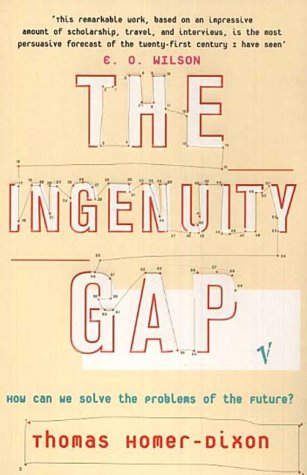
"The most persuasive forecast of the 21st century I have seen." -- E.O. Wilson, author of The Unity of Knowledge and twice winner of a Pulitzer prize
“Human beings have been smart enough to turn nature to their ends, generate vast wealth for themselves, and double their average life span. But are they smart enough to solve the problems of the 21st century?” -- Thomas Homer-Dixon
Can we create ideas fast enough to solve the very problems -- environmental, social, and technological -- we’ve created? Homer-Dixon pinpoints the “ingenuity gap” as the critical problem we face today, and tackles it in a riveting, groundbreaking examination of a world that is rapidly exceeding our intellectual grasp.
In The Ingenuity Gap, Thomas Homer-Dixon, "global guru" (the Toronto Star), "genuine academic celebrity" (Saturday Night) and "one of Canada's most talked about and controversial scholars" (Maclean's) is our world becoming too complex, too fast-paced to manage? The challenges facing us -- ranging from international financial crises and global climate change to pandemics of tuberculosis and AIDS- converge, intertwine, and remain largely beyond our ken. Most of suspect the "experts don't really know what's going on; that as a species we've released forces that are neither managed nor manageable. We are fast approaching a time when we may no longer be able to control a world that increasingly exceeds our grasp. This is "the ingenuity gap" -- the term coined by Thomas Homer-Dixon, political scientist and advisor to the White House -- the critical gap between our need for practical, innovative ideas to solve complex problems and our actual supply of those ideas.
Through gripping narrative stories and incidents that exemplify his arguments, he takes us on a world tour that begins with a heartstopping description of the tragic crash of United Airlines Flight 232 from Denver to Chicago and includes Las Vegas in its desert, a wilderness beach in British Columbia, and his solitary search for a little girl in Patna, India. He shows how, in our complex world, while poor countries are particularly vulnerable to ingenuity gaps, our own rich countries are not immune, and we are caught dangerously between a soaring requirement for ingenuity and an increasingly uncertain supply. When the gap widens, political disintegration and violent upheaval can result, reaching into our own economies and daily lives in subtle ways. In compelling, lucid, prose, he makes real the problems we face and suggests how we might overcome them -- in our own lives, our thing, our business and our societies.
"synopsis" may belong to another edition of this title.
Review
As the world becomes more complex, so do its problems--and the solutions to these problems become tougher to grasp, writes University of Toronto professor Thomas Homer-Dixon in The Ingenuity Gap. "As we strive to maintain or increase our prosperity and improve the quality of our lives, we must make far more sophisticated decisions, and in less time, than ever before," he writes. Is the day coming in which our ingenuity can't keep up? Homer-Dixon fears that it is: "the hour is late," and we're blindly "careening into the future." What we face, he says, is a "very real chasm that sometimes looms between our ever more difficult problems and our lagging ability to solve them." There are moments when Homer-Dixon comes close to sounding like a modern-day Malthus, with his never-ending worries about population growth, the environment, the strength of international financial institutions, civil wars, and so on. Yet parts of this book are downright fascinating; at its best, The Ingenuity Gap reads like one of Malcolm Gladwell's stories for The New Yorker (or his book The Tipping Point).
Homer-Dixon is very good when he tackles particular problems, and his interests are wide-ranging, moving from the psychology of an airplane cockpit during a crisis to the depletion of the world's fisheries to differences between the minds of Neanderthals and Homo sapiens. He also dredges up fine details. Did you know that "the largest human-made structure on the planet is not an Egyptian pyramid or a hydroelectric dam but the Staten Island Fresh Kills landfill near New York City, which has a depth of one hundred meters and an area of nine square kilometers"? There's plenty to argue with on these pages, and some readers will find Homer-Dixon's tendency to write in the first person a bit self-indulgent. Yet fans of big-think books like Jared Diamond's Guns, Germs, and Steel, David Landes's The Wealth and Poverty of Nations, and Robert Wright's The Moral Animal will find The Ingenuity Gap riveting. --John J. Miller
From the Inside Flap
Despite all of society's advances, our problems proliferate. Wars abound, environmental degradation accelerates, economies topple overnight, and pandemics such as AIDS and tuberculosis continue to spread. The Internet and other media help to disseminate knowledge, but they've also created an "info-glut" and left us too little time to process it. What's more, advances in technology have made the world so bewilderingly fast-paced and complex that fewer people are able even to grasp the problems, let alone generate solutions. That space between the problems that arise and our ability to solve them is "the ingenuity gap," and as we careen towards an increasingly harried and hectic future, the gap seems only to widen.
As he explores the possible consequences of this gap, Thomas Homer-Dixon offers an absorbing assessment of the state of the world and our ability to fix it. Culling from an astounding array of fields-from economics to evolution, political science to paleontology, computers to communications -he integrates his vast knowledge into an accessible and engaging argument. This is a book with profound implications for everyone that we can ill afford to ignore.
"About this title" may belong to another edition of this title.
Search results for The Ingenuity Gap : How Can We Solve the Problems of...

Stock Image
The Ingenuity Gap: How Can We Solve the Problems of the Future?
Seller: AwesomeBooks, Wallingford, United Kingdom
Seller rating 5 out of 5 stars

Paperback. Condition: Very Good. The Ingenuity Gap: How Can We Solve the Problems of the Future? This book is in very good condition and will be shipped within 24 hours of ordering. The cover may have some limited signs of wear but the pages are clean, intact and the spine remains undamaged. This book has clearly been well maintained and looked after thus far. Money back guarantee if you are not satisfied. See all our books here, order more than 1 book and get discounted shipping. Seller Inventory # 7719-9780099286288
Buy Used
US$ 11.31
US$ 2.66 shipping
Ships from United Kingdom to U.S.A.
Ships from United Kingdom to U.S.A.
Quantity: 2 available
Stock Image
The Ingenuity Gap: How Can We Solve the Problems of the Future?
Seller: Bahamut Media, Reading, United Kingdom
Seller rating 5 out of 5 stars
Paperback. Condition: Very Good. This book is in very good condition and will be shipped within 24 hours of ordering. The cover may have some limited signs of wear but the pages are clean, intact and the spine remains undamaged. This book has clearly been well maintained and looked after thus far. Money back guarantee if you are not satisfied. See all our books here, order more than 1 book and get discounted shipping. Seller Inventory # 6545-9780099286288
Buy Used
US$ 11.11
US$ 3.32 shipping
Ships from United Kingdom to U.S.A.
Ships from United Kingdom to U.S.A.
Quantity: 2 available
Stock Image
The Ingenuity Gap: How Can We Solve the Problems of the Future?
Seller: WorldofBooks, Goring-By-Sea, WS, United Kingdom
Seller rating 5 out of 5 stars
Paperback. Condition: Very Good. The book has been read, but is in excellent condition. Pages are intact and not marred by notes or highlighting. The spine remains undamaged. Seller Inventory # GOR001650440
Buy Used
US$ 9.16
US$ 7.48 shipping
Ships from United Kingdom to U.S.A.
Ships from United Kingdom to U.S.A.
Quantity: 1 available
Seller Image
The Ingenuity Gap: How Can We Solve the Problems of the Future?
Seller: WeBuyBooks, Rossendale, LANCS, United Kingdom
Seller rating 5 out of 5 stars
paperback. Condition: Very Good. Most items will be dispatched the same or the next working day. A copy that has been read, but is in excellent condition. Pages are intact and not marred by notes or highlighting. The spine remains undamaged. Seller Inventory # rev1858393654
Buy Used
US$ 9.42
US$ 8.68 shipping
Ships from United Kingdom to U.S.A.
Ships from United Kingdom to U.S.A.
Quantity: 1 available
Stock Image
The Ingenuity Gap: How Can We Solve the Problems of the Future?
Seller: Anybook.com, Lincoln, United Kingdom
Seller rating 5 out of 5 stars
Condition: Fair. This is an ex-library book and may have the usual library/used-book markings inside.This book has soft covers. Clean from markings. In fair condition, suitable as a study copy. Please note the Image in this listing is a stock photo and may not match the covers of the actual item,550grams, ISBN:9780099286288. Seller Inventory # 8653709
Buy Used
US$ 11.17
US$ 17.65 shipping
Ships from United Kingdom to U.S.A.
Ships from United Kingdom to U.S.A.
Quantity: 1 available
Seller Image
THE INGENUITY GAP.
Published by
Randon House Group., London,, 2001
ISBN 10: 0099286289
ISBN 13: 9780099286288
Used
Softcover
Seller: Libreria Lopez de Araujo, RIVAS VACIAMADRID, M, Spain
Seller rating 5 out of 5 stars
20 x 13 cm., 480 pag. LEA LAS CONDICIONES DE ENVIO DE LA LIBRERÍA. ENVIOS GRATUITOS HASTA 1 KILO, MAS DE 1 KILO SE COBRA SUPLEMENTO. Texto en Ingles. Tapa blanda, buen estado de conservacion. Seller Inventory # 40858A