
Items related to Structural Monitoring with Fiber Optic Technology
Synopsis
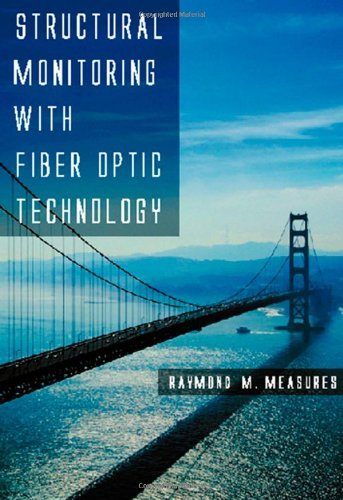
This book is the first to address the field of structurally integrated fiber optic sensors. Fiber optic sensors embedded within materials and systems are able to measure a variety of parameters (i.e. temperature, vibration, deformation, strain, etc.) that allows for real time non-destructive evaluation. Examples include the following: monitoring structural fatigue in aging aircraft or loads in bridge structures. In more advanced applications, fiber optic sensors control actuators that allow materials to adapt to their environment. This gives rise to the names, "smart," "intelligent," and/or "adaptive" materials or structures.
Structural Monitoring with Fiber Optic Technology is the firs single author book on the new field of fiber optic structural sensing. As such it provides: coverage of the fundamentals of the technology, a coherent and systematic discussion on the most important aspects of the subject, a broad view of the subject, while retaining a degree of focus on those advances most significant in terms of their future potential, particularly in regard to broad implementation of the technology. The book provides an introduction to the relevant value to structural monitoring. It also highlights the advantages of fiber optic based sensors over conventional electrical measurement technology.
The book richly illustrates the subject matter with 615 figures and provides many examples of fiber optic structural sensing, including a detailed overview of a number of major field site applications. Most of these large scale applications are drawn from the civil engineering community as they have been the first to strongly embrace fiber optic structural monitoring. This is especially true for bridges, where innovative new designs and the use of fiber reinforced polymer composite materials to replace steel represents a major advance that is expected to revolutionize the construction industry. Examples include new bridges, which are serving as testbeds for these new materials and are instrumented with arrays of fiber optic structural sensors. In one case, this state-of-the-art monitoring system permits engineers at a distant site to track the response of the bridge to traffic loads and keep an eye on the long term performance of the new materials. Fiber optic structural sensing technology is equally applicable to other industrial sectors, such as the aerospace and marine industries. Indeed, several examples of ships being instrumented with arrays of fiber optic sensors are also included.
* The author directed one of the leading laboratories in the development of this technology and its application to civil engineering
* Provides a strong, concise foundation in the basics of the technology
* Includes many examples of the application of the technology, including many major field site case studies
* Richly illustrated with 615 figures, many redrawn to make them easier to understand; also includes over 600 references
* Written in a style designed to help the reader unfamiliar with fiber optic technology appreciate what can be accomplished with this new form of structural monitoring
"synopsis" may belong to another edition of this title.
About the Author
Dr. Raymond M. Measures was a Professor at the University of Toronto Institute for Aerospace Studies from 1964 to 1998, and served as the Associate Director from 1984 to 1991. In 1987, he was a member of the team that established the Ontario Laser and Lightwave Research Centre and in the early years, served on both its Board of Directors and its Management Committee. Dr. Measures played a key role in the creation of the Intelligent Sensing for Innovative Structures Network Centres of Excellence in 1995 and served as its Vice President for its firs two years. In the past decade, Dr. Measures has pioneered fiber optic structural sensing in Canada and established Fiber Optic Smart Structures Laboratory at the University of Toronto Institute for Aerospace Studies in 1988. The success of this project led to the formation of a new and vibrant company, ElectroPhotonics Corporation, which now produces state-of-the-art fiber optic telecommunication and structural sensing systems into innovative new bridges. Dr. Measures has authored or edited four books, contributed chapters to six books, an author or co-author on over 190 papers, and is a co-inventor on five patents.
From the Back Cover
Fiber optic technology is destined to form the backbone of the 21st Century's Information Age. During the past 10 years it has also become apparent that fiber optic technology is very well suited to structural monitoring and is capable of tasks not practical or economically viable with conventional technology. Structural Monitoring with Fiber Optic Technology provides an introduction to the relevant background material needed to understand and appreciate the technology that underpins this new form of structural monitoring. The book richly illustrates the subject matter with 615 figures and provides many examples of fiber optic structural sensing, including a detailed overview of a number of major field site applications. A conscious effort has been made to focus on those aspects of the technology that show the greatest promise in terms of future development and broad implementation. Although the civil engineering community has been the first to really embrace fiber optic structural monitoring, as seen in the abundant examples of applications, the technology is equally applicable to other industrial sectors, such as the aerospace and marine industry.
A number of innovative bridges have been built recently to demonstrate that fiber reinforced polymer composite materials can be used to replace steel in many of its functions. This includes stay-cables, prestressing tendons and shear reinforcements. Fiber reinforced polymer rehabilitation and strengthening wraps and patches are equally showing great promise. In both instances the use of fiber optic structural sensing systems has been shown to be well suited for monitoring the sue of these new materials. The combination of these two new technologies represents a major advance that is expected to revolutionize the construction industry. In one example a state-of-the-art fiber optic monitoring system permits engineers at a distant monitoring site to closely observe the response of this innovative bridge to traffic loads and track the long term performance of its new materials. Fiber optic structural sensing technology is equally applicable to other industrial sectors, such as the aerospace and marine industries. Indeed, several examples of ships instrumented with arrays of fiber optic structural sensors are also included.
Excerpt. © Reprinted by permission. All rights reserved.
Preface
Structures today are primarily designed for a single purpose, such as supporting a load. Nature, by contrast, almost always creates multi-functional structures. Look at your hand! Your hand can certainly lift weights, but in addition you can assess the weight and the speed with which you are lifting it. You are also aware of any force or heat directed at your hand and can even locate the site of this stress. Although it will be some time before we can duplicate nature, the first step to following nature's paradigm is to build structures with the ability to monitor their status and health.
Fiber optic technology is destined to become one of the core technologies of the twenty-first century. The purpose of this book is to show that this exciting new technology could also have an important role to play in structural monitoring. We explain the merits of this technology and show that it is unrivaled in terms of measurement versatility and convenience when it comes to integrating sensor arrays into practical structures as diverse as bridges, ships, and aircraft. One of its most significant advantages over conventional technology is the ability to use a single strand of optical fiber to replace the hundreds of wires required for measuring a given strain field using strain gauges. The fact that such a highly instrumented optical fiber can readily be embedded within FRP composite material structures, even if pultruded, contributes to the excitement in regard to its potential applications. When it is also appreciated that fiber optic sensors are immune to electrical interference and corrosion and do not create electrical pathways, it can be understood why there is so much interest in this revolutionary technology.
In the case of the construction industry, the condition of large numbers of major structures {bridges, dams, tunnels . . .} could be monitored by this fiber optic sensing technology from central monitoring stations through telephone lines, cellular phones, or satellite links. It may be possible in the twenty-first century for an engineer, or student, anywhere on the planet to use the Internet to log-on to one of many major structures and see in real-time the structure's response to its environment and loading and then to compare this response to that predicted by a computer model of the structure.
This book is designed to introduce fiber optic structural sensing to those interested in learning what is possible with this new monitoring technology. The book is intended to serve as a primer for understanding the basics of the technology and, most important, to provide an insight into its extraordinary measurement capability.
Chapter 1 provides some background and places fiber optic structural monitoring into the broader context of the emerging field of ``smart structures.'' Chapter 2 establishes the need for structural monitoring with fiber optic technology in many diverse disciplines ranging from civil to aerospace engineering. Chapter 3 introduces the most important concepts and principles of lightwave theory and lays the groundwork for fiber optic technology. Chapter 4 reviews in some detail light sources and detectors as these topics constitute the heart of the optoelectronic systems designed to read fiber optic sensors. Chapter 5 describes the propagation of light in optical fibers and describes the primary fiber optic components referred to in subsequent chapters.
Chapter 6 indicates the merits of fiber optic sensors and provides an overview of the different types of fiber optic sensors. Chapter 7 lays the foundation for understanding the strain and temperature sensitivity of fiber optic sensors and discusses thermal apparent strain and methods of compensating its in¯uence. Chapter 8 is concerned with the installation of fiber optic sensors on, and within, structures and addresses a number of important material integration issues, including the in¯uence of embedded optical fiber sensors on the properties of the host structure.
Chapter 9 focuses on the short gauge-length fiber optic sensor and reviews methods of demodulating (interrogating) Fiber Bragg grating and Fabry±Perot interferometric sensors. A rich collection of applications for such sensors is described, including a number of key field site applications. Chapter 10 concentrates on long gauge-length fiber optic sensors, describing methods of demodulation and a broad range of applications.
Chapter 11 presents a detailed description of techniques used to serial multiplex and demodulate strings of Fiber Bragg grating sensors and illustrates this topic with a number of applications. Chapter 12 is concerned with truly distributed strain and temperature sensing, with an emphasis on techniques involving Fiber Bragg gratings. Chapter 13 presents a brief discussion on future prospects and describes a universal Fiber Bragg grating sensor demodulation system based on the use of an advanced rapidly scanned, tunable DFB laser. It also provides a brief summary of many of the key points made in the sensing part of the book, that is to say, Chapters 6 through 12.
In a field that is advancing as rapidly as fiber optic structural monitoring, the best we can hope to achieve is provide: (i) a strong foundation that will serve the reader for some years, (ii) a snapshot of the status of the technology today, and (iii) insight into the myriad of ways in which this technology can be used for structural monitoring. I have tried to also steer the reader in the direction for future advances and demonstrate that the technology has an established record of success in many applications, including a number of major field-site applications.It is also planned to provide an update on research and applications of this technology through this web site. A more in-depth overview of the subject material of the book is available directly from the author in the form of an interactive CD-ROM. This presentation is highly animated and visually exciting and intended for people who wish to quickly grasp the most important aspects of this subject.
Raymond M. Measures
Thornhill, Ontario
rm.measures@home.com
"About this title" may belong to another edition of this title.
Search results for Structural Monitoring with Fiber Optic Technology

Stock Image
Structural Monitoring with Fiber Optic Technology
Published by
Academic Press, 2001
ISBN 10: 0124874304
ISBN 13: 9780124874305
Used
Hardcover
First Edition
Seller: Textbooks2go, Sebastopol, CA, U.S.A.
Seller rating 5 out of 5 stars

Hardcover. Condition: Fine. 1st Edition. (M10) gently used. ships lightning fast. Seller Inventory # ABE-1732219060881