
Items related to Learning Bayesian Networks
Synopsis
In this first edition book, methods are discussed for doing inference in Bayesian networks and inference diagrams. Hundreds of examples and problems allow readers to grasp the information. Some of the topics discussed include Pearl's message passing algorithm, Parameter Learning: 2 Alternatives, Parameter Learning r Alternatives, Bayesian Structure Learning, and Constraint-Based Learning. For expert systems developers and decision theorists.
"synopsis" may belong to another edition of this title.
About the Author
Richard E. Neapolitan has been a researcher in Bayesian networks and the area of uncertainty in artificial intelligence since the mid-1980s. In 1990, he wrote the seminal text, Probabilistic Reasoning in Expert Systems, which helped to unify the field of Bayesian networks. Dr. Neapolitan has published numerous articles spanning the fields of computer science, mathematics, philosophy of science, and psychology. Dr. Neapolitan is currently professor and chair of Computer Science at Northeastern Illinois University.
From the Back Cover
Learning Bayesian Networks offers the first accessible and unified text on the study and application of Bayesian networks. This book serves as a key textbook or reference for anyone with an interest in probabilistic modeling in the fields of computer science, computer engineering, and electrical engineering. This text is also a valuable supplemental resource for courses on expert systems, machine learning, and artificial intelligence.
Appropriate for classroom teaching or self-instruction, the text is organized to provide fundamental concepts in an accessible, practical format. Beginning with a basic theoretical introduction, the author then provides a comprehensive discussion of inference, methods of learning, and applications based on Bayesian networks and beyond.
Learning Bayesian Networks:- Includes hundreds of examples and problems
- Makes learning easy by introducing complex concepts through simple examples
- Clarifies with separate discussions on statistical development of Bayesian networks and application to causality
Excerpt. © Reprinted by permission. All rights reserved.
Bayesian networks are graphical structures for representing the probabilistic relationships among a large number of variables and for doing probabilistic inference with those variables. During the 1980s, a good deal of related research was done on developing Bayesian networks (belief networks, causal networks, influence diagrams), algorithms for performing inference with them, and applications that used them. However, the work was scattered throughout research articles. My purpose in writing the 1990 text Probabilistic Reasoning in Expert Systems was to unify this research and to establish a textbook and reference for the field which has come to be known as "Bayesian networks." The 1990s saw the emergence of excellent algorithms for learning Bayesian networks from data. However, by 2000 there still seemed to be no accessible source for "learning Bayesian networks." Similar to my purpose a decade ago, the goal of this text is to provide such a source.
In order to make this text a complete introduction to Bayesian networks, I discuss methods for doing inference in Bayesian networks and influence diagrams. However, there is no effort to be exhaustive in this discussion. For example, I give the details of only two algorithms for exact inference with discrete variables. . These algorithms are Pearl's message-passing algorithm and D'Ambrosio and Li's symbolic probabilistic inference algorithm. It may seem odd that I present Pearl's algorithm, since it is one of the oldest. I have two reasons for doing this: (1) Pearl's algorithm corresponds to a model of human causal reasoning, which is discussed in this text; and (2) Pearl's algorithm extends readily to an algorithm for doing inference with continuous variables, which is also discussed in this text.
The content of the text is as follows. Chapters 1 and 2 cover basics. Specifically, Chapter 1 provides an introduction to Bayesian networks; Chapter 2 discusses further relationships between DAGs and probability distributions such as d-separation, the faithfulness condition, and the minimality condition. Chapters 3-5 concern inference. Chapter 3 covers Pearl's message-passing algorithm, D'Ambrosio and Li's symbolic probabilistic inference, and the relationship of Pearl's algorithm to human causal reasoning. Chapter 4 presents an algorithm for doing inference with continuous variables, an approximate inference algorithm, and an algorithm for abductive inference (finding the most probable explanation). Chapter 5 discusses influence diagrams, which are Bayesian networks augmented with decision nodes and a value node, and dynamic Bayesian networks and influence diagrams. Chapters 6-10 address learning. Chapters 6 and 7 are concerned with parameter learning. Since the notation for these learning algorithm is somewhat arduous, I introduce the algorithms by discussing binary variables in Chapter 6. I then generalize to multinomial variables in Chapter 7. Furthermore, in Chapter 7, I discuss learning parameters when the variables are continuous. Chapters 8, 9, and 10 are concerned with structure learning. Chapter 8 presents the Bayesian method for learning structure in the cases of both discrete and continuous variables, while Chapter 9 discusses the constraint-based method for learning structure. Chapter 10 compares the Bayesian and constraint-based methods, and it presents several real-world examples of learning Bayesian networks. The text ends by referencing applications of Bayesian networks in Chapter 11.
This is a text on learning Bayesian networks; it is not a text on artificial intelligence, expert systems, or decision analysis. However, since these are fields in which Bayesian networks find application, they emerge frequently throughout the text. Indeed, I have used the manuscript for this text in my course on expert systems at Northeastern Illinois University. In one semester, I have found that I can cover the core of the following chapters: 1, 2, 3, 5, 6, 7, 8, and 9.
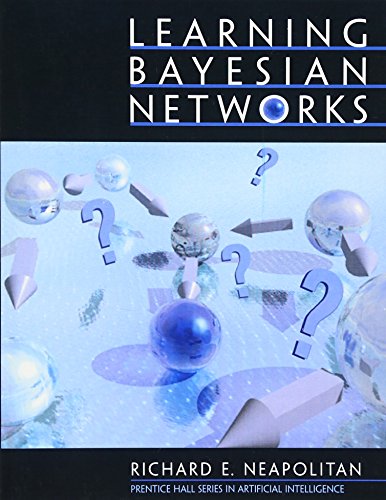
I would like to thank those researchers who have provided valuable corrections, comments, and dialog concerning the material in this text. They include Bruce D'Ambrosio, David Maxwell Chickering, Gregory Cooper, Tom Dean, Carl Entemann, John Erickson, Finn Jensen, Clark Glymour, Piotr Gmytrasiewicz, David Heckerman, Xia Jiang, James Kenevan, Henry Kyburg, Kathryn Blackmond Laskey, Don LaBudde, David Madigan, Christopher Meek, Paul-Andre Monney, Scott Morris, Peter Norvig, Judea Pearl, Richard Scheines, Marco Valtorta, Alex Wolpert, and Sandy Zabell. I thank Sue Coyle for helping me draw the cartoon containing the robots. The idea for the cover design was motivated by Eric Horvitz's graphic for the UAI `97 web page. I thank Mark McKernin for creating a stunning cover using that idea as a seed.
"About this title" may belong to another edition of this title.
Search results for Learning Bayesian Networks

Seller Image
Learning Bayesian Networks
Seller: -OnTimeBooks-, Phoenix, AZ, U.S.A.
Seller rating 5 out of 5 stars

Condition: good. A copy that has been read, remains in good condition. All pages are intact, and the cover is intact. The spine and cover show signs of wear. Pages can include notes and highlighting and show signs of wear, and the copy can include "From the library of" labels or previous owner inscriptions. 100% GUARANTEE! Shipped with delivery confirmation, if you're not satisfied with purchase please return item! Ships via media mail. Seller Inventory # OTV.0130125342.G
Stock Image
Learning Bayesian Networks
Seller: HPB-Red, Dallas, TX, U.S.A.
Seller rating 5 out of 5 stars
Hardcover. Condition: Good. Connecting readers with great books since 1972! Used textbooks may not include companion materials such as access codes, etc. May have some wear or writing/highlighting. We ship orders daily and Customer Service is our top priority! Seller Inventory # S_471515556
Stock Image
Learning Bayesian Networks
Seller: Wonder Book, Frederick, MD, U.S.A.
Seller rating 5 out of 5 stars
Condition: Very Good. Very Good condition. A copy that may have a few cosmetic defects. May also contain light spine creasing or a few markings such as an owner's name, short gifter's inscription or light stamp. Seller Inventory # P01P-00198
Stock Image
Learning Bayesian Networks
Seller: ThriftBooks-Dallas, Dallas, TX, U.S.A.
Seller rating 5 out of 5 stars
Hardcover. Condition: As New. No Jacket. Pages are clean and are not marred by notes or folds of any kind. ~ ThriftBooks: Read More, Spend Less. Seller Inventory # G0130125342I2N00
Stock Image
Learning Bayesian Networks
Seller: Anybook.com, Lincoln, United Kingdom
Seller rating 5 out of 5 stars
Condition: Fair. This is an ex-library book and may have the usual library/used-book markings inside.This book has hardback covers. In fair condition, suitable as a study copy. No dust jacket. Please note the Image in this listing is a stock photo and may not match the covers of the actual item,1250grams, ISBN:9780130125347. Seller Inventory # 5845160
Buy Used
US$ 39.83
US$ 17.38 shipping
Ships from United Kingdom to U.S.A.
Ships from United Kingdom to U.S.A.
Quantity: 1 available
Stock Image
Learning Bayesian Networks
Seller: Anybook.com, Lincoln, United Kingdom
Seller rating 5 out of 5 stars
Condition: Fair. This is an ex-library book and may have the usual library/used-book markings inside.This book has hardback covers. In fair condition, suitable as a study copy. No dust jacket. Please note the Image in this listing is a stock photo and may not match the covers of the actual item,1300grams, ISBN:9780130125347. Seller Inventory # 2942432
Buy Used
US$ 50.28
US$ 17.38 shipping
Ships from United Kingdom to U.S.A.
Ships from United Kingdom to U.S.A.
Quantity: 1 available
Stock Image
Learning Bayesian Networks
Seller: GoldBooks, Denver, CO, U.S.A.
Seller rating 5 out of 5 stars
Hardcover. Condition: new. New Copy. Customer Service Guaranteed. Seller Inventory # 21H91_50_0130125342
Stock Image
Learning Bayesian Networks
Seller: Revaluation Books, Exeter, United Kingdom
Seller rating 5 out of 5 stars
Paperback. Condition: Brand New. illustrated edition. 674 pages. 9.75x7.75x0.75 inches. In Stock. Seller Inventory # 0130125342
Buy New
US$ 251.88
US$ 19.81 shipping
Ships from United Kingdom to U.S.A.
Ships from United Kingdom to U.S.A.
Quantity: 1 available
Stock Image
Learning Bayesian Networks
Seller: PAPER CAVALIER UK, London, United Kingdom
Seller rating 5 out of 5 stars
Condition: very good. Gently used. May include previous owner's signature or bookplate on the front endpaper, sticker on back and/or remainder mark on text block. Seller Inventory # 9780130125347-3
Buy Used
US$ 447.62
US$ 7.93 shipping
Ships from United Kingdom to U.S.A.
Ships from United Kingdom to U.S.A.
Quantity: 1 available