
Items related to Scientific Farm Animal Production: An Introduction...
Synopsis
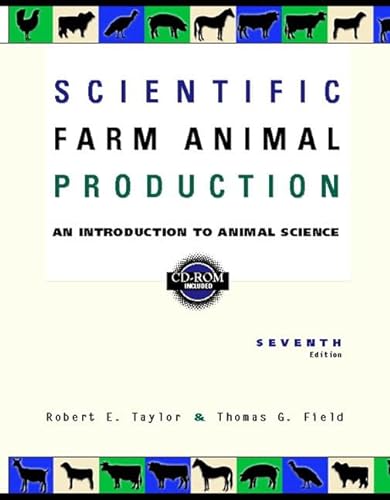
Textbook providing up-to-date information encompassing the depth and breadth of livestock and poultry production and their respective industries. The included CD-ROM contains a student study guide with questions for each chapter in the text.
"synopsis" may belong to another edition of this title.
About the Author
DR. ROBERT E. TAYLOR was raised on an Idaho livestock operation where several livestock species were produced. He received his B.S. and M.S. degrees from Utah State University. This background, combined with a Ph.D. in animal breeding and physiology from Oklahoma State University, provided the foundations of his knowledge about livestock production. He worked with beef cattle, dairy cattle, horses, poultry, sheep, and swine during his career.
Dr. Taylor received teaching awards from Iowa State University, Colorado State University, the USDA National Excellence in Teaching program, and the American Society of Animal Science. Many of his concepts for effective teaching are utilized in this book. Dr. Taylor passed away in 1998.
DR. THOMAS G. FIELD was raised on a Colorado cow-calf and seedstock enterprise. He managed a seedstock herd of cattle after completing his B.S. degree. A competitive horseman as a youth, he has had practical experience with seedstock cattle, commercial cow-calf production, stockers, and horses. He has a B.S., M.S., and Ph.D. in animal science from Colorado State University.
Dr. Field has received teaching awards from the USDA National Excellence in Teaching program, the National Association of Colleges and Teachers of Agriculture, the Western Section of the American Society of Animal Science, and Colorado State University. Dr. Field is the teaching coordinator for the Department of Animal Sciences at Colorado State University and is responsible for coordinating the teaching herd.
From the Back Cover
Scientific Farm Animal Production presents all of the necessary information pertaining to successful breeding, feeding, and management of the following:
- beef cattle
- dairy cattle
- horses
- sheep
- swine
- poultry
- goats
- aquaculture
while also providing an overview of the principles applicable to the animal sciences with chapters on Genetics, Reproduction, Lactation, Growth and Development, Nutrition, Animal Behavior, Consumer Products, Careers in the Industry, and other essential topics.
Scientific Farm Animal Production, written for the introductory animal science course typically taught at universities and junior or community colleges, is also a valuable reference book for livestock producers, vocational agriculture instructors, and others desiring an overview of livestock production principles and management. With coverage that meets the needs of an urban audience while challenging the reader who may have a background in livestock production, the seventh edition of this trusted text continues to represent the standard for comprehensive, balanced, and authoritative coverage.
From the Inside Flap
Preface
Scientific Farm Animal Production is distinguished by an appropriate combination of both breadth and depth of livestock and poultry production and their respective industries. The book gives an overview of the biological principles applicable to the Animal Sciences, with chapters on reproduction, genetics, nutrition, lactation, consumer products, and other subjects. The book also covers the breeding, feeding, and management of beef cattle, dairy cattle, horses, sheep, swine, poultry, goats, and aquaculture. Although books have been written on each of these separate subjects, the authors have highlighted the significant biological principles, scientific relationships, and management practices in a condensed but informative manner. TARGET AUDIENCE
This book is designed as a text for the introductory Animal Science course typically taught at universities and junior or community colleges. It is also a valuable reference book for livestock producers, vocational agriculture instructors, and others desiring an overview of livestock production principles and management. The book is basic and sufficiently simple for urban students with limited livestock experience, yet challenging for students who have a livestock production background. KEY FEATURES
Chapters 1-9 cover animal products and give an overview of the livestock and poultry industries, Chapters 10-22 discuss the biological principles, while livestock, poultry, and aquaculture management practices are presented in Chapters 23-38.
The glossary of the terms used throughout the book has been expanded so students can readily become familiar with animal science terminology. The bold-lettered words in the text are included in the glossary.
Many illustrations in the form of photographs and line drawings are used throughout the book to communicate key points and major relationships. If "a picture is worth a thousand words," the numerous photographs and drawings expand the usefulness of the book beyond its pages.
Selected references are provided for each chapter to direct students into greater depth and breadth as they become intrigued with certain topics. Instructors can also use the references to expand their knowledge in current background material. Also included in the selected-references sections are references to visuals that relate to the specific chapter. Instructors are encouraged to review these visuals and use those that will enrich their courses. USING THE BOOK
The book is designed to accommodate several instructional approaches to teaching the introductory course: (1) the life-cycle biological principles approach, including such areas as consumer products, reproduction, breeding, nutrition, and animal health; (2) the species approach (teaching the course primarily in reference to the various species); or (3) a combination of the previous two. The latter appears to be the most popular teaching approach, covering principles in lecture and combining principles and species into laboratory exercises.
Some instructors will assign one or more papers on a topic selected by them or the students. The references at the end of each chapter are designed for students who want or need to explore certain topics in more depth.
Most instructors will not have sufficient time in their courses to assign all the chapters. Course outlines can be developed to include the chapters assigned and put them in the sequence that meets an instructor's preference. CHANGES IN THIS EDITION
This edition has been updated with current technical and applied information. Whenever possible, tables and figures have been revised with current data. A chapter on aquaculture has been added to the text, and major revisions of the careers chapter (37), the species breeding and management chapters (25-36), and the reproduction chapter (10) have been made. This revision provides more detail in terms of selection strategies and tools, management benchmarks, endocrinology, and food safety issues. The emphasis on bioeconomics and global perspectives has been continued. A list of useful Web sites is provided to allow students and faculty the opportunity to explore a variety of information sources that complement the text. The addition of a CD-ROM that provides interactive study questions for each chapter also adds to the value of this edition.
"About this title" may belong to another edition of this title.
Search results for Scientific Farm Animal Production: An Introduction...

Stock Image
Scientific Farm Animal Production: An Introduction to Animal Science
Seller: World of Books (was SecondSale), Montgomery, IL, U.S.A.
Seller rating 5 out of 5 stars

Hardback. Condition: Fair. Suitable for freshman-level courses in Introductory Animal Science, this book explores both the livestock and poultry industries. It provides an overview of the biological principles of animal science and offers coverage of the practical areas of breeding, feeding, and management of major farm animal species. Seller Inventory # 00108994187
Stock Image
Scientific Farm Animal Production: An Introduction to Animal Science
Seller: World of Books Inc, Montgomery, IL, U.S.A.
Seller rating 4 out of 5 stars

Hardback. Condition: Fair. Suitable for freshman-level courses in Introductory Animal Science, this book explores both the livestock and poultry industries. It provides an overview of the biological principles of animal science and offers coverage of the practical areas of breeding, feeding, and management of major farm animal species. Seller Inventory # CIN0130200328A
Stock Image
Scientific Farm Animal Production: An Introduction to Animal Science (7th Edition)
Seller: ThriftBooks-Atlanta, AUSTELL, GA, U.S.A.
Seller rating 5 out of 5 stars
Hardcover. Condition: Good. No Jacket. Pages can have notes/highlighting. Spine may show signs of wear. ~ ThriftBooks: Read More, Spend Less. Seller Inventory # G0130200328I3N00
Stock Image
Scientific Farm Animal Production: An Introduction to Animal Science (7th Edition)
Seller: ThriftBooks-Atlanta, AUSTELL, GA, U.S.A.
Seller rating 5 out of 5 stars
Hardcover. Condition: Very Good. No Jacket. May have limited writing in cover pages. Pages are unmarked. ~ ThriftBooks: Read More, Spend Less. Seller Inventory # G0130200328I4N00
Stock Image
scientific-farm-animal-production---an-introduction-to-animal-science
Seller: HPB-Red, Dallas, TX, U.S.A.
Seller rating 5 out of 5 stars
Paperback. Condition: Good. Connecting readers with great books since 1972! Used textbooks may not include companion materials such as access codes, etc. May have some wear or writing/highlighting. We ship orders daily and Customer Service is our top priority! Seller Inventory # S_333052865
Stock Image
Scientific Farm Animal Production: An Introduction to Animal Science (7th Edition)
Seller: Mikes Book Market, North Lancaster, ON, Canada
Seller rating 5 out of 5 stars
Hardcover. Condition: As New. No Jacket. PICTORIAL BOARDS,TIGHT COPY,CLEAN TEXT,NO MARKS. Seller Inventory # PP-446
Buy Used
US$ 36.67
US$ 22.50 shipping
Ships from Canada to U.S.A.
Ships from Canada to U.S.A.
Quantity: 1 available
Stock Image
Scientific Farm Animal Production: An Introduction to Animal Science (7th Edition)
Seller: BennettBooksLtd, Los Angeles, CA, U.S.A.
Seller rating 5 out of 5 stars
hardcover. Condition: New. In shrink wrap. Looks like an interesting title! Seller Inventory # Q-0130200328