
Items related to The Police and the Community (7th Edition)
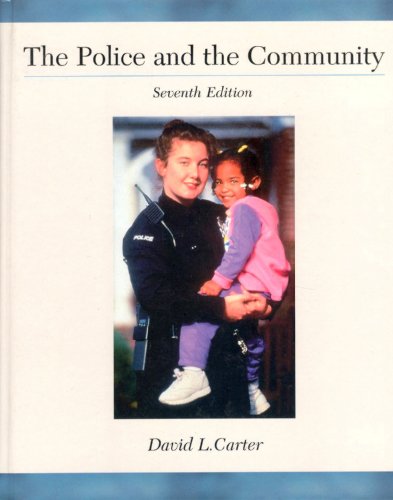
Synopsis
This leading book presents a comprehensive introduction to community policing—one of the most significant recent trends in policing, and related topics which are central to the effective management of the police community relationship. It integrates contemporary discussions of the community policing/problem solving concepts with systematic issues, at the same time covering the important transition from traditional practices in police-community relations to the new programs of community policing. Comprehensive coverage includes racial profiling, an original discussion of new and emerging technologies (e-policing), and an updated treatment of ethics and integrity issues. For law enforcement personnel.
"synopsis" may belong to another edition of this title.
From the Back Cover
The seventh edition of The Police and the Community continues the long-standing tradition of this well-established book by providing a solid foundation of history in the police-community relationship integrated with the most contemporary issues and trends. The author, who has worked extensively with police agencies around the world, brings a unique combination of theory, research, and policy to the issues discussed. A unique aspect of this book is that it goes beyond community policing and examines an array of important issues which are inextricably related to the provision of police service and the general police-community relationship. The book is intended for researchers, students, and practitioners who seek a broad and thoughtful approach in the police-community relationship.
New to the Seventh Edition:- A complete discussion of the COMPSTAT process, presented in a broader context of "deployment by analysis," including crime mapping and crime analysis, and the role these concepts play in community policing.
- A detailed examination of "racial profiling," including detailed discussion of its history, the issues, and remedies.
- A unique discussion of what the author calls "e-Policing" which explores both "client" and "enterprise" computing as they relate to police information management, community policing, and the provision of value-added service to the community.
- A complete update of research and federal initiatives, including the Office of Community Oriented Policing Services, as they relate to community policing and the police-community relationship.
- An updated Instructor's Manual which includes a test question bank.
Excerpt. © Reprinted by permission. All rights reserved.
As we have entered the twenty-first century, we have seen both dramatic developments affecting policing while, ironically, endemic problems continue to resurface in the police community relationship. Without question, the most notable developments have been related to new and emerging technologies. The growth of networking, more sophisticated, yet easy-to-use software, and the greater capacity of computers to process information at lower costs have all been embraced by law enforcement. Crime mapping and more sophisticated crime analysis led to the development of the COMPSTAT process, which is a philosophy of accountability and responsive to crime problems within a community. The development of intranets within police organizations have made information processing, hence problem solving, more efficacious. The development of more functional police web pages have opened the doors to new levels of police-citizen communications through not only the provision of information but also the ability to report crime online, obtain copies of police reports, and conduct other e-commerce transactions that serve the community in important new virtual ways.
Despite the growth of the exciting new technological developments that promise improvements in police service delivery and communications, there are persistent problems within the police community relationship that seem to never be resolved. Perhaps the most noteworthy deals with racial profiling. The persistent conflict between the police and minority communities continues to boil despite ongoing creative efforts to resolve problems. While progress has clearly been made in police-minority relations, there is a significant amount of work ahead.
Other changes occurring include a renewed emphasis in ethics and integrity issues following a series of high-profile police misconduct cases in New York and Los Angeles. The changing face of the United States following the 2000 census, the nine-year crime rate drop-which will be starting to sputter-and changes in the character of crime are all changing issues that are important in the police community relationship. All of these factors, along with new research findings in policing, are incorporated into this new edition.
Many people have helped me in the preparation of this book as well as previous editions. I would particularly like to thank again my friend Rick Holden at Central Missouri State University for his insights, thoughtful ideas, and friendship during our various travels coast-to-coast. Similarly, thanks also go to Merle Manzi of S,M,&C Sciences, Inc. of Tallahassee, Florida, for his friendship, humor, and ideas, whether we were sitting in a stoic British pub or a less-than-stoic bar in Thailand. And a special thanks to my dear friend Andra Bannister of Wichita State University for her help, candid feedback, humor, and collusion on various projects and explorations covering four continents and Italian restaurants from Casablanca to Bangkok. Andi, you know I can always count on you. My thanks also go to reviewers James F. Albrecht (John Jay College of Criminal Justice), Francis Schreiner (Mansfield University of Pennsylvania), and Robert Taylor (University of North Texas) for their time and input.
I dedicate this book to my late parents, Donald and Alta Carter, who provided more support, encouragement, guidance, and praise than a person could ask for. I was blessed with extraordinary and loving parents who afforded me the opportunity to grow up in a "Leave It to Beaver" household. I miss them both dearly. For my children, I strive to give as much guidance and to be as good a role model as my parents were to me. Finally, thanks go to my wife, Karen, and my children Hilary, Jeremy, and Lauren. You all know how special you are to me and how I depend on you. My thanks and love to you all.
David L. Carter
Mason, Michigan
"About this title" may belong to another edition of this title.
Search results for The Police and the Community (7th Edition)

Stock Image
The Police and the Community
Seller: World of Books (was SecondSale), Montgomery, IL, U.S.A.
Seller rating 5 out of 5 stars

Condition: Good. Item in very good condition! Textbooks may not include supplemental items i.e. CDs, access codes etc. Seller Inventory # 00077501457
Stock Image
The Police and the Community
Seller: World of Books (was SecondSale), Montgomery, IL, U.S.A.
Seller rating 5 out of 5 stars
Condition: Very Good. Item in very good condition! Textbooks may not include supplemental items i.e. CDs, access codes etc. Seller Inventory # 00103797383
Stock Image
The Police and the Community
Seller: World of Books (was SecondSale), Montgomery, IL, U.S.A.
Seller rating 5 out of 5 stars
Condition: Acceptable. Item in acceptable condition! Textbooks may not include supplemental items i.e. CDs, access codes etc. Seller Inventory # 00102166138
Stock Image
The Police and the Community (7th Edition)
Seller: ThriftBooks-Dallas, Dallas, TX, U.S.A.
Seller rating 5 out of 5 stars
Paperback. Condition: Fair. No Jacket. Readable copy. Pages may have considerable notes/highlighting. ~ ThriftBooks: Read More, Spend Less. Seller Inventory # G0130410632I5N00
Stock Image
The Police and the Community
Published by
Pearson Education, Limited, 2001
ISBN 10: 0130410632
ISBN 13: 9780130410634
Used
Softcover
Seller: Better World Books, Mishawaka, IN, U.S.A.
Seller rating 5 out of 5 stars
Condition: Good. 7 Edition. Pages intact with minimal writing/highlighting. The binding may be loose and creased. Dust jackets/supplements are not included. Stock photo provided. Product includes identifying sticker. Better World Books: Buy Books. Do Good. Seller Inventory # 5549667-6
Stock Image
The Police and the Community
Seller: World of Books Inc, Montgomery, IL, U.S.A.
Seller rating 4 out of 5 stars

Hardback. Condition: Fair. For sophomore/junior/graduate-level courses in Police and Society, Police Community Relations, Community Policing, and Introduction to Law Enforcement.This leading book presents a comprehensive introduction to community policing?one of the most significant recent trends in policing, and related topics which are central to the effective management of the police community relationship. It integrates contemporary discussions of the community policing/problem solving concepts with systematic issues, at the same time covering the important transition from traditional practices in police-community relations to the new programs of community policing. Seller Inventory # CIN0130410632A
Stock Image
The Police and the Community
Seller: World of Books Inc, Montgomery, IL, U.S.A.
Seller rating 4 out of 5 stars
Hardback. Condition: Very Good. For sophomore/junior/graduate-level courses in Police and Society, Police Community Relations, Community Policing, and Introduction to Law Enforcement.This leading book presents a comprehensive introduction to community policing?one of the most significant recent trends in policing, and related topics which are central to the effective management of the police community relationship. It integrates contemporary discussions of the community policing/problem solving concepts with systematic issues, at the same time covering the important transition from traditional practices in police-community relations to the new programs of community policing. Seller Inventory # CIN0130410632VG
Stock Image
The Police and the Community
Seller: World of Books Inc, Montgomery, IL, U.S.A.
Seller rating 4 out of 5 stars
Hardback. Condition: Good. For sophomore/junior/graduate-level courses in Police and Society, Police Community Relations, Community Policing, and Introduction to Law Enforcement.This leading book presents a comprehensive introduction to community policing?one of the most significant recent trends in policing, and related topics which are central to the effective management of the police community relationship. It integrates contemporary discussions of the community policing/problem solving concepts with systematic issues, at the same time covering the important transition from traditional practices in police-community relations to the new programs of community policing. Seller Inventory # CIN0130410632G
Stock Image
The Police and the Community (7th Edition)
Seller: HPB-Red, Dallas, TX, U.S.A.
Seller rating 5 out of 5 stars
Paperback. Condition: Acceptable. Connecting readers with great books since 1972. Used textbooks may not include companion materials such as access codes, etc. May have condition issues including wear and notes/highlighting. We ship orders daily and Customer Service is our top priority! Seller Inventory # S_353190704
Stock Image
The Police and the Community (7th Edition)
Seller: HPB-Red, Dallas, TX, U.S.A.
Seller rating 5 out of 5 stars
Paperback. Condition: Good. Connecting readers with great books since 1972! Used textbooks may not include companion materials such as access codes, etc. May have some wear or writing/highlighting. We ship orders daily and Customer Service is our top priority! Seller Inventory # S_425363002