
Items related to The Essential Guide to Telecommunications
Synopsis
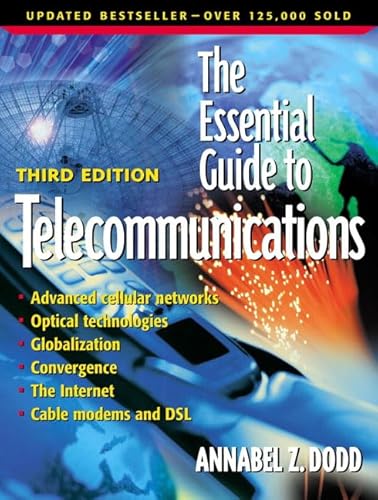
The Essential Guide to Telecommunications, Third Edition, is a hugely popular non-technical guide. Over 126,000 copies of the previous edition have been sold. It has helped professionals worldwide understand the major changes transforming the telecommunications industry. Leading consultant Annabel Z. Dodd presents easy-to-understand, insightful explanations of todayÕs key trends and technologies: optical networking, 3G wireless, globalization, high-speed Internet, speech recognition, call centers, and industry structures worldwide.
"synopsis" may belong to another edition of this title.
About the Author
ANNABEL Z. DODD is an adjunct professor at Northeastern University and has taught at the State University of New York at Stony Brook. Formerly in marketing at New England Telephone and Telecommunications and manager at a Fortune 500 company, she consults widely and gives seminars at major corporations and institutions worldwide. The Massachusetts Telecommunications Council honored her as the Professor of the Year 2000.
From the Back Cover
The completely updated nontechnical telecom guide for business people and other professionals.
- Advanced cellular networks
- Optical technologies
- Globalization
- Convergence
- The Internet
- Cable modems and DSL
In the past two years, the telecommunications industry has undergone major changes. The Essential Guide to Telecommunications, Third Edition, is your complete guide to the new realities of telecommunications. This new edition reflects all of today's most critical issues, trends and technologies. In addition to providing crucial insights into the fast-changing competitive landscape, Annabel Dodd provides important information about the structure of, and key players in, the industry.
The Essential Guide to Telecommunications, Third Edition will give you an easy-to-comprehend, broad understanding of this fast-changing industry. Coverage includes:
- Optical technologies expanded
- Advanced cellular networks: 2.5G and 3G standards
- Speech recognition, call centers and PBXs
- Comprehensive coverage of key players and the state of telecommunications in Europe, Asia, and Latin America
- Updated and expanded coverage of the Internet and convergence
What readers of the previous editions had to say:
"With jargon-free definitions, clear schematic drawings and its steady narrative drive,The Essential Guide to Telecommunications is a reassuring testament to the human ability to comprehend and communicate at some fundamental level even the most bewildering technology."—David Warsh, The Boston Globe"This book cuts through all the jargon and mysterious acronyms to give easily understood explanations of telecommunications, from the basics to the latest technology. I refer to it on a regular basis and constantly recommend it to others."—Michael Rieke, Editor of the Dow Jones Bandwidth Intelligence Alert"It is fair to say that Annabel Dodd has done more to demystify the industry for more people than anyone else in Massachusetts. For those who don't know bandwidth from a band saw or optical networks from an ophthalmologist, Dodd's book offers valuable insights into the products and services that fall under the telecommunications umbrella."—Katherine Raphaelson, Director, Massachusetts Telecommunications Council"This book is written for those who have little or no technical background. It's an easy-to-read overview of much of the technology available now and great if you have no patience for technical terminology."—George Runkle, The Motley Fool, Inc.Excerpt. © Reprinted by permission. All rights reserved.
Preface
Enormous changes in telecommunications occurred in the two years between the second and third editions of The Essential Guide to Telecommunications. The Essential Guide to Telecommunications is intended as a road map clarifying technologies, history and trends in telecommunications. Technological innovations in fiber optics and attendant lower costs has led to the construction of vast networks. The book contrasts the glut of these fiber optic networks in long distance routes and some urban areas with their scarcity in developing countries, rural and most suburban regions.
The Essential Guide to Telecommunications explains how technology and regulatory factors impact each other. Deregulation and the presence of competition have resulted in the development of technological innovations. These innovations, particularly those in gigabit Ethernet and optical switching, are examined.
Cellular service has grown tremendously in the last decade. It is a key technology for providing basic voice service in large parts of the world. The book examines technologies used to provide greater capacity for basic voice service in fast growing urban areas, rural communities and tall skyscrapers. It also explains the advanced cellular technologies for transmitting higher speed data and accessing the Internet over wireless networks. It also addresses the concerns about safety. It is not known what impact fears about cancer and driving safety will have on the cellular market.
The Essential Guide to Telecommunications, third edition reviews telecommunications in Europe, Asia and Latin America, as well as in developing countries, and the wide-reaching impact of wireless technology in these areas. Deregulation of local long distance and international services, as well as industry structure and major carriers, are covered. The structure of the telecommunications industry and steps in deregulation are examined in key areas of the world. The pace of adoption of technologies, such as high-speed Internet access, also is highlighted. The significance of a strong telecommunications infrastructure on the economy and on international trade is widely recognized and has prompted governments' attention worldwide.
The Essential Guide to Telecommunications, third edition presents profiles of industry segments and vendor types to provide readers an understanding of the industry. The roles of Internet service providers, backbone Internet providers, competitive local exchange carriers, utilities and cable TV companies are explained. The number of network providers and resellers and the fast pace of mergers has created new layers of complexity. In addition, regulatory rulings and the Telecommunications Act of 1996 are examined in light of their impact on consumers, commercial organizations and carriers.
The language and significance of important telecommunications technologies are explored. The Essential Guide to Telecommunications, third edition is not intended to be a deeply technical book. Rather, it is an overview of technologies and an explanation of the structure of the telecommunications industry. Technologies important in competition for local calling, high-capacity communications, third generation wireless services and Internet access are clarified. Intertwined with high-level technical explanations are examples of how the various vendors interconnect their networks. The book explains key technologies and options available for small and large organizations and consumers. It further explores significant trends, applications and the impact of the Internet.
This book is intended for non-technical people working in the field of telecommunications, laymen interested in learning more about the field and people responsible for the administration of telecommunications services for their organizations. They include regulatory staff, salespeople, law firms, research organizations, marketing personnel, human resources professionals, project managers, telecommunications managers and high-level administrators.
The Essential Guide to Telecommunications, third edition starts out with interpretations of fundamental concepts so that readers will have a basis for understanding more complex, new telecommunications services. It examines the structure of the industry, local competition, regulatory proceedings, the Internet, convergence and wireless services.
Along with explanations of technology are examples of applications and historical highlights. How the industry evolved and how the technology changed is explained. The stories and descriptions that accompany the technical details are key to the book.
"About this title" may belong to another edition of this title.
Search results for The Essential Guide to Telecommunications

Stock Image
The Essential Guide to Telecommunications
Seller: World of Books (was SecondSale), Montgomery, IL, U.S.A.
Seller rating 5 out of 5 stars

Condition: Good. Item in good condition and has highlighting/writing on text. Used texts may not contain supplemental items such as CDs, info-trac etc. Seller Inventory # 00097400247
Seller Image
The Essential Guide to Telecommunications
Seller: Greenworld Books, Arlington, TX, U.S.A.
Seller rating 5 out of 5 stars
Condition: very_good. Fast Free Shipping â" Very Good condition book with a firm cover and clean pages. Shows normal use and some light wear or limited notes markings. A solid, nice copy to enjoy. Seller Inventory # GWV.0130649074.VG
Stock Image
The Essential Guide to Telecommunications
Seller: World of Books Inc, Montgomery, IL, U.S.A.
Seller rating 4 out of 5 stars

Paperback. Condition: Good. A non-technical guide to telecommunications around the world, this third edition text provides comprehensive discussions of globalization, optical networking technologies, convergence, speech recognition and 3G cellular networks. It is useful for courses in Financial Analysis and Telecommunications. Seller Inventory # CIN0130649074G
Stock Image
Essential Guide to Telecommunications, The (3rd Edition) (Essential Guides (Prentice Hall))
Seller: Wonder Book, Frederick, MD, U.S.A.
Seller rating 5 out of 5 stars
Condition: Very Good. Very Good condition. 3rd edition. A copy that may have a few cosmetic defects. May also contain light spine creasing or a few markings such as an owner's name, short gifter's inscription or light stamp. Seller Inventory # C10A-05686
Stock Image
The Essential Guide to Telecommunications
Seller: ThriftBooks-Atlanta, AUSTELL, GA, U.S.A.
Seller rating 5 out of 5 stars
Paperback. Condition: As New. No Jacket. Pages are clean and are not marred by notes or folds of any kind. ~ ThriftBooks: Read More, Spend Less. Seller Inventory # G0130649074I2N00
Stock Image
The Essential Guide to Telecommunications
Published by
Pearson Education, Limited, 2001
ISBN 10: 0130649074
ISBN 13: 9780130649072
Used
Softcover
Seller: Better World Books: West, Reno, NV, U.S.A.
Seller rating 5 out of 5 stars
Condition: Very Good. 3rd. Former library copy. Pages intact with possible writing/highlighting. Binding strong with minor wear. Dust jackets/supplements may not be included. Includes library markings. Stock photo provided. Product includes identifying sticker. Better World Books: Buy Books. Do Good. Seller Inventory # 3111942-75
Stock Image
The Essential Guide to Telecommunications
Seller: HPB-Red, Dallas, TX, U.S.A.
Seller rating 5 out of 5 stars
paperback. Condition: Good. Connecting readers with great books since 1972! Used textbooks may not include companion materials such as access codes, etc. May have some wear or writing/highlighting. We ship orders daily and Customer Service is our top priority! Seller Inventory # S_474096309
Stock Image
Essential Guide to Telecommunications, The (3rd Edition) (Essential Guides (Prentice Hall))
Seller: Georgia Book Company, CHICKAMAUGA, GA, U.S.A.
Seller rating 5 out of 5 stars
Paperback. Condition: As New. LIKE NEW -3RD EDITION NEVER ISSUED-MAY HAVE SCHOOL STAMP, NUMBER, MINIMAL SHELF WEAR - EXPERIENCE AMAZING CUSTOMER SERVICE - WE SHIP DAILY. Seller Inventory # SKU00000000011999
Stock Image
The Essential Guide to Telecommunications
Seller: Ammareal, Morangis, France
Seller rating 5 out of 5 stars
Softcover. Condition: Très bon. Légères traces d'usure sur la couverture. Edition 2001. Ammareal reverse jusqu'à 15% du prix net de cet article à des organisations caritatives. ENGLISH DESCRIPTION Book Condition: Used, Very good. Slight signs of wear on the cover. Edition 2001. Ammareal gives back up to 15% of this item's net price to charity organizations. Seller Inventory # D-619-440
Buy Used
US$ 4.05
US$ 18.51 shipping
Ships from France to U.S.A.
Ships from France to U.S.A.
Quantity: 1 available
Stock Image
The Essential Guide to Telecommunications
Seller: Ammareal, Morangis, France
Seller rating 5 out of 5 stars
Softcover. Condition: Très bon. Ancien livre de bibliothèque. Edition 2001. Ammareal reverse jusqu'à 15% du prix net de cet article à des organisations caritatives. ENGLISH DESCRIPTION Book Condition: Used, Very good. Former library book. Edition 2001. Ammareal gives back up to 15% of this item's net price to charity organizations. Seller Inventory # D-598-601
Buy Used
US$ 4.61
US$ 18.51 shipping
Ships from France to U.S.A.
Ships from France to U.S.A.
Quantity: 1 available