
Items related to Introduction to Geography : People, Places, and Environment
Synopsis
More than any other, this up-to-the-minute book is dedicated to helping readers understand the world around them. The authors introduce the major tools, techniques, and methodological approaches of geography, and present a wide range of positions currently debated about provocative current issues. Weaves the theme of human-environmental interaction throughout. Demonstrates applications of GIS and GPS in physical geography - includes urban planning, registration of urban and rural landholding, farming techniques. Covers the aging of the human population, and the different ramifications of this fact in rich and poor countries. Expands discussion of Islam, church and state in Islam - includes relations between church and state in various religions. Discusses Islam in Europe and its cultural, religious, and political impact. Covers the spread of Islamic Sharia law across North Africa, the Near East, and Indonesia. An interesting reference for anyone who wants a deeper understanding of major world issues.
"synopsis" may belong to another edition of this title.
About the Author
Edward F. Bergman stands beside the stone wall that is the very eastern edge of the North American tectonic plate, where it is exposed in Iceland. Professor Bergman was born in Wisconsin and studied at the University of Wisconsin (Madison), the University of Vienna (Austria), and the University of Washington in Seattle. Today he teaches at Lehman College of the City University of New York and lectures widely across several continents. When not lecturing or writing, he enjoys Manhattan's cultural and social life.
William H. Renwick earned a B.A. from Rhode Island College in 1973 and a Ph.D. in geography from Clark University in 1979. He has taught at the University of California, Los Angeles, and Rutgers University, and is currently Associate Professor of Geography at Miami University. A physical geographer with interests in geomorphology and environmental issues, his research focuses on impacts of land-use change on rivers and lakes, particularly in agricultural landscapes in the Midwest. When time permits, he studies these environments from the seat of a wooden canoe.
From the Back Cover
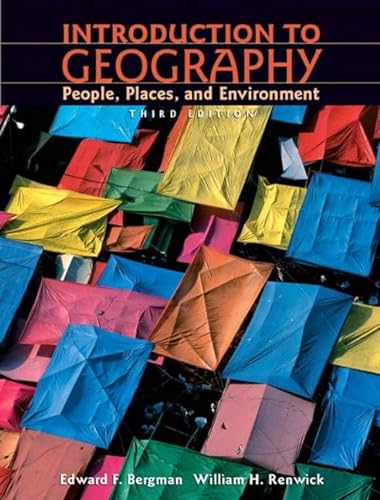
This book's cover is an aerial photo of a market in the Xochimilco district of Mexico City. This mosaic of brightly colored parasols hides a bustling market that offers fresh fruits arid vegetables, a selection of handmade local products, plus small household items of both local and foreign manufacture. Mexico boasts a vigorous international economy, with exports growing at a rate of 18 percent every year. Nevertheless, economic inequality is growing, and in some areas average earnings are as little as a quarter of the national average. Mexico's participation in the global economy exemplifies the global connections and farces that trigger constant and dynamic change everywhere on Earth. The study of these forces is one of modern geography's central missions.
This book develops the idea that modern geography explores and explains the forces behind today's world. The book organizes its coverage around several main themes and ideas:
Exploring the forces at work behind constantly evolving maps.In today's interconnected world, what happens at places depends more and more on what happens among places. Therefore, we can understand maps of economic or cultural activity only if we understand the activities and movements that create them.
Understanding contemporary issues bar applying geographic concepts.What you read in your geography text and learn in your geography classroom will help you understand current events and form your own well-informed ideas about issues. Each chapter in this book uses the geographic concepts under discussion to help you understand current affairs.
Highlighting important spatial relationships with a rich and diverse cartographic program.This book features many different types of maps and cartograms, as well as graphs, charts, and carefully chosen photographs. All are designed to clarify and illustrate the concepts under discussion. The book features contributions to the field made by new techniques in Geographic Information Science.
Exploring the relationships between humans and their environment.Earth's physical environment sets the stage upon which humans act out their lives. The theme of human-environmental interaction is woven throughout the book.
"About this title" may belong to another edition of this title.
Search results for Introduction to Geography : People, Places, and Environment

Stock Image
Introduction to Geography : People, Places, and Environment
Published by
Pearson Education, Limited, 2004
ISBN 10: 0131445456
ISBN 13: 9780131445451
Used
Hardcover
Seller: Better World Books, Mishawaka, IN, U.S.A.
Seller rating 5 out of 5 stars

Condition: Good. 3rd. Pages intact with minimal writing/highlighting. The binding may be loose and creased. Dust jackets/supplements are not included. Stock photo provided. Product includes identifying sticker. Better World Books: Buy Books. Do Good. Seller Inventory # 4907663-75
Stock Image
Introduction to Geography : People, Places, and Environment
Published by
Pearson Education, Limited, 2004
ISBN 10: 0131445456
ISBN 13: 9780131445451
Used
Hardcover
Seller: Better World Books, Mishawaka, IN, U.S.A.
Seller rating 5 out of 5 stars
Condition: Good. 3rd. Former library copy. Pages intact with minimal writing/highlighting. The binding may be loose and creased. Dust jackets/supplements are not included. Includes library markings. Stock photo provided. Product includes identifying sticker. Better World Books: Buy Books. Do Good. Seller Inventory # GRP91047994
Seller Image
Introduction to Geography : People, Places, and Environment
Seller: Zoom Books East, Glendale Heights, IL, U.S.A.
Seller rating 5 out of 5 stars
Condition: good. Book is in good condition and may include underlining highlighting and minimal wear. The book can also include "From the library of" labels. May not contain miscellaneous items toys, dvds, etc. . We offer 100% money back guarantee and 24 7 customer service. Seller Inventory # ZEV.0131445456.G
Seller Image
Introduction to Geography : People, Places, and Environment
Seller: Zoom Books Company, Lynden, WA, U.S.A.
Seller rating 5 out of 5 stars
Condition: very_good. Book is in very good condition and may include minimal underlining highlighting. The book can also include "From the library of" labels. May not contain miscellaneous items toys, dvds, etc. . We offer 100% money back guarantee and 24 7 customer service. Seller Inventory # ZBV.0131445456.VG
Stock Image
Introduction to Geography : People, Places, and Environment
Seller: HPB-Red, Dallas, TX, U.S.A.
Seller rating 5 out of 5 stars
hardcover. Condition: Good. Connecting readers with great books since 1972! Used textbooks may not include companion materials such as access codes, etc. May have some wear or writing/highlighting. We ship orders daily and Customer Service is our top priority! Seller Inventory # S_474057084
Stock Image
Introduction to Geography: People, Places, and Environment
Seller: Anybook.com, Lincoln, United Kingdom
Seller rating 5 out of 5 stars
Condition: Good. This is an ex-library book and may have the usual library/used-book markings inside.This book has soft covers. In good all round condition. Please note the Image in this listing is a stock photo and may not match the covers of the actual item,1400grams, ISBN:9780131445451. Seller Inventory # 9201618
Buy Used
US$ 8.90
US$ 20.77 shipping
Ships from United Kingdom to U.S.A.
Ships from United Kingdom to U.S.A.
Quantity: 1 available
Stock Image
Introduction to Geography: People, Places, and Environment, 3rd
Published by
Prentice Hall, Upper Saddle River, NJ, 2005
ISBN 10: 0131445456
ISBN 13: 9780131445451
Used
Softcover
Seller: a2zbooks, Burgin, KY, U.S.A.
Seller rating 5 out of 5 stars
Softcover. Condition: Good. 3rd Edition. Text appears clean , but may have minor marks that we missed, shelf and corner wear to cover 643 pages. Multiple copies available this title. Quantity Available: 8. Category: Geography & Maps; Indigenous Cultures. ISBN: 0131445456. ISBN/EAN: 9780131445451. Pictures of this item not already displayed here available upon request. Inventory No: 1560802696. Seller Inventory # 1560802696
Stock Image
Introduction to Geography: People, Places, and Environment, 3rd
Published by
Prentice Hall, Upper Saddle River, NJ, 2005
ISBN 10: 0131445456
ISBN 13: 9780131445451
Used
Softcover
Seller: a2zbooks, Burgin, KY, U.S.A.
Seller rating 5 out of 5 stars
Softcover. Condition: Good. 3rd Edition. Text appears clean, shelf and corner wear to cover 643 pages. Multiple copies available this title. Quantity Available: 7. Category: Geography & Maps; Indigenous Cultures. ISBN: 0131445456. ISBN/EAN: 9780131445451. Pictures of this item not already displayed here available upon request. Inventory No: 1560800309. Seller Inventory # 1560800309
Stock Image
Introduction to Geography: People, Places, and Environment, 3rd
Published by
Prentice Hall, Upper Saddle River, NJ, 2005
ISBN 10: 0131445456
ISBN 13: 9780131445451
Used
Softcover
Seller: a2zbooks, Burgin, KY, U.S.A.
Seller rating 5 out of 5 stars
Softcover. Condition: Good. 3rd Edition. The text has highlighting, the cover has shelf and corner wear with a small tear on the lower front hinge. 643 pages. Quantity Available: 1. Category: Geography & Maps; Indigenous Cultures. ISBN: 0131445456. ISBN/EAN: 9780131445451. Pictures of this item not already displayed here available upon request. Inventory No: 1560798951. Seller Inventory # 1560798951
Stock Image
Introduction To Geography: People, Places, and Environment, 3rd
Published by
Prentice Hall, Upper Saddle River, NJ, 2005
ISBN 10: 0131445456
ISBN 13: 9780131445451
Used
Softcover
Seller: a2zbooks, Burgin, KY, U.S.A.
Seller rating 5 out of 5 stars
Softcover. Condition: Very Good. 3rd Edition. The text appears clean, the covers have minor shelf and corner wear with a small tear on the top middle of the back cover, fixed with clear tape. Binding is in good condition. 643 pages. Multiple copies available this title. Quantity Available: 2. Shipped Weight: Under 1 kilo. Category: Geography & Maps; Indigenous Cultures. ISBN: 0131445456. ISBN/EAN: 9780131445451. Pictures of this item not already displayed here available upon request. Inventory No: 1561003774. Seller Inventory # 1561003774