
Items related to Methods for Teaching Elementary School Science (5th...
Synopsis
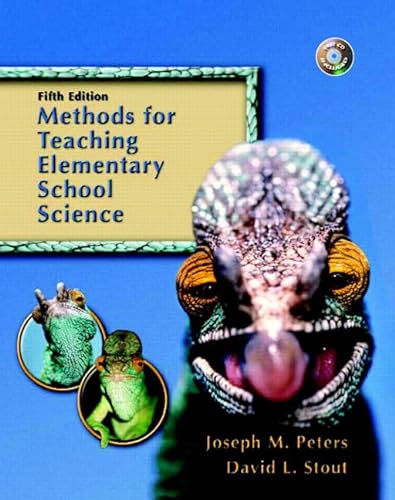
For Elementary Science Methods courses. Streamlined to be more manageable in limited class time, the new edition of Methods for Teaching Elementary School Science has been crafted to be the text that best prepares pre-service teachers for today's science classroom. It accomplishes this by clearly modeling inquiry teaching and addressing the realities of the contemporary science classroom.
"synopsis" may belong to another edition of this title.
Excerpt. © Reprinted by permission. All rights reserved.
{id: Peters, Stout core text preface} table.MsoNormalTable {mso-style-name:"Table Normal"; mso-tstyle-rowband-size:0; mso-tstyle-colband-size:0; mso-style-noshow:yes; mso-style-parent:""; mso-padding-alt:0in 5.4pt 0in 5.4pt; mso-para-margin:0in; mso-para-margin-bottom:.0001pt; mso-pagination:widow-orphan; font-size:10.0pt; font-family:"Times New Roman";}
Peters, Stout Methods for Teaching Elementary School Science preface
Elementary and middle school teaching is a rewarding and exciting career. Your future as a professional educator includes the responsibility to help your students meet the demands and challenges of society, and the elementary and middle school classroom is where it all begins. It is your job to build the skills, content knowledge, and desire for inquiry that will allow your students to function in a society that will be highly scientific and technologically developed. T his new edition of Methods for Teaching Elementary School Science has been crafted to help you do just that.
Focusing on the methods of teaching elementary and middle school science, the text centers on why science education is basic to children’s schooling and explains the foundations that give it form and substance. Each of the eight chapters develops a broad concept or a cluster of related teaching skills through descriptions and the use of many real-life examples.
The chapters and special features should enable you to
- Decide what areas of science are basic, useful, and curious to children.
- Recognize and assess differences in children’s thinking.
- Use open-ended and closed-ended teaching activities in planning and implementing lessons and units.
- Improve children’s scientific skills.
- Develop technological applications.
- Locate and use a variety of resources to teach science.
- Arrange and manage learning centers, computer centers, and projects.
- Assess science teaching.
Each chapter focuses on an overall concept such as learning, assessment, or technology. Practical teaching tips are highlighted and sprinkled throughout each chapter, and teaching concepts are aligned to the National Research Council’s National Science Education Standards. In addition, learning objectives are linked to the American Association for the Advancement of Science’s (AAAS) Benchmarks for Science Literacy, which are cited throughout the text when applicable. To help summarize and extend the content, each chapter includes a summary, reflection, and additional readings.
A Closer Look at the Text’s Features
Modeling Inquiry Teaching
By taking you into successful inquiry-based classrooms, we contextualize the concepts being covered and help you envision your own constructivist science classroom.
- {ed: insert CD logo in margin} Free CD-ROM Science in Elementary Education: Visit an Inquiry Classroom, containing footage of master teacher Glenn McKnight, models constructivist teaching and successful, inquiry-based science classroom management.
- Visit an Inquiry Classroom features throughout chapters integrate the chapter content, CD footage, and the text’s Companion Website.
"About this title" may belong to another edition of this title.
Search results for Methods for Teaching Elementary School Science (5th...

Stock Image
Methods for Teaching Elementary School Science
Seller: World of Books (was SecondSale), Montgomery, IL, U.S.A.
Seller rating 5 out of 5 stars

Condition: Good. For Elementary Science Methods courses.Streamlined to be more manageable in limited class time, the new edition of Methods for Teaching Elementary School Science has been crafted to be the text that best prepares pre-service teachers for today?s science classroom. It accomplishes this by clearly modeling inquiry teaching and addressing the realities of the contemporary science classroom. Seller Inventory # 00106732626
Stock Image
Methods for Teaching Elementary School Science
Seller: World of Books (was SecondSale), Montgomery, IL, U.S.A.
Seller rating 5 out of 5 stars
Condition: Fair. For Elementary Science Methods courses.Streamlined to be more manageable in limited class time, the new edition of Methods for Teaching Elementary School Science has been crafted to be the text that best prepares pre-service teachers for today?s science classroom. It accomplishes this by clearly modeling inquiry teaching and addressing the realities of the contemporary science classroom. Seller Inventory # 00107525992
Stock Image
Methods for Teaching Elementary School Science (5th Edition)
Seller: Orion Tech, Kingwood, TX, U.S.A.
Seller rating 5 out of 5 stars
paperback. Condition: Very Good. Seller Inventory # 0131715992-2-32555320
Stock Image
Methods for Teaching Elementary School Science (5th Edition)
Seller: Greenworld Books, Arlington, TX, U.S.A.
Seller rating 5 out of 5 stars
Condition: good. Fast Free Shipping â" Good condition. It may show normal signs of use, such as light writing, highlighting, or library markings, but all pages are intact and the book is fully readable. A solid, complete copy that's ready to enjoy. Seller Inventory # GWV.0131715992.G
Stock Image
Methods for Teaching Elementary School Science (5th Edition)
Seller: BooksRun, Philadelphia, PA, U.S.A.
Seller rating 5 out of 5 stars
Paperback. Condition: Very Good. 5. Supplements included. It's a well-cared-for item that has seen limited use. The item may show minor signs of wear. All the text is legible, with all pages included. It may have slight markings and/or highlighting. Seller Inventory # 0131715992-11-1-116
Stock Image
Methods for Teaching Elementary School Science
Seller: World of Books Inc, Montgomery, IL, U.S.A.
Seller rating 4 out of 5 stars

Condition: Fair. For Elementary Science Methods courses.Streamlined to be more manageable in limited class time, the new edition of Methods for Teaching Elementary School Science has been crafted to be the text that best prepares pre-service teachers for today?s science classroom. It accomplishes this by clearly modeling inquiry teaching and addressing the realities of the contemporary science classroom. Seller Inventory # CIN0131715992A
Stock Image
Methods for Teaching Elementary School Science
Seller: World of Books Inc, Montgomery, IL, U.S.A.
Seller rating 4 out of 5 stars
Condition: Good. For Elementary Science Methods courses.Streamlined to be more manageable in limited class time, the new edition of Methods for Teaching Elementary School Science has been crafted to be the text that best prepares pre-service teachers for today?s science classroom. It accomplishes this by clearly modeling inquiry teaching and addressing the realities of the contemporary science classroom. Seller Inventory # CIN0131715992G
Stock Image
Methods for Teaching Elementary School Science (5th Edition)
Seller: ThriftBooks-Atlanta, AUSTELL, GA, U.S.A.
Seller rating 5 out of 5 stars
Paperback. Condition: Fair. No Jacket. Readable copy. Pages may have considerable notes/highlighting. ~ ThriftBooks: Read More, Spend Less. Seller Inventory # G0131715992I5N00
Stock Image
Methods for Teaching Elementary School Science (5th Edition)
Seller: Textbook Bookie, Little Rock, AR, U.S.A.
Seller rating 5 out of 5 stars
Paperback. Condition: Fair. Book in Fair condition. Seller Inventory # 9780131715998-acceptable
Stock Image
Methods for Teaching Elementary School Science (5th Edition)
Seller: Textbook Bookie, Little Rock, AR, U.S.A.
Seller rating 5 out of 5 stars
Paperback. Condition: Good. Book in Good condition. Seller Inventory # 9780131715998-good