
Items related to Mathematical Statistics: Basic Ideas And Selected Topics:...
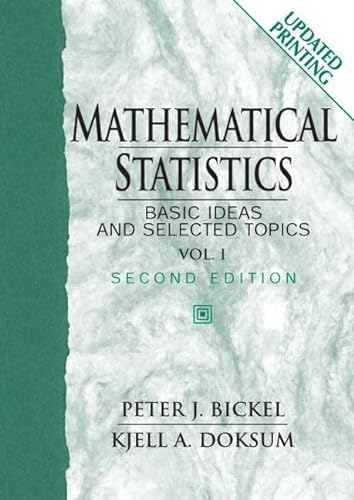
Synopsis
For graduate-level courses in Statistical Inference or Theoretical Statistics in departments of Statistics, Bio-Statistics, Economics, Computer Science, and Mathematics. An updated printing! In response to feedback from faculty and students, some sections within the book have been rewritten. Also, a number of corrections have been made, further improving the accuracy of this outstanding textbook.This updated classic, time-honored introduction to the theory and practice of statistics modeling and inference reflects the changing focus of contemporary Statistics. Coverage begins with the more general nonparametric point of view and then looks at parametric models as submodels of the nonparametric ones which can be described smoothly by Euclidean parameters. Although some computational issues are discussed, this is very much a book on theory. It relates theory to conceptual and technical issues encou
"synopsis" may belong to another edition of this title.
From the Inside Flap
PREFACE TO THE SECOND EDITION: VOLUME I
In the twenty-three years that have passed since the first edition of our book appeared statistics has changed enormously under the impact of several forces:
The generation of what were once unusual types of data such as images, trees (phylogenetic and other), and other types of combinatorial objects.
The generation of enormous amounts of data—terrabytes (the equivalent of 1012 characters) for an astronomical survey over three years.
The possibility of implementing computations of a magnitude that would have once been unthinkable.
The underlying sources of these changes have been the exponential change in computing speed (Moore's "law") and the development of devices (computer controlled) using novel instruments and scientific techniques (e.g., NMR tomography, gene sequencing). These techniques often have a strong intrinsic computational component. Tomographic data are the result of mathematically based processing. Sequencing is done by applying computational algorithms to raw gel electrophoresis data.
As a consequence the emphasis of statistical theory has shifted away from the small sample optimality results that were a major theme of our book in a number of directions:
Methods for inference based on larger numbers of observations and minimal assumptions—asymptotic methods in non- and semiparametric models, models with "infinite" number of parameters.
The construction of models for time series, temporal spatial series, and other complex data structures using sophisticated probability modeling but again relying for analytical results on asymptotic approximation. Multiparameter models are the rule.
The use of methods of inference involving simulation as a key element such as the bootstrap and Markov Chain Monte Carlo.
The development of techniques not describable in "closed mathematical form" but rather through elaborate algorithms for which problems of existence of solutions are important and far from obvious.
The study of the interplay between numerical and statistical considerations. Despite advances in computing speed, some methods run quickly in real time. Others do not and some though theoretically attractive cannot be implemented in a human lifetime.
The study of the interplay between the number of observations and the number of parameters of a model and the beginnings of appropriate asymptotic theories.
There have, of course, been other important consequences such as the extensive development of graphical and other exploratory methods for which theoretical development and connection with mathematics have been minimal. These will not be dealt with in our work.
As a consequence our second edition, reflecting what we now teach our graduate students, is much changed from the first. Our one long book has grown to two volumes, each to be only a little shorter than the first edition.
Volume I, which we present in 2000, covers material we now view as important for all beginning graduate students in statistics and science and engineering graduate students whose research will involve statistics intrinsically rather than as an aid in drawing conclusions.
In this edition we pursue our philosophy of describing the basic concepts of mathematical statistics relating theory to practice. However, our focus and order of presentation have changed.
Volume I covers the material of Chapters 1-6 and Chapter 10 of the first edition with pieces of Chapters 7-10 and includes Appendix A on basic probability theory. However, Chapter 1 now has become part of a larger Appendix B, which includes more advanced topics from probability theory such as the multivariate Gaussian distribution, weak convergence in Euclidean spaces, and probability inequalities as well as more advanced topics in matrix theory and analysis. The latter include the principal axis and spectral theorems for Euclidean space and the elementary theory of convex functions on Rd as well as an elementary introduction to Hilbert space theory. As in the first edition, we do not require measure theory but assume from the start that our models are what we call "regular." That is, we assume either a discrete probability whose support does not depend on the parameter set, or the absolutely continuous case with a density. Hilbert space theory is not needed, but for those who know this topic Appendix B points out interesting connections to prediction and linear regression analysis.
Appendix B is as self-contained as possible with proofs of most statements, problems, and references to the literature for proofs of the deepest results such as the spectral theorem. The reason for these additions are the changes in subject matter necessitated by the current areas of importance in the field.
Specifically, instead of beginning with parametrized models we include from the start non- and semiparametric models, then go to parameters and parametric models stressing the role of identifiability. From the beginning we stress function-valued parameters, such as the density, and function-valued statistics, such as the empirical distribution function. We also, from the start, include examples that are important in applications, such as regression experiments. There is more material on Bayesian models and analysis. Save for these changes of emphasis the other major new elements of Chapter 1, which parallels Chapter 2 of the first edition, are an extended discussion of prediction and an expanded introduction to k-parameter exponential families. These objects that are the building blocks of most modern models require concepts involving moments of random vectors and convexity that are given in Appendix B.
Chapter 2 of this edition parallels Chapter 3 of the first and deals with estimation. Major differences here are a greatly expanded treatment of maximum likelihood estimates (MLEs), including a complete study of MLEs in canonical k-parameter exponential families. Other novel features of this chapter include a detailed analysis including proofs of convergence of a standard but slow algorithm for computing MLEs in multiparameter exponential families and an introduction to the EM algorithm, one of the main ingredients of most modern algorithms for inference. Chapters 3 and 4 parallel the treatment of Chapters 4 and 5 of the first edition on the theory of testing and confidence regions, including some optimality theory for estimation as well and elementary robustness considerations. The main difference in our new treatment is the downplaying of unbiasedness both in estimation and testing and the presentation of the decision theory of Chapter 10 of the first edition at this stage.
Chapter 5 of the new edition is devoted to asymptotic approximations. It includes the initial theory presented in the first edition but goes much further with proofs of consistency and asymptotic normality and optimality of maximum likelihood procedures in inference. Also new is a section relating Bayesian and frequentist inference via the Bernsteinvon Mises theorem.
Finally, Chapter 6 is devoted to inference in multivariate (multiparameter) models. Included are asymptotic normality of maximum likelihood estimates, inference in the general linear model, Wilks theorem on the asymptotic distribution of the likelihood ratio test, the Wald and Rao statistics and associated confidence regions, and some parallels to the optimality theory and comparisons of Bayes and frequentist procedures given in the univariate case in Chapter 5. Generalized linear models are introduced as examples. Robustness from an asymptotic theory point of view appears also. This chapter uses multivariate calculus in an intrinsic way and can be viewed as an essential prerequisite for the more advanced topics of Volume II.
As in the first edition problems play a critical role by elucidating and often substantially expanding the text. Almost all the previous ones have been kept with an approximately equal number of new ones added—to correspond to our new topics and point of view. The conventions established on footnotes and notation in the first edition remain, if somewhat augmented.
Chapters 1-4 develop the basic principles and examples of statistics. Nevertheless, we star sections that could be omitted by instructors with a classical bent and others that could be omitted by instructors with more computational emphasis. Although we believe the material of Chapters 5 and 6 has now become fundamental, there is clearly much that could be omitted at a first reading that we also star. There are clear dependencies between starred sections that follow: 5.4.2, 5.4.3, 6.2, 6.3, 6.4, 6.5, 6.6
Volume II is expected to be forthcoming in 2003. Topics to be covered include permutation and rank tests and their basis in completeness and equivariance. Examples of application such as the Cox model in survival analysis, other transformation models, and the classical nonparametric k sample and independence problems will be included. Semiparametric estimation and testing will be c
"About this title" may belong to another edition of this title.
Search results for Mathematical Statistics: Basic Ideas And Selected Topics:...

Stock Image
Mathematical Statistics, Updated Printing
Seller: World of Books (was SecondSale), Montgomery, IL, U.S.A.
Seller rating 5 out of 5 stars

Hardback. Condition: Very Good. For graduate-level courses in Statistical Inference or Theoretical Statistics in departments of Statistics, Bio-Statistics, Economics, Computer Science, and Mathematics.An updated printing! In response to feedback from faculty and students, some sections within the book have been rewritten. Also, a number of corrections have been made, further improving the accuracy of this outstanding textbook.This updated classic, time-honored introduction to the theory and practice of statistics modeling and inference reflects the changing focus of contemporary Statistics. Coverage begins with the more general nonparametric point of view and then looks at parametric models as submodels of the nonparametric ones which can be described smoothly by Euclidean parameters. Although some computational issues are discussed, this is very much a book on theory. It relates theory to conceptual and technical issues encountered in practice, viewing theory as suggestive for practice, not prescriptive. It shows readers how assumptions which lead to neat theory may be unrealistic in practice. KEY TOPICS: Statistical Models, Goals, and Performance Criteria. Methods of Estimation. Measures of Performance, Notions of Optimality, and Construction of Optimal Procedures in Simple Situations. Testing Statistical Hypotheses: Basic Theory. Asymptotic Approximations. Multiparameter Estimation, Testing and Confidence Regions. A Review of Basic Probability Theory. More Advanced Topics in Analysis and Probability. Matrix Algebra. . Seller Inventory # 00098190616
Stock Image
Mathematical Statistics: Basic Ideas And Selected Topics: 1
Seller: BooksRun, Philadelphia, PA, U.S.A.
Seller rating 5 out of 5 stars
Paperback. Condition: Fair. 2. The item might be beaten up but readable. May contain markings or highlighting, as well as stains, bent corners, or any other major defect, but the text is not obscured in any way. Seller Inventory # 0132306379-7-1
Seller Image
Mathematical Statistics: Basic Ideas And Selected Topics: 1
Seller: Books for Life, LAUREL, MD, U.S.A.
Seller rating 5 out of 5 stars
Condition: acceptable. Book is in acceptable condition. May have shelf wear, edge wear, and spine wear, but a very readable copy. May not come with supplemental materials if applicable. Does not include original dustcover jacket. Possibly Ex Library Copy. Seller Inventory # LFM.7KGI
Stock Image
Mathematical Statistics: Basic Ideas And Selected Topics: 1
Seller: HPB-Red, Dallas, TX, U.S.A.
Seller rating 5 out of 5 stars
Paperback. Condition: Good. Connecting readers with great books since 1972! Used textbooks may not include companion materials such as access codes, etc. May have some wear or writing/highlighting. We ship orders daily and Customer Service is our top priority! Seller Inventory # S_473029075
Stock Image
Mathematical Statistics, Updated Printing
Seller: World of Books Inc, Montgomery, IL, U.S.A.
Seller rating 4 out of 5 stars

Hardback. Condition: Very Good. For graduate-level courses in Statistical Inference or Theoretical Statistics in departments of Statistics, Bio-Statistics, Economics, Computer Science, and Mathematics.An updated printing! In response to feedback from faculty and students, some sections within the book have been rewritten. Also, a number of corrections have been made, further improving the accuracy of this outstanding textbook.This updated classic, time-honored introduction to the theory and practice of statistics modeling and inference reflects the changing focus of contemporary Statistics. Coverage begins with the more general nonparametric point of view and then looks at parametric models as submodels of the nonparametric ones which can be described smoothly by Euclidean parameters. Although some computational issues are discussed, this is very much a book on theory. It relates theory to conceptual and technical issues encountered in practice, viewing theory as suggestive for practice, not prescriptive. It shows readers how assumptions which lead to neat theory may be unrealistic in practice. KEY TOPICS: Statistical Models, Goals, and Performance Criteria. Methods of Estimation. Measures of Performance, Notions of Optimality, and Construction of Optimal Procedures in Simple Situations. Testing Statistical Hypotheses: Basic Theory. Asymptotic Approximations. Multiparameter Estimation, Testing and Confidence Regions. A Review of Basic Probability Theory. More Advanced Topics in Analysis and Probability. Matrix Algebra. . Seller Inventory # CIN0132306379VG
Stock Image
Mathematical Statistics: Basic Ideas And Selected Topics: 1
Seller: Paper Oddities, Wantage, NJ, U.S.A.
Seller rating 4 out of 5 stars
Condition: Very Good. Well kept copy, tight and unmarked, little wear. Fast Shipping - Safe and Secure Bubble Mailer! Seller Inventory # 1M5GSB000I8Q_ns
Stock Image
Mathematical Statistics Volume I: Basic Ideas and Selected Topics
Published by
Prentice Hall April 2006, 2006
ISBN 10: 0132306379
ISBN 13: 9780132306379
Used
Trade Paperback
Seller: Magus Books Seattle, Seattle, WA, U.S.A.
Seller rating 5 out of 5 stars
Trade Paperback. Condition: VG. used hardcover copy in illustrated boards, no jacket, as issued. light shelfwear, corners perhaps slightly bumped. pages and binding are clean, straight and tight. there are no marks to the text or other serious flaws. Seller Inventory # 1527500
Stock Image
Mathematical Statistics: Basic Ideas And Selected Topics: 1
Seller: YESIBOOKSTORE, MIAMI, FL, U.S.A.
Seller rating 5 out of 5 stars
paperback. Condition: As New. Seller Inventory # 0132306379-VB
Stock Image
MATHEMATICAL STATISTICS, BASIC IDEAS and SELECTED TOPICS, VOL. I, UpDated Printing *
Published by
Pearson Prentice Hall, New Jersey And Various Other World Wide Locations * * * * *, 2007
ISBN 10: 0132306379
ISBN 13: 9780132306379
Used
Hardcover
First Edition
Seller: L. Michael, North Hollywood, CA, U.S.A.
Seller rating 5 out of 5 stars
Hardcover. Condition: Fine. 2007 Fine/, (illustrator). 1st Edition. Book: Fine/, $129.77 0132306379 MATHEMATICAL STATISTICS, BASIC IDEAS and SELECTED TOPICS, VOL. I, UpDated Printing BICKEL, Peter J.; DOKSUM, Kjell A. Pearson Prentice Hall 2007 1sT Edition, 2nD Printing New Jersey And Various Other World Wide Locations * * * * * H/c. Glossy Green Spine With Title In Letters, Hard Cover Book: Fine/, Slight Shelf, Edge And Corner Wear. 556 Numbered Pages That Are Printed On 0ff~White Paper In Fine/ Condition, Clean And Tight To The Spine. Lightly Viewed. D/j: None. = No Odors, No Writing, No Names, No Rippling, Not Stuck Together, No Book Plate, Not X~Library, No Remainder Or Other Marks. This Item Will Be Sent In A = Mailing B0X = To Prevent Shipping Damage So That It Will Arrive In The Description Described. Description Applies To This B00K, Only. = This B00K Is Hard To Find, Will Be Packaged And Shipped Carefully, = To Avoid Shipping Damage And Will Make It, An Excellent Addition To Your Own Personal Library Collection, Or As A Gift, For The Discriminating Reader / Collector. = WORLD WIDE SHIPPING, AVAILABLE *. Seller Inventory # 016440
Stock Image
Mathematical Statistics: Basic Ideas And Selected Topics: V-1 2e 2007 "Updated printing"
Seller: BooXX in Stock, Dekalb, IL, U.S.A.
Seller rating 4 out of 5 stars
Hardcover. Condition: As New. 2nd Edition. handsome pre owned copy; beautiful! now with 556 pages, formerly w 492 pages, clean, unmarked; very white paper inside; tight, sturdy, holding up well; updated printing; I ship anywhere you like; Seller Inventory # 005607