
Items related to Death in Rome (Penguin Twentieth-Century Classics)
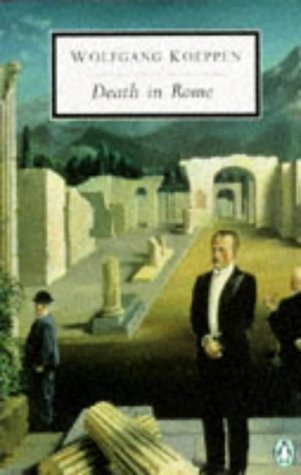
Synopsis
Four men who are related to each other but became estranged during World War II are reunited in Rome after the war
"synopsis" may belong to another edition of this title.
About the Author
Michael Hofmann has translated the work of Joseph Roth, Herta Müller, Zoë Jenny, Wim Wenders, Wolfgang Koeppen, and Franz Kafka.
Michael Hofmann has translated the work of Joseph Roth, Herta Müller, Zoë Jenny, Wim Wenders, Wolfgang Koeppen, and Franz Kafka.
Reviews
This Mann-esque German import, previously unpublished in English, takes readers on a lonely midnight walk without a map through crumbling foreign alleyways. Koeppen (Pigeons on the Grass, not reviewed) gives his postWW II narrative, a cross between domestic drama and fairy tale, four leading characters: Siegfried Pfaffrath, a composer; his father, Friedrich, the corrupt Oberb�rgermeister of their hometown; Friedrich's brother-in-law Gottlieb Judejahn, a former SS soldier; and Gottlieb's son Adolf, a priest. Estranged during the war, the four become reacquainted in Rome. Hofmann, who won a Times Literary Supplement prize in England for this translation, explains in his introduction that the characters are allegories as well as people (they represent music, bureaucracy, murder, and religion--four areas in which Germans have excelled), and that the text is a symbol as well as a story. Woe, then, to the lay reader without a background in German culture. A sense of alienation hangs over the text: The characters never seem able to penetrate one another's lives, and the prose is equally detached. The big family reunion is a case in point. Koeppen's staccato narrative brings the four protagonists together at Siegfried's concert, where they engage in about as much intimate contact as would pieces on a chessboard. The action occurs primarily in the characters' minds and memories. There are some vivid and disturbing depictions, especially that of Gottlieb, whose relationship to his family, women, and the heinous Third Reich is closely examined. Still obsessed with Jews, he forms a twisted attraction to a local barmaid who he suspects is Jewish. His plans to bed and destroy her are temporarily interrupted by Adolf's appearance and the discovery that she is Catholic, but his anger is rerouted to another outlet. Desolate, cold, cryptic. -- Copyright ©1994, Kirkus Associates, LP. All rights reserved.
So what has Koeppen's novel, now appearing in the U.S. for the first time, got to do with Thomas Mann? There are elements of Death in Venice , of obssession under a Mediterranean sun, but Mann's novella was published in 1912 and his compatriot's intelligent, deeply discomfiting novel was written in the much different world of 1954. At the center of the book is Gottlieb Judejahn, a vile, tormented SS general who escaped Germany to train Arab irregulars in the Levantine deserts. He returns to Rome under an assumed name for a problematic reunion with his wife, her sister and his brother-in-law, Friedrich Wilhelm Pffafrath, an ex-Nazi administrator who has once again risen to prominence. Judejahn, who once paraded through Rome as the Fuhrer's favorite, is now intimidated and angered by the cosmopolites ("the deracinated ones, international, homeless golden jetsam") and the clergy--among them his nephew Siegfried Pfaffrath, an avant-garde composer, and his own son Adolf, a deacon. Against the decrepit physical trappings of a toppled Roman Empire and the discredited mental ones of a destroyed German Reich, the narrative cuts between the four men, entwining the militarism, bureaucracy, music and religion of the German soul in a sad quadrille. Perhaps Koeppen's ( Pigeons on the Grass ) writing is not as evocative as that of Grass or Boll, but one clear reason for his relative obscurity is his unsparing portrait of moral fetidness.
Copyright 1994 Reed Business Information, Inc.
German great Koeppen first published this highly regarded novel in 1954. The plot follows the personal histories of four men who symbolize music, bureaucracy, arms, and religion, which represent the components of the German soul.
Copyright 1994 Reed Business Information, Inc.
Death in Rome sank from sight in 1954 because it was an uncomfortable reminder of national war guilt. To readers wanting to forget the war, Koeppen relentlessly presented two brothers-in-law, an odious SS executioner who escaped the Reich's collapse and an oily small-town mayor. Both personify, at the least, a lack of contrition. They have come to the Eternal City for a family reunion with their sonsa seminarian and a composer. The four reveal their souls through internal dialogues containing sentences that go on for a page, bursting forth like automatic fire. Koeppen's target is the nature of faith: the SS man, named Judejahn (a neologism akin to Jew madness, according to translator Hofmann) is an unreformed believer in the final solution, while his son Adolf (the text is permeated with such bitter allusions) wrestles with his religious beliefs, as crystallized in his hesitation about arranging extreme unction for his dying father. The pairing of the composer and burgomasterson and fatheris equally disturbing and issue-raising in the German context. All Teutonic tastes will be engaged in the revival of this neglected novelist. Gilbert Taylor
"About this title" may belong to another edition of this title.
Search results for Death in Rome (Penguin Twentieth-Century Classics)

Stock Image
Death in Rome
Seller: World of Books (was SecondSale), Montgomery, IL, U.S.A.
Seller rating 5 out of 5 stars

Condition: Fair. Four members of a German family are reunited by chance in the decaying beauty of post-war Rome. These different men, mutually antagonistic and fearful, learn of one another's presence in Rome and meet, their often chilling histories unfolding through a variety of literary styles and voices. Seller Inventory # 00096841986
Stock Image
Death in Rome (Penguin Twentieth-Century Classics)
Published by
Penguin Classics, 1994
ISBN 10: 0140187901
ISBN 13: 9780140187908
Used
Mass Market Paperback
Seller: HPB Inc., Dallas, TX, U.S.A.
Seller rating 5 out of 5 stars
Mass Market Paperback. Condition: Very Good. Connecting readers with great books since 1972! Used books may not include companion materials, and may have some shelf wear or limited writing. We ship orders daily and Customer Service is our top priority! Seller Inventory # S_490865219
Stock Image
Death in Rome (Penguin Twentieth-Century Classics)
Seller: WorldofBooks, Goring-By-Sea, WS, United Kingdom
Seller rating 4 out of 5 stars

Paperback. Condition: Very Good. The book has been read, but is in excellent condition. Pages are intact and not marred by notes or highlighting. The spine remains undamaged. Seller Inventory # GOR004307704
Buy Used
US$ 21.10
US$ 7.36 shipping
Ships from United Kingdom to U.S.A.
Ships from United Kingdom to U.S.A.
Quantity: 1 available
Seller Image
Death in Rome
Published by
Penguin Classics, 1994
ISBN 10: 0140187901
ISBN 13: 9780140187908
Used
brossura mass_market
Seller: Libreria sottomarina - Studio Bibliografico, ROMA, RM, Italy
Seller rating 5 out of 5 stars
brossura mass_market. Condition: Ottimo (Fine). Book. Seller Inventory # SOL10840ne05
Buy Used
US$ 21.47
US$ 46.08 shipping
Ships from Italy to U.S.A.
Ships from Italy to U.S.A.
Quantity: 1 available
Seller Image
Death in Rome (Penguin Twentieth-Century Classics)
Published by
Penguin Classics, 1994
ISBN 10: 0140187901
ISBN 13: 9780140187908
Used
Paperback
First Edition
Seller: Southampton Books, Sag Harbor, NY, U.S.A.
Seller rating 5 out of 5 stars
Paperback. Condition: Like New. First Edition. First Edition, First Printing. Published by Penguin Classics, 1994. Octavo. Paperback. Book is like new. Seller Inventory # 580655
Stock Image
Death in Rome (Penguin Twentieth-Century Classics)
Seller: Sell Books, Elland, YORKS, United Kingdom
Seller rating 5 out of 5 stars
mass_market. Condition: Acceptable. Please see the condition note after this for details, if this is missing please consider Acceptable to mean poor quality that could include major staining, water damage, writing, missing dustjacket, etc etc. Our books are dispatched from a Yorkshire former cotton mill. We list via barcode/ISBN so please note that the images are stock images and may not be the exact copy you receive, furthermore the details about edition and year might not be accurate as many publishers reuse the same ISBN for multiple editions and as we simply scan a barcode or enter an ISBN we do not check the validity of the edition data when listing. If you're looking for an exact edition please don't order (at least not without checking with us first, although we don't always have time to check). We aim to dispatch prompty, the service used will depend on order value and book size. We can ship to most countries, see our shipping policies. Payment is via Abe only. Seller Inventory # SBAB-L-BIJ00556-RAG-20240301-A
Buy Used
US$ 82.07
US$ 10.20 shipping
Ships from United Kingdom to U.S.A.
Ships from United Kingdom to U.S.A.
Quantity: 1 available
Stock Image
Death in Rome (Penguin Twentieth-Century Classics)
Seller: GoldBooks, Denver, CO, U.S.A.
Seller rating 5 out of 5 stars
Paperback. Condition: new. New Copy. Customer Service Guaranteed. Seller Inventory # 99K98_32_0140187901
Stock Image
Death in Rome (Penguin Twentieth-Century Classics) - Koeppen, Wolfgang
Seller: BUCHSERVICE / ANTIQUARIAT Lars Lutzer, Wahlstedt, Germany
Seller rating 5 out of 5 stars
Condition: gut. Death in Rome (Penguin Twentieth-Century Classics) - Koeppen, Wolfgang In englischer Sprache. pages. Seller Inventory # BN356664
Buy Used
US$ 271.11
US$ 43.83 shipping
Ships from Germany to U.S.A.
Ships from Germany to U.S.A.
Quantity: 1 available