
Items related to Dig Safe (Penguin Poets)
Synopsis
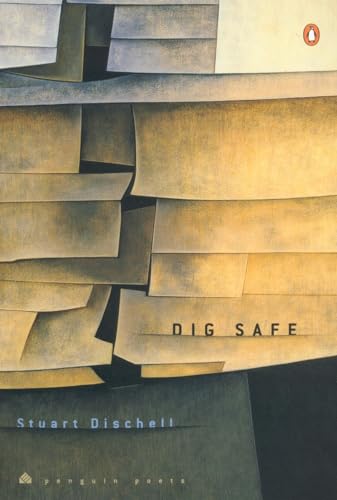
Stuart Dischell's poetry is passionate, darkly comic, heartbreaking, and always unpredictable. Dig Safe reaffirms why he commands high regard among poets and critics and popularity among his readers. Taking as their metaphor the markings that construction workers use to warn of utilities below street level—these new poems pierce the body politic as they evoke interconnection and misalliance, movement and inhabitation.
"synopsis" may belong to another edition of this title.
About the Author
Stuart Dischell's work has appeared in many publications, including The New Republic, Partisan Review, and Ploughshares. He has been awarded the Pushcart Prize and a National Endowment of the Arts Fellowship in Literature. He teaches at the University of North Carolina at Greensboro.
Reviews
There's a deep sweetness in the way that Stuart Dischell, a romantic poet with a funny bone, returns to the past in his three books: Good Hope Road (1993), Evenings & Avenues (1996) and Dig Safe (2003). The latter, his most recent collection, is his best to date -- its title derives from the brightly colored warning signs that construction workers spray paint on sidewalks and roadways: "Steam rising from the coffee and exhalations/ Of workers on break around a manhole cover,/ The abbreviated utilities scribbled in Dig Safe" ("Crooked Wood"). Dischell cleverly employs the term "Dig Safe" as the reigning metaphor of the book, as both a wish and a command, for how one might settle down and delve inward, approaching the treacheries of one's own past, the hard turning wheel of time lost and found and lost again. We're going to the erotic underground -- the underworld -- of a male psyche, and it's as if he's sending regards ("be well, dig safe") as we enter the danger zone where necessary but potentially hazardous psychological work always gets done.
Dischell's discursive lyrics have a light touch and a serious undertow. They have the jaunty quality of recollection, of trying to recall the past as honestly as possible, reporting back from the front. One thinks of them as invocations that come from the wide, middle regions of life, which is to say that they have a kind of equanimity about them. His particular way of approaching a subject, his strategy of attack, seems influenced by C. K. Williams and Robert Pinsky. It is close kin, say, to Carl Dennis and Tony Hoagland, both of whom also have a neighborly way of piercing the inner mysteries and taking up -- taking on -- the social world.
Dischell's poems typically operate by summoning the past, rather than simply inhabiting it, as so many traditional lyrics seem to do. Thus one poem characteristically begins: "Trying to remember what it was like to live/ Here and how it was I used to feel and fit/ Into those days -- like a convict in the movies/ I have come back to put on my old clothes" ("The Report"). "My memory is an upright sweeping back . . .," he continues. "A man would be a scarecrow in a birdless field." Another commences: "Hey it's been fourteen years since that summer/ We drove the little green Citroën out of Paris/ Through Lyon to the blue coast and went Mediterranean,/ Wearing no or little clothes, dozing in the bedchairs,/ The naked democracy of the beach, appreciating the sun/ Who was now making famous European love" ('The Squanderers").
There's an antic strain humming through Dischell's writing -- "When people say they miss me,/ I think how much I miss me too,/ Me, the old me, the great me" ("Days of Me") -- but his underlying subject is loss, which is what gives his poems their poignancy. "A Tenant at Will" provides a strong example of how his sensibility works:
A Tenant at Will
I no longer live on Linnaean Street
Where I watched the others going to work
As I drank coffee and smoked a pipe,
Inventing my current existence.
I was not bothered by the phone much.
No credit cards and little to bank.
My typewriter had just gone electric.
Nights I returned after drink and talk
To the punctuation of the white spark
On the trackless trolley wire.
And the slow-moving populace of summer
And the naked sub-lessee
In the lamplight flossing her teeth
Whether I looked or not were there.
Honks and voices and stereo speakers.
Those were the windows of that life.
Some faced a courtyard, the others a street.
I would like to visit who lives there now,
See how my face remains there framed. By Edward Hirsch
Copyright 2004, The Washington Post Co. All Rights Reserved.
"About this title" may belong to another edition of this title.
Search results for Dig Safe (Penguin Poets)

Stock Image
Dig Safe (Penguin Poets)
Published by
Penguin Publishing Group, 2003
ISBN 10: 0142002682
ISBN 13: 9780142002681
Used
Softcover
Seller: World of Books (was SecondSale), Montgomery, IL, U.S.A.
Seller rating 5 out of 5 stars

Condition: Very Good. Item in very good condition! Textbooks may not include supplemental items i.e. CDs, access codes etc. Seller Inventory # 00089951471
Stock Image
Dig Safe
Published by
Penguin Random House Australia, 2003
ISBN 10: 0142002682
ISBN 13: 9780142002681
Used
Paperback
Seller: World of Books Inc, Montgomery, IL, U.S.A.
Seller rating 4 out of 5 stars

Paperback. Condition: Very Good. Stuart Dischell's poetry is passionate, darkly comic, heartbreaking, and always unpredictable. Dig Safe reaffirms why he commands high regard among poets and critics and popularity among his readers. Taking as their metaphor the markings that construction workers use to warn of utilities below street level-these new poems pierce the body politic as they evoke interconnection and misalliance, movement and inhabitation. Seller Inventory # CIN0142002682VG
Stock Image
Dig Safe
Published by
Penguin Group USA, 2003
ISBN 10: 0142002682
ISBN 13: 9780142002681
Used
Trade Paperback
Seller: Murphy-Brookfield Books, Iowa City SE, IA, U.S.A.
Seller rating 5 out of 5 stars
Trade Paperback. Condition: Fine. Seller Inventory # 339553
Stock Image
Dig Safe (Penguin Poets)
Published by
Penguin Publishing Group, 2003
ISBN 10: 0142002682
ISBN 13: 9780142002681
Used
paperback
Seller: HPB-Diamond, Dallas, TX, U.S.A.
Seller rating 5 out of 5 stars
paperback. Condition: Very Good. Connecting readers with great books since 1972! Used books may not include companion materials, and may have some shelf wear or limited writing. We ship orders daily and Customer Service is our top priority! Seller Inventory # S_483928165
Stock Image
Dig Safe [SIGNED]
Published by
Penguin Publishing Group, New York, 2003
ISBN 10: 0142002682
ISBN 13: 9780142002681
Used
Soft cover
First Edition
Signed
Seller: Pages Past--Used & Rare Books, Greensboro, NC, U.S.A.
Seller rating 4 out of 5 stars
Soft cover. Condition: Very Good. 1st Edition. 8vo. 65 pages. Softcover in colour pictorial wrappers. Binding has light wear at edges. Author has written an inscription on the title page. Text is clean. Signed by Author(s). Seller Inventory # 052551
Seller Image
Dig Safe
Published by
Penguin Publishing Group, 2003
ISBN 10: 0142002682
ISBN 13: 9780142002681
New
Softcover
Seller: GreatBookPrices, Columbia, MD, U.S.A.
Seller rating 5 out of 5 stars
Condition: New. Seller Inventory # 959849-n
Stock Image
Dig Safe (Penguin Poets)
Published by
Penguin Publishing Group, 2003
ISBN 10: 0142002682
ISBN 13: 9780142002681
New
Softcover
Seller: Lakeside Books, Benton Harbor, MI, U.S.A.
Seller rating 5 out of 5 stars
Condition: New. Brand New! Not Overstocks or Low Quality Book Club Editions! Direct From the Publisher! We're not a giant, faceless warehouse organization! We're a small town bookstore that loves books and loves it's customers! Buy from Lakeside Books! Seller Inventory # OTF-S-9780142002681
Seller Image
Dig Safe
Published by
Penguin Publishing Group, 2003
ISBN 10: 0142002682
ISBN 13: 9780142002681
Used
Softcover
Seller: GreatBookPrices, Columbia, MD, U.S.A.
Seller rating 5 out of 5 stars
Condition: As New. Unread book in perfect condition. Seller Inventory # 959849
Stock Image
Dig Safe (Penguin Poets)
Published by
Penguin Publishing Group, 2003
ISBN 10: 0142002682
ISBN 13: 9780142002681
New
Softcover
Seller: California Books, Miami, FL, U.S.A.
Seller rating 5 out of 5 stars
Condition: New. Seller Inventory # I-9780142002681
Stock Image
Dig Safe (Paperback)
Published by
Penguin Random House Australia, Hawthorn, 2003
ISBN 10: 0142002682
ISBN 13: 9780142002681
New
Paperback
Seller: Grand Eagle Retail, Bensenville, IL, U.S.A.
Seller rating 5 out of 5 stars
Paperback. Condition: new. Paperback. Stuart Dischell's poetry is passionate, darkly comic, heartbreaking, and always unpredictable. Dig Safe reaffirms why he commands high regard among poets and critics and popularity among his readers. Taking as their metaphor the markings that construction workers use to warn of utilities below street level-these new poems pierce the body politic as they evoke interconnection and misalliance, movement and inhabitation. Stuart Dischell's poetry is passionate, darkly comic, heartbreaking, and always unpredictable. Dig Safe reaffirms why he commands high regard among poets and critics and popularity among his readers. Taking as their metaphor the markings that construction workers use to warn of utilities below street level—these new poems pierce the body politic as they evoke interconnection and misalliance, movement and inhabitation. This item is printed on demand. Shipping may be from multiple locations in the US or from the UK, depending on stock availability. Seller Inventory # 9780142002681