
Items related to Relativity: The Special and the General Theory (Penguin...
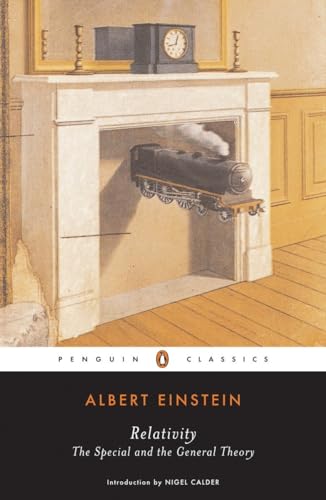
Synopsis
An accesible version of Einstein's masterpiece of theory, written by the genius himself
According to Einstein himself, this book is intended "to give an exact insight into the theory of Relativity to those readers who, from a general scientific and philosophical point of view, are interested in the theory, but who are not conversant with the mathematical apparatus of theoretical physics." When he wrote the book in 1916, Einstein's name was scarcely known outside the physics institutes. Having just completed his masterpiece, The General Theory of Relativity—which provided a brand-new theory of gravity and promised a new perspective on the cosmos as a whole—he set out at once to share his excitement with as wide a public as possible in this popular and accessible book.
Here published for the first time as a Penguin Classic, this edition of Relativity features a new introduction by bestselling science author Nigel Calder.
For more than seventy years, Penguin has been the leading publisher of classic literature in the English-speaking world. With more than 1,700 titles, Penguin Classics represents a global bookshelf of the best works throughout history and across genres and disciplines. Readers trust the series to provide authoritative texts enhanced by introductions and notes by distinguished scholars and contemporary authors, as well as up-to-date translations by award-winning translators.
"synopsis" may belong to another edition of this title.
About the Author
Albert Einstein (1879–1955), one of the greatest thinkers of the twentieth century, was born in Ulm, Germany, to German-Jewish parents. He published his first great theories in Switzerland in the early 1900s while working as a patent clerk.
Nigel Calder, educated as a physicist at Cambridge University, began his full-time writing career on the original staff of New Scientist magazine. His most recent book is the bestselling Einstein's Universe.
Reviews
"The present book is intended," Einstein wrote in 1916, "as far as possible, to give an exact insight into the theory of Relativity to those readers who, from a general scientific and philosophical point of view, are interested in the theory, but who are not conversant with the mathematical apparatus of theoretical physics.... In the interest of clearness, it appeared to me inevitable that I should repeat myself frequently, without paying the slightest attention to the elegance of the presentation. I adhered scrupulously to the precept of that brilliant theoretical physicist L. Boltzmann, according to whom matters of elegance ought to be left to the tailor and to the cobbler." But it is elegant, in part because of the 1920 translation, by Robert W. Lawson, a British physicist who had polished his German while a prisoner of war in Austria. The introduction, by science writer Nigel Calder, guides the reader through the work section by section, even giving advice on which sections to skip, or at least not to worry about, if you can't "accompany Einstein through the forest of tricky ideas contained in this slim volume." Okay, this book isn't easy--again, in the master's elegant words, it "lays no small claims on the patience and on the power of abstraction of the reader"--but it is well worth the try.
Editors of Scientific American
"About this title" may belong to another edition of this title.
Search results for Relativity: The Special and the General Theory (Penguin...

Stock Image
Relativity
Published by
Penguin Publishing Group, 2006
ISBN 10: 0143039822
ISBN 13: 9780143039822
Used
Paperback
Seller: World of Books (was SecondSale), Montgomery, IL, U.S.A.
Seller rating 5 out of 5 stars

Paperback. Condition: Good. The volume contains new publications of five works by Einstein - his valuable book Relativity: The Special and the General Theory, written for a wider audience - and four articles, which nicely complement the issues discussed in the book.The selected works contain not only Einstein's own explanations of his revolutionary contributions to fundamental physics, but also give the readers, particularly his popular book, the unique chance to be exposed to Einstein's original thinking in action. Einstein's five works included in the volume are:1. Relativity: The Special and the General Theory. A Popular Exposition 2. What is the Theory of Relativity, written at the request of The London Times and published on November 28, 19193. Ether and the Theory of Relativity, An Address delivered on May 5th, 1920 in the University of Leyden4. Geometry and Experience, An expanded form of an Address to the Prussian Academy of Sciences in Berlin on January 27th, 19215. A Brief Outline of the Development of the Theory of Relativity, Nature volume 106, pages 782-784 (17 February 1921)One notable issue - the concept of relativistic mass - is not discussed in Einstein's five works republished in the volume. Although he wrote in his popular book (included here, p. 36) the inertial mass of a body is not a constant, Einstein did not discuss the concept of relativistic mass (i.e., the relativistic increase of the mass of a body as its velocity increases), which he silently abandoned after using it in his 1905 paper, where he defined longitudinal mass and transverse mass. As Einstein's unclear view of the relativistic mass might have provided some encouragement for what has probably been the most vigorous campaign ever waged against the concept of relativistic mass, an Appendix On Relativistic Mass is included in this volume to address that unprecedented campaign and to help the readers make their own decision on the concept of relativistic mass. Seller Inventory # 00110113205
Stock Image
Relativity
Published by
Penguin Publishing Group, 2006
ISBN 10: 0143039822
ISBN 13: 9780143039822
Used
Paperback
Seller: World of Books (was SecondSale), Montgomery, IL, U.S.A.
Seller rating 5 out of 5 stars
Paperback. Condition: Fair. The volume contains new publications of five works by Einstein - his valuable book Relativity: The Special and the General Theory, written for a wider audience - and four articles, which nicely complement the issues discussed in the book.The selected works contain not only Einstein's own explanations of his revolutionary contributions to fundamental physics, but also give the readers, particularly his popular book, the unique chance to be exposed to Einstein's original thinking in action. Einstein's five works included in the volume are:1. Relativity: The Special and the General Theory. A Popular Exposition 2. What is the Theory of Relativity, written at the request of The London Times and published on November 28, 19193. Ether and the Theory of Relativity, An Address delivered on May 5th, 1920 in the University of Leyden4. Geometry and Experience, An expanded form of an Address to the Prussian Academy of Sciences in Berlin on January 27th, 19215. A Brief Outline of the Development of the Theory of Relativity, Nature volume 106, pages 782-784 (17 February 1921)One notable issue - the concept of relativistic mass - is not discussed in Einstein's five works republished in the volume. Although he wrote in his popular book (included here, p. 36) the inertial mass of a body is not a constant, Einstein did not discuss the concept of relativistic mass (i.e., the relativistic increase of the mass of a body as its velocity increases), which he silently abandoned after using it in his 1905 paper, where he defined longitudinal mass and transverse mass. As Einstein's unclear view of the relativistic mass might have provided some encouragement for what has probably been the most vigorous campaign ever waged against the concept of relativistic mass, an Appendix On Relativistic Mass is included in this volume to address that unprecedented campaign and to help the readers make their own decision on the concept of relativistic mass. Seller Inventory # 00098580032
Seller Image
Relativity: The Special and the General Theory (Penguin Classics)
Seller: Zoom Books Company, Lynden, WA, U.S.A.
Seller rating 5 out of 5 stars
Condition: very_good. Book is in very good condition and may include minimal underlining highlighting. The book can also include "From the library of" labels. May not contain miscellaneous items toys, dvds, etc. . We offer 100% money back guarantee and 24 7 customer service. Seller Inventory # ZBV.0143039822.VG
Stock Image
Relativity: The Special and the General Theory (Penguin Classics)
Published by
Penguin Classics (edition Reprint), 2006
ISBN 10: 0143039822
ISBN 13: 9780143039822
Used
Paperback
Seller: BooksRun, Philadelphia, PA, U.S.A.
Seller rating 5 out of 5 stars
Paperback. Condition: Fair. Reprint. The item might be beaten up but readable. May contain markings or highlighting, as well as stains, bent corners, or any other major defect, but the text is not obscured in any way. Seller Inventory # 0143039822-7-1
Stock Image
Relativity
Published by
Penguin Publishing Group, 2006
ISBN 10: 0143039822
ISBN 13: 9780143039822
Used
Paperback
Seller: World of Books Inc, Montgomery, IL, U.S.A.
Seller rating 4 out of 5 stars

Paperback. Condition: Good. The volume contains new publications of five works by Einstein - his valuable book Relativity: The Special and the General Theory, written for a wider audience - and four articles, which nicely complement the issues discussed in the book.The selected works contain not only Einstein's own explanations of his revolutionary contributions to fundamental physics, but also give the readers, particularly his popular book, the unique chance to be exposed to Einstein's original thinking in action. Einstein's five works included in the volume are:1. Relativity: The Special and the General Theory. A Popular Exposition 2. What is the Theory of Relativity, written at the request of The London Times and published on November 28, 19193. Ether and the Theory of Relativity, An Address delivered on May 5th, 1920 in the University of Leyden4. Geometry and Experience, An expanded form of an Address to the Prussian Academy of Sciences in Berlin on January 27th, 19215. A Brief Outline of the Development of the Theory of Relativity, Nature volume 106, pages 782-784 (17 February 1921)One notable issue - the concept of relativistic mass - is not discussed in Einstein's five works republished in the volume. Although he wrote in his popular book (included here, p. 36) the inertial mass of a body is not a constant, Einstein did not discuss the concept of relativistic mass (i.e., the relativistic increase of the mass of a body as its velocity increases), which he silently abandoned after using it in his 1905 paper, where he defined longitudinal mass and transverse mass. As Einstein's unclear view of the relativistic mass might have provided some encouragement for what has probably been the most vigorous campaign ever waged against the concept of relativistic mass, an Appendix On Relativistic Mass is included in this volume to address that unprecedented campaign and to help the readers make their own decision on the concept of relativistic mass. Seller Inventory # CIN0143039822G
Stock Image
Relativity
Published by
Penguin Publishing Group, 2006
ISBN 10: 0143039822
ISBN 13: 9780143039822
Used
Paperback
Seller: World of Books Inc, Montgomery, IL, U.S.A.
Seller rating 4 out of 5 stars
Paperback. Condition: Fair. The volume contains new publications of five works by Einstein - his valuable book Relativity: The Special and the General Theory, written for a wider audience - and four articles, which nicely complement the issues discussed in the book.The selected works contain not only Einstein's own explanations of his revolutionary contributions to fundamental physics, but also give the readers, particularly his popular book, the unique chance to be exposed to Einstein's original thinking in action. Einstein's five works included in the volume are:1. Relativity: The Special and the General Theory. A Popular Exposition 2. What is the Theory of Relativity, written at the request of The London Times and published on November 28, 19193. Ether and the Theory of Relativity, An Address delivered on May 5th, 1920 in the University of Leyden4. Geometry and Experience, An expanded form of an Address to the Prussian Academy of Sciences in Berlin on January 27th, 19215. A Brief Outline of the Development of the Theory of Relativity, Nature volume 106, pages 782-784 (17 February 1921)One notable issue - the concept of relativistic mass - is not discussed in Einstein's five works republished in the volume. Although he wrote in his popular book (included here, p. 36) the inertial mass of a body is not a constant, Einstein did not discuss the concept of relativistic mass (i.e., the relativistic increase of the mass of a body as its velocity increases), which he silently abandoned after using it in his 1905 paper, where he defined longitudinal mass and transverse mass. As Einstein's unclear view of the relativistic mass might have provided some encouragement for what has probably been the most vigorous campaign ever waged against the concept of relativistic mass, an Appendix On Relativistic Mass is included in this volume to address that unprecedented campaign and to help the readers make their own decision on the concept of relativistic mass. Seller Inventory # CIN0143039822A
Stock Image
Relativity: The Special and the General Theory
Seller: ThriftBooks-Reno, Reno, NV, U.S.A.
Seller rating 5 out of 5 stars
Paperback. Condition: Good. No Jacket. Pages can have notes/highlighting. Spine may show signs of wear. ~ ThriftBooks: Read More, Spend Less. Seller Inventory # G0143039822I3N00
Stock Image
Relativity: The Special and the General Theory
Seller: ThriftBooks-Phoenix, Phoenix, AZ, U.S.A.
Seller rating 5 out of 5 stars
Paperback. Condition: Good. No Jacket. Pages can have notes/highlighting. Spine may show signs of wear. ~ ThriftBooks: Read More, Spend Less. Seller Inventory # G0143039822I3N00
Stock Image
Relativity: The Special and the General Theory
Seller: ThriftBooks-Atlanta, AUSTELL, GA, U.S.A.
Seller rating 5 out of 5 stars
Paperback. Condition: Good. No Jacket. Pages can have notes/highlighting. Spine may show signs of wear. ~ ThriftBooks: Read More, Spend Less. Seller Inventory # G0143039822I3N00
Stock Image
Relativity: The Special and the General Theory
Seller: ThriftBooks-Dallas, Dallas, TX, U.S.A.
Seller rating 5 out of 5 stars
Paperback. Condition: Good. No Jacket. Pages can have notes/highlighting. Spine may show signs of wear. ~ ThriftBooks: Read More, Spend Less. Seller Inventory # G0143039822I3N00