
Items related to Snow Falling on Cedars
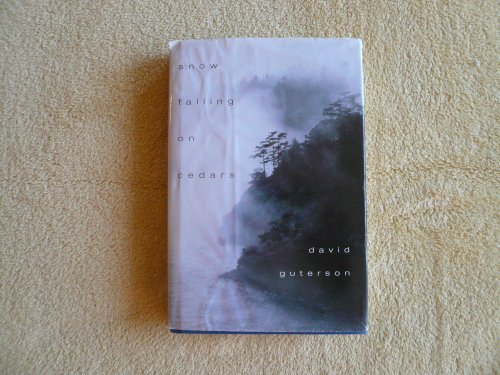
Synopsis
Ishmael Chambers, a newspaperman from the Pacific Northwest who lost an arm in World War II, reunites with his childhood sweetheart, Hatsue Imada, whom he was separated from by the Japanese-American internment, when Imada's husband is tried for murder.
"synopsis" may belong to another edition of this title.
About the Author
No Bio
Reviews
Old passions, prejudices, and grudges surface in a Washington State island town when a Japanese man stands trial for the murder of a fisherman in the 1950s. Guterson (The Country Ahead of Us, the Country Behind, 1989, etc.) has written a thoughtful, poetic first novel, a cleverly constructed courtroom drama with detailed, compelling characters. Many years earlier, Kabuo Miyamoto's family had made all but the last payment on seven acres of land they were in the process of buying from the Heine family. Then the Japanese bombed Pearl Harbor, and Kabuo's family was interned. Etta Heine, Carl's mother, called off the deal. Kabuo served in the war, returned, and wanted his land back. After changing hands a few times, the land ended up with Carl Heine. When Carl, a fisherman, is found drowned in his own net, all the circumstantial evidence, with the land dispute as a possible motive, points to Kabuo as the murderer. Meanwhile, Hatsue Miyamoto, Kabuo's wife, is the undying passion of Ishmael Chambers, the publisher and editor of the town newspaper. Ishmael, who returned from the war minus an arm, can't shake his obsession for Hatsue any more than he can ignore the ghost pains in his nonexistent arm. As a thick snowstorm whirls outside the courtroom, the story is unburied. The same incidents are recounted a number of times, with each telling revealing new facts. In the end, justice and morality are proven to be intimately woven with beauty--the kind of awe and wonder that children feel for the world. But Guterson communicates these truths through detail, not philosophical argument: Readers will come away with a surprising store of knowledge regarding gill-netting boats and other specifics of life in the Pacific Northwest. Packed with lovely moments and as compact as haiku--at the same time, a page-turner full of twists. (Author tour) -- Copyright ©1994, Kirkus Associates, LP. All rights reserved.
A 1954 murder trial in an island community off the coast of Washington state broadens into an exploration of war, race, and the mysteries of human motivation. The dead man, Carl Heine, his accused murderer, Kabuo Miyomoto, and the one-man staff of the local newspaper, Ishmael Chambers, were all scarred by their experiences in World War II but resumed normal-seeming lives upon their return to the fishing and strawberry-farming community of San Piedro in Puget Sound. While fishermen Heine and Miyomoto set about raising families, the newspaperman remains alone and apart, alienated by the loss of an arm and a childhood love, who married Miyomoto. Chambers comes upon information that could alter the verdict of the trial if presented or change his own life if suppressed, creating a private trial as momentous as the public one, with the outcome as much in doubt. Guterson's first novel is compellingly suspenseful on each of its several levels. Dennis Dodge
Japanese American Kabuo Miyomoto is arrested in 1954 for the murder of a fellow fisherman, Carl Heine. Miyomoto's trial, which provides a focal point to the novel, stirs memories of past relationships and events in the minds and hearts of the San Piedro Islanders. Through these memories, Guterson illuminates the grief of loss, the sting of prejudice triggered by World War II, and the imperatives of conscience. With mesmerizing clarity he conveys the voices of Kabuo's wife, Hatsue, and Ishmael Chambers, Hatsue's first love who, having suffered the loss of her love and the ravages of war, ages into a cynical journalist now covering Kabuo's trial. The novel poetically evokes the beauty of the land while revealing the harshness of war, the nuances of our legal system, and the injustice done to those interned in U.S. relocation camps. Highly recommended for all fiction collections.
Sheila Riley, Smith- sonian Inst. Libs., Washington, D.C.
Copyright 1994 Reed Business Information, Inc.
"About this title" may belong to another edition of this title.
Search results for Snow Falling on Cedars

Stock Image
Snow Falling on Cedars
Published by
Harcourt Brace International, 1994
ISBN 10: 0151001006
ISBN 13: 9780151001002
Used
Hardcover
Seller: World of Books (was SecondSale), Montgomery, IL, U.S.A.
Seller rating 5 out of 5 stars

Hardback. Condition: Fair. Winner of the PEN/Faulkner Award American Booksellers Association Book of the Year Award San Piedro Island, north of Puget Sound, is a place so isolated that no one who lives there can afford to make enemies. But in 1954 a local fisherman is found suspiciously drowned, and a Japanese American named Kabuo Miyamoto is charged with his murder. In the course of the ensuing trial, it becomes clear that what is at stake is more than a man's guilt. For on San Pedro, memory grows as thickly as cedar trees and the fields of ripe strawberries--memories of a charmed love affair between a white boy and the Japanese girl who grew up to become Kabuo's wife; memories of land desired, paid for, and lost. Above all, San Piedro is haunted by the memory of what happened to its Japanese residents during World War I, when an entire community was sent into exile while its neighbors watched. Gripping, tragic, and densely atmospheric, Snow Falling on Cedars is a masterpiece of suspense-- one that leaves us shaken and changed. Haunting. A whodunit complete with courtroom maneuvering and surprising turns of evidence and at the same time a mystery, something altogether richer and deeper.--Los Angeles Times Compelling.heartstopping. Finely wrought, flawlessly written.--The New York Times Book Review. Seller Inventory # 00099021487
Stock Image
Snow Falling on Cedars
Published by
Harcourt Brace International, 1994
ISBN 10: 0151001006
ISBN 13: 9780151001002
Used
Hardcover
Seller: World of Books (was SecondSale), Montgomery, IL, U.S.A.
Seller rating 5 out of 5 stars
Hardback. Condition: Good. Winner of the PEN/Faulkner Award American Booksellers Association Book of the Year Award San Piedro Island, north of Puget Sound, is a place so isolated that no one who lives there can afford to make enemies. But in 1954 a local fisherman is found suspiciously drowned, and a Japanese American named Kabuo Miyamoto is charged with his murder. In the course of the ensuing trial, it becomes clear that what is at stake is more than a man's guilt. For on San Pedro, memory grows as thickly as cedar trees and the fields of ripe strawberries--memories of a charmed love affair between a white boy and the Japanese girl who grew up to become Kabuo's wife; memories of land desired, paid for, and lost. Above all, San Piedro is haunted by the memory of what happened to its Japanese residents during World War I, when an entire community was sent into exile while its neighbors watched. Gripping, tragic, and densely atmospheric, Snow Falling on Cedars is a masterpiece of suspense-- one that leaves us shaken and changed. Haunting. A whodunit complete with courtroom maneuvering and surprising turns of evidence and at the same time a mystery, something altogether richer and deeper.--Los Angeles Times Compelling.heartstopping. Finely wrought, flawlessly written.--The New York Times Book Review. Seller Inventory # 00103705764
Seller Image
Snow Falling on Cedars
Published by
Harcourt Brace & Company, 1994
ISBN 10: 0151001006
ISBN 13: 9780151001002
Used
Hardcover
Seller: Greenworld Books, Arlington, TX, U.S.A.
Seller rating 5 out of 5 stars
Condition: good. Fast Free Shipping â" Good condition. It may show normal signs of use, such as light writing, highlighting, or library markings, but all pages are intact and the book is fully readable. A solid, complete copy that's ready to enjoy. Seller Inventory # GWV.0151001006.G
Seller Image
Snow Falling on Cedars
Published by
Harcourt Brace & Company, 1994
ISBN 10: 0151001006
ISBN 13: 9780151001002
Used
Hardcover
Seller: ZBK Books, Carlstadt, NJ, U.S.A.
Seller rating 5 out of 5 stars
Condition: good. Fast & Free Shipping â" Good condition. It may show normal signs of use, such as light writing, highlighting, or library markings, but all pages are intact and the book is fully readable. A solid, complete copy that's ready to enjoy. Seller Inventory # ZWV.0151001006.G
Stock Image
Snow Falling on Cedars
Published by
Harcourt Brace & Company, 1994
ISBN 10: 0151001006
ISBN 13: 9780151001002
Used
Hardcover
Seller: Evergreen Goodwill, Seattle, WA, U.S.A.
Seller rating 5 out of 5 stars
hardcover. Condition: Good. Seller Inventory # mon0000543930
Stock Image
Snow Falling on Cedars
Published by
Harcourt Brace International, 1994
ISBN 10: 0151001006
ISBN 13: 9780151001002
Used
Hardcover
Seller: World of Books Inc, Montgomery, IL, U.S.A.
Seller rating 4 out of 5 stars

Hardback. Condition: Fair. Winner of the PEN/Faulkner Award American Booksellers Association Book of the Year Award San Piedro Island, north of Puget Sound, is a place so isolated that no one who lives there can afford to make enemies. But in 1954 a local fisherman is found suspiciously drowned, and a Japanese American named Kabuo Miyamoto is charged with his murder. In the course of the ensuing trial, it becomes clear that what is at stake is more than a man's guilt. For on San Pedro, memory grows as thickly as cedar trees and the fields of ripe strawberries--memories of a charmed love affair between a white boy and the Japanese girl who grew up to become Kabuo's wife; memories of land desired, paid for, and lost. Above all, San Piedro is haunted by the memory of what happened to its Japanese residents during World War I, when an entire community was sent into exile while its neighbors watched. Gripping, tragic, and densely atmospheric, Snow Falling on Cedars is a masterpiece of suspense-- one that leaves us shaken and changed. Haunting. A whodunit complete with courtroom maneuvering and surprising turns of evidence and at the same time a mystery, something altogether richer and deeper.--Los Angeles Times Compelling.heartstopping. Finely wrought, flawlessly written.--The New York Times Book Review. Seller Inventory # CIN0151001006A
Stock Image
Snow Falling on Cedars
Published by
Harcourt Brace International, 1994
ISBN 10: 0151001006
ISBN 13: 9780151001002
Used
Hardcover
Seller: World of Books Inc, Montgomery, IL, U.S.A.
Seller rating 4 out of 5 stars
Hardback. Condition: Good. Winner of the PEN/Faulkner Award American Booksellers Association Book of the Year Award San Piedro Island, north of Puget Sound, is a place so isolated that no one who lives there can afford to make enemies. But in 1954 a local fisherman is found suspiciously drowned, and a Japanese American named Kabuo Miyamoto is charged with his murder. In the course of the ensuing trial, it becomes clear that what is at stake is more than a man's guilt. For on San Pedro, memory grows as thickly as cedar trees and the fields of ripe strawberries--memories of a charmed love affair between a white boy and the Japanese girl who grew up to become Kabuo's wife; memories of land desired, paid for, and lost. Above all, San Piedro is haunted by the memory of what happened to its Japanese residents during World War I, when an entire community was sent into exile while its neighbors watched. Gripping, tragic, and densely atmospheric, Snow Falling on Cedars is a masterpiece of suspense-- one that leaves us shaken and changed. Haunting. A whodunit complete with courtroom maneuvering and surprising turns of evidence and at the same time a mystery, something altogether richer and deeper.--Los Angeles Times Compelling.heartstopping. Finely wrought, flawlessly written.--The New York Times Book Review. Seller Inventory # CIN0151001006G
Seller Image
Snow Falling on Cedars
Published by
Harcourt Brace & Company, 1994
ISBN 10: 0151001006
ISBN 13: 9780151001002
Used
Hardcover
Seller: clickgoodwillbooks, Indianapolis, IN, U.S.A.
Seller rating 4 out of 5 stars
Condition: acceptable. Used - Acceptable: All pages and the cover are intact, but shrink wrap, dust covers, or boxed set case may be missing. Pages may include limited notes, highlighting, or minor water damage but the text is readable. Item may be missing bundled media. Seller Inventory # 3O6JUN001DHS_ns
Stock Image
Snow Falling on Cedars
Published by
Harcourt Brace & Company, 1994
ISBN 10: 0151001006
ISBN 13: 9780151001002
Used
Hardcover
Seller: ThriftBooks-Dallas, Dallas, TX, U.S.A.
Seller rating 5 out of 5 stars
Hardcover. Condition: Good. No Jacket. Former library book; Pages can have notes/highlighting. Spine may show signs of wear. ~ ThriftBooks: Read More, Spend Less. Seller Inventory # G0151001006I3N10
Stock Image
Snow Falling on Cedars
Published by
Harcourt Brace & Company, 1994
ISBN 10: 0151001006
ISBN 13: 9780151001002
Used
Hardcover
Seller: ThriftBooks-Dallas, Dallas, TX, U.S.A.
Seller rating 5 out of 5 stars
Hardcover. Condition: Good. No Jacket. Missing dust jacket; Pages can have notes/highlighting. Spine may show signs of wear. ~ ThriftBooks: Read More, Spend Less. Seller Inventory # G0151001006I3N01