
Items related to Mermaids Explained: Poems
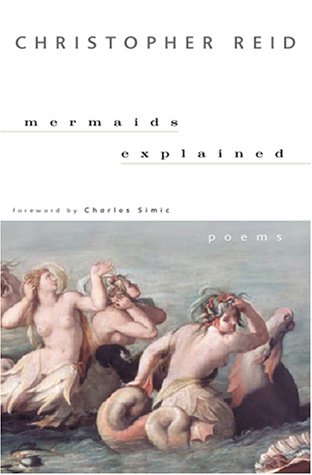
Synopsis
Since 1976, Christopher Reid has been startling and delighting readers of poetry. His philosphic concerns are often expressed in small, domestic details, but, as with the Metaphysical poets he admires, the effect heightens his poetry's seriousness and impact. Reid finds significance in the marginal, the endangered, the apocryphal, and the absurd. His verse, which has earned him both the distinguished Hawthornden and Somerset Maugham Prizes, is subversive and highly intelligent.
The Pultizer Prize-winning poet Charles Simic provides a welcome introduction to one of England's most distinguished and original voices.
The Pultizer Prize-winning poet Charles Simic provides a welcome introduction to one of England's most distinguished and original voices.
"synopsis" may belong to another edition of this title.
About the Author
Former poetry editor at Faber & Faber, Christopher Reid has published five volumes of poetry. He lives in London. Charles Simic, author of, most recently, Jackstraws, is the recepient of many awards and honors for his poetry. He lives in New Hampshire.
Reviews
Known to Britons since the late 1970s, Reid (along with Craig Raine) inaugurated so-called "Martian poetry," which sough outlandish, sometimes comic descriptions of ordinary things and events. Reid then switched gears entirely: the stripped-down, simplified, contemplative work in his 1985 Katerina Brac claimed to translate a (fictive) East Bloc poet. Reid spent much of the 1990s as poetry editor at Faber & Faber, returning to print with restrained and elegiac series of poems. This selected volume is his first in the U.S. and contains poems from all of Reid's phases so far. The "Martian" work includes a jaunt through a zoo, where "Spider monkeys,/ who nurse a dread/ of stopping still, play tag on their trapeze"; a poem about suburbia called "Dark Ages" explains "This is our heraldry of dirt:/ a dog crappant on a lawn vert." The Brac poems can be bathetic in their attempts at moral seriousness "Every day, history takes place,/ even when nothing happens." Yet others are as vivid as their Polish models: "pale-blue butterflies" make up "an army composed entirely of stragglers the gust-driven trash of migration." Later work tries hard to be at once charming and sad successes here include a sequence about domestic love and cancer and a four-page poem in couplets rhymed entirely on "-th" and "-ff" (loth, bath, shelf, Molotov). Reid is above all a reader-friendly poet, one whose undemanding tones and figures will strike readers here as reserved in the best English sense of the word. (Apr.) Forecast: A brief foreword from poet Charles Simic (whose work Reid's can resemble) should help draw fans to this belated State-side debut, and the Faber connection may draw some po-biz attention, but the book's release does not augur a second Martian invasion.
Copyright 2001 Reed Business Information, Inc.
Reid is so easy to like that it is dumbfounding that this is his first U.S. edition. He has published five collections in Britain, from which the esteemed U.S. poet Simic here presents a sterling selection. Simic says Reid is a poet of masks, who seldom speaks as himself. Moreover, Reid's masks are faceted, reminiscent of holograms that present different states of an image as the viewer moves around them. In his most sustained masquerade, his third book, Katerina Brac (1985), the speaker is an Eastern European poet who has moved, for political reasons, it seems, from the city to the country; there she writes rather elegiacally of her nation's folkways, always with a wary eye on the capital. Reading like good translations, the poems are simultaneously parodically amusing and ethically affecting. The masks in earlier poems may cover nonhuman or nonadult faces; halfway through "Our Commune," we grasp that the speaker is an ape. Most recently, the speaker is closer to Reid himself, and the poems' tenor even funnier and more profound. Ray Olson
Copyright © American Library Association. All rights reserved
Excerpt. © Reprinted by permission. All rights reserved.
Black Bananas
Arcadia
In this crayoned dream town,
the chimneys think smoke
and every house is lovingly
Battenburged with windows.
A studious invention:
these strange, ecstatic folk,
who tower above their dwellings
and whose trees are deckled biscuits,
nuggeted with fruit.
As they step among the traffic
that lurches down the road
on its long sum of noughts,
they look like damaged packages,
targets for pin limbs,
and yet they contrive to greet us
with smiles like black bananas.
Copyright ©2001by Christopher Reid
Introduction copyright ©2001by Charles Simic
Published by Harcourt, Inc. All rights reserved.
"About this title" may belong to another edition of this title.
Search results for Mermaids Explained: Poems

Stock Image
Mermaids Explained: Poems
Seller: World of Books (was SecondSale), Montgomery, IL, U.S.A.
Seller rating 5 out of 5 stars

Hardback. Condition: Fair. Seller Inventory # 00106549128
Stock Image
Mermaids Explained: Poems
Seller: World of Books (was SecondSale), Montgomery, IL, U.S.A.
Seller rating 5 out of 5 stars
Hardback. Condition: Very Good. Seller Inventory # 00106390696
Stock Image
Mermaids Explained: Poems
Published by
Houghton Mifflin Harcourt, 2001
ISBN 10: 0151001065
ISBN 13: 9780151001064
Used
Hardcover
Seller: ThriftBooks-Dallas, Dallas, TX, U.S.A.
Seller rating 5 out of 5 stars
Hardcover. Condition: Very Good. No Jacket. Former library book; May have limited writing in cover pages. Pages are unmarked. ~ ThriftBooks: Read More, Spend Less. Seller Inventory # G0151001065I4N10
Stock Image
Mermaids Explained: Poems
Published by
Houghton Mifflin Harcourt, 2001
ISBN 10: 0151001065
ISBN 13: 9780151001064
Used
Hardcover
Seller: Open Books, Chicago, IL, U.S.A.
Seller rating 5 out of 5 stars
hardcover. Condition: Very Good. Open Books is a nonprofit social venture that provides literacy experiences for thousands of readers each year through inspiring programs and creative capitalization of books. Seller Inventory # mon0000844325
Stock Image
Mermaids Explained: Poems
Published by
Houghton Mifflin Harcourt, 2001
ISBN 10: 0151001065
ISBN 13: 9780151001064
Used
Hardcover
Seller: Chaparral Books, Portland, OR, U.S.A.
Seller rating 5 out of 5 stars
Hardcover. Condition: Very Good. Dust Jacket Condition: Very Good. First American Edition. A clean and straight first U.S. printing. Text is unmarked. The dust jacket shows some light handling, in a mylar cover. 129pp. Seller Inventory # JCOSreiMEP
Stock Image
Mermaids Explained, Poems
Published by
Harcourt, Inc, New York, 2001
ISBN 10: 0151001065
ISBN 13: 9780151001064
Used
Hardcover
First Edition
Seller: Fahrenheit's Books, Denver, CO, U.S.A.
Seller rating 5 out of 5 stars
Hardcover. Condition: Very Good+. Dust Jacket Condition: Very Good+. 1st U.S. Edition. First U.S. edition, hardcover, has tiny skew to binding, touch of bowing to boards, and very slight bumps to spine ends and board corners, otherwise a solid, clean VG+ copy in like dust jacket which has very slight bumps to spine ends and upper corners, and light rubbing. Seller Inventory # 96005
Seller Image
Mermaids Explained
Published by
Harcourt, New York, 2001
ISBN 10: 0151001065
ISBN 13: 9780151001064
Used
Hardcover
First Edition
Seller: Between the Covers-Rare Books, Inc. ABAA, Gloucester City, NJ, U.S.A.
Seller rating 5 out of 5 stars
Hardcover. Condition: Fine. Dust Jacket Condition: Near Fine. First edition. Edited and selected with a foreword by Charles Simic. Jacket design by Vaughn Andrews. Fine in near fine dust jacket is not centered on the book causing an uneven crease to flaps. Poetry. Seller Inventory # 404923
Seller Image
Mermaids Explained
Published by
Harcourt, New York, 2001
ISBN 10: 0151001065
ISBN 13: 9780151001064
Used
Hardcover
First Edition
Seller: Between the Covers-Rare Books, Inc. ABAA, Gloucester City, NJ, U.S.A.
Seller rating 5 out of 5 stars
Hardcover. Condition: Fine. Dust Jacket Condition: Fine. First edition. Edited and selected with a foreword by Charles Simic. Jacket design by Vaughn Andrews. Fine in fine dustwrapper. Poetry. Seller Inventory # 404922
Stock Image
Mermaids Explained: Poems
Published by
Houghton Mifflin Harcourt, 2001
ISBN 10: 0151001065
ISBN 13: 9780151001064
New
Hardcover
Seller: BennettBooksLtd, Los Angeles, CA, U.S.A.
Seller rating 5 out of 5 stars
hardcover. Condition: New. In shrink wrap. Looks like an interesting title! Seller Inventory # Q-0151001065