
Items related to Don't Call It Night
Synopsis
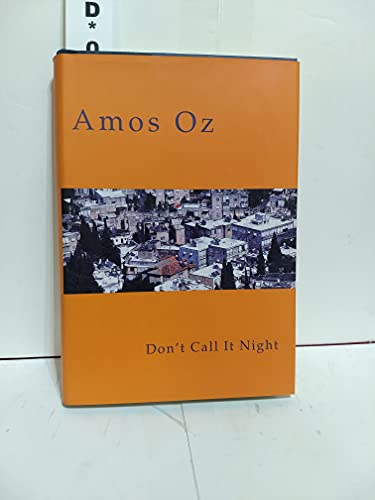
Set in a small Israeli settlement in the desert during the summer of 1989--a town full of eccentric characters--a novel follows the difficult romance between a sixty-year-old engineer and a schoolteacher fifteen years his junior.
"synopsis" may belong to another edition of this title.
Reviews
Few writers have explored the souls of Israelis with the clear, unsentimental vision that Oz brings to both his novels and his nonfiction. His characters, while influenced by political events in a land under constant siege, also exhibit the universal emotions of love, longing, fear and ambition, as well as the tension of ethical dilemmas. This novel, his 10th (after Fima), is set in Tel Kedar, a quiet desert town in the Negev that is both a microcosm of Israeli society and a vividly evoked setting whose atmosphere and residents are palpable. The protagonists, whose voices alternate in narration, are lovers, but their relationship is starting to fray. Theo, a stolid, graying, insomniac civil engineer in his 60s, feels his life has entered a stage in which he will experience "the gradual decline from pain into sadness." He and Noa, a frenetic, idealistic schoolteacher 15 years his junior, seem to live at cross purposes. They share an apartment, but they exist in a shadowy state of contained emotions and mild bickering. After one of Noa's students accidentally falls to his death from a cliff while on drugs (or did he jump?), ensuing events threaten Theo and Noa's relationship. The boy's shady father, a military adviser in Nigeria (or is he an arms dealer?), offers to finance a drug rehabilitation clinic in his son's memory. Noa leads the task force for the project, which Theo, like most of the community, opposes. The subtle tug-of-war between them shakes rational Theo out of his passivity and into a cautious idealism ("when you're not burning to do anything... you start dying") and moves impulsive Noa to a more thoughtful position. Perhaps Oz's intends this as an object lesson for his country. The narrative sometimes has a static quality despite Oz's lyrical prose, but in the end, his story carries thought-provoking implications.
Copyright 1996 Reed Business Information, Inc.
A vividly and affectionately detailed picture of Israeli village life--and of what might be called a JulyOctober relationship--by acclaimed essayist and novelist Oz (Under This Blazing Light, 1995; Fima, 1993, etc.). The story is set in 1989 in the desert town of Tel-Kedar and is concerned primarily with the relationship between its two principal characters: Theo, a reflective and patient 60-year-old engineer (who was one of the builders of Tel-Kedar), and his more volatile counterpart and lover, 40ish Noa, a busy teacher of literature who also burns up energy with countless community obligations (``It is . . . my ambition to serve the Good . . . not with gushing emotion but with supreme precision''). The novel begins with a superabundance of plot, as the death (perhaps by drug overdose) of one of Noa's students brings to the village the late boy's father, a ``military adviser'' long stationed elsewhere whose neglect of his son motivates him to bankroll a drug-rehabilitation center for young people--a project that Noa is enlisted to head. Her reluctant efforts draw in the amused Theo, involve the unwise purchase of a ``derelict building,'' and necessitate the couple's continuing involvement with a colorfully portrayed bevy of townspeople, most notably the canny woman mayor Batsheva Dinur and local businessman and hustler Muki Peleg (a ``middle-aged lamb . . . trying hard to be a wolf''). Oz handles this pattern of events adroitly, but it pales by contrast with the novel's far richer revelations--in Theo's and Noa's alternating narratives as well as in occasional omniscient chapters, set both now and in flashback, about the unconventional hero and heroine's past history and present amorous d‚tente. Imagine an easygoing Othello matched with a somewhat younger Cleopatra, each gifted with the quicksilver wit of Beatrice and Benedick, and you'll have some sense of the gently mocking, life-affirming energy that suffuses their union. A perfectly pitched comedy, expertly translated, and one of Oz's most attractive and accomplished books. -- Copyright ©1996, Kirkus Associates, LP. All rights reserved.
Aging civil engineer Theo and his younger lover, No'a, who teaches school, have wound up in the stark little town of Tel-Kedar, which seems to be at the ends of the earth. Theo is stolid, proficient, and resigned; dynamic and flighty No'a is his opposite; and their relationship is beginning to wear thin. Then one of No'a's student's dies, apparently of a drug overdose, and the bereaved father comes to Tel-Kedar to establish a drug rehabilitation clinic, putting No'a in charge. Shifting his narrative between the two lovers in a stream-of-consciousness style that seems personal and introspective, as if these characters were talking to themselves, noted Israeli novelist Oz examines the impact of No'a's new job on the lovers while tracing their separate histories. The clinic never gets built, but the relationship endures, perhaps renewed, perhaps not. A lesser writer might have used these events to engineer a momentous change in the lives of his characters, but Oz's brilliance here is to acknowledge that in real life such changes rarely occur. Instead, life ticks on, subtly, slowly, and by novel's end we feel as dusty and obdurate as the desert surrounding Tel-Kedar. For most collections.
-?Barbara Hoffert, "Library Journal"
Copyright 1996 Reed Business Information, Inc.
Subtlety, both in form and content, defines this quiet yet penetrating short novel from Israel's best-known writer. Set in Tel-Kedar, an Israeli settlement in the Negev Desert, the story concerns a slowly disintegrating relationship, distance gradually displacing intimacy just as the desert inexorably threatens to reclaim the forlorn little town. Teo, a 60-year-old engineer, has recently returned to Israel from Latin America at the whim of his lover, the much-younger No'a, a teacher. Their relationship, begun in Venezuela, startled both of them with its intensity, the limitless connection that broke down all of the self's defenses. Yet, now, limits have reasserted themselves, and the lovers tread warily, "like touching glass with glass and drawing back just in time." When one of No'a's pupils dies of a drug overdose, the townsfolk argue over a fitting memorial, and Teo and No'a are drawn into the turmoil. Skillfully alternating point of view between his two main characters, Oz shows us the painful process by which a couple uncouples, one sinew at a time. And yet, hope is never quite extinguished: Is tenderness alone enough to withstand the desert's arid wind? Bill Ott
"About this title" may belong to another edition of this title.
Search results for Don't Call It Night

Stock Image
Don't Call It Night
Seller: World of Books (was SecondSale), Montgomery, IL, U.S.A.
Seller rating 5 out of 5 stars

Condition: Very Good. Item in very good condition! Textbooks may not include supplemental items i.e. CDs, access codes etc. Seller Inventory # 00094966383
Stock Image
Don't Call It Night
Seller: World of Books (was SecondSale), Montgomery, IL, U.S.A.
Seller rating 5 out of 5 stars
Condition: Good. Item in good condition. Textbooks may not include supplemental items i.e. CDs, access codes etc. Seller Inventory # 00085666240
Stock Image
Don't Call It Night
Seller: More Than Words, Waltham, MA, U.S.A.
Seller rating 5 out of 5 stars
Condition: Good. A sound copy with only light wear. Overall a solid copy at a great price! Seller Inventory # BOS-I-11h-01796
Stock Image
Don't Call It Night
Seller: ThriftBooks-Atlanta, AUSTELL, GA, U.S.A.
Seller rating 5 out of 5 stars
Hardcover. Condition: Good. No Jacket. Former library book; Pages can have notes/highlighting. Spine may show signs of wear. ~ ThriftBooks: Read More, Spend Less. Seller Inventory # G0151001529I3N10
Stock Image
Don't Call It Night
Seller: Wonder Book, Frederick, MD, U.S.A.
Seller rating 5 out of 5 stars
Condition: Good. Good condition. Very Good dust jacket. A copy that has been read but remains intact. May contain markings such as bookplates, stamps, limited notes and highlighting, or a few light stains. Seller Inventory # N02B-04355
Stock Image
Don't Call It Night
Published by
Harcourt Trade Publishers, 1996
ISBN 10: 0151001529
ISBN 13: 9780151001521
Used
Hardcover
First Edition
Seller: Better World Books, Mishawaka, IN, U.S.A.
Seller rating 5 out of 5 stars
Condition: Very Good. First Edition. Former library copy. Pages intact with possible writing/highlighting. Binding strong with minor wear. Dust jackets/supplements may not be included. Includes library markings. Stock photo provided. Product includes identifying sticker. Better World Books: Buy Books. Do Good. Seller Inventory # 3130439-75
Stock Image
Don't Call It Night
Published by
Harcourt Trade Publishers, 1996
ISBN 10: 0151001529
ISBN 13: 9780151001521
Used
Hardcover
First Edition
Seller: Better World Books, Mishawaka, IN, U.S.A.
Seller rating 5 out of 5 stars
Condition: Good. First Edition. Former library copy. Pages intact with minimal writing/highlighting. The binding may be loose and creased. Dust jackets/supplements are not included. Includes library markings. Stock photo provided. Product includes identifying sticker. Better World Books: Buy Books. Do Good. Seller Inventory # GRP102123371
Stock Image
Don't Call It Night
Published by
Harcourt Brace & Company, New York, New York, USA, 1996
ISBN 10: 0151001529
ISBN 13: 9780151001521
Used
Hardcover
Seller: Bookmarc's, La Porte, TX, U.S.A.
Seller rating 5 out of 5 stars
Hard Cover. Condition: Good. Dust Jacket Condition: Good. CC6 - A hard cover first American edition withdrawn ex-library book in very good- condition. A tight, clean, sound copy with very minor overall shelf wear plus the dust jacket endflaps are glued to the inside surfaces of the boards plus there are the usual library stamps and label on the top outside paper edges, front endpaper, and title page. The dust jacket shows no visible signs of wear plus there is a library label on the back plus the endflaps are glued to the inside surfaces of the boards plus it is still in the original library mylar sleeve. Translated from the Hebrew by Nicholas de Lange. Size: 5.75"x8.5". Ex-Library. Seller Inventory # SCW07899
Stock Image
Don't Call It Night
Seller: Richard's Books, Boise, ID, U.S.A.
Seller rating 5 out of 5 stars
Hardcover. Condition: Good. DJ HAS LIGHT CREASING WITH LIGHT EDGE AND SHELF WEAR. BLUE COVER HAS VERY LIGHT EDGE AND SHELF WEAR. 199 PAGE TEXT HAS VERY LIGHT WEAR. FICTION. WE USE BUBBLE MAILERS. Seller Inventory # 013169
Stock Image
Don't Call It Night
Seller: HPB-Ruby, Dallas, TX, U.S.A.
Seller rating 5 out of 5 stars
hardcover. Condition: Very Good. Connecting readers with great books since 1972! Used books may not include companion materials, and may have some shelf wear or limited writing. We ship orders daily and Customer Service is our top priority! Seller Inventory # S_415498855