
Items related to At End of Day: A Novel
Synopsis
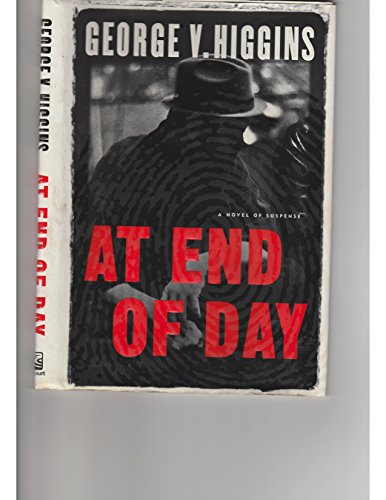
For thirty years, Arthur McKeach and Nick Cistaro have masterminded a criminal empire in the Boston area, eluding capture at every turn, but now their secret is about to be revealed. 35,000 first printing.
"synopsis" may belong to another edition of this title.
About the Author
George V. Higgins is the author of more than twenty novels, most notably The Friends of Eddie Coyle. At End of Day is his last novel completed just prior to his death in 1999.
Reviews
At the time of his death last November, acclaimed crime novelist Higgins had published 29 books, beginning with The Friends of Eddie Coyle in 1972. His 30th and last offers another of his beautifully rendered wanderings through the underworld of south Boston. Much of the story drills into the domain of two gangsters, Nick Cistaro and Arthur McKeath, and their unusual relationship with the city's top FBI men, tough veteran Jack Farrier and bumbling sycophant Darren Stoat. Both sides meet regularly for a civilized dinner, slipping each other just enough information so they can succeed at their respective pursuits. The genius of the narration, however, lies in the (at first) seemingly aimless side roadsAcharacter sketches, back stories, long dialogue digressionsAthat Higgins takes just when it looks like a central plot is forming. There's the crippled Vietnam vet who's scheming to cheat pharmacies out of painkillers usually reserved for bone cancer sufferers; the antiques dealer who treats his loan sharks dismissivelyAuntil they break his teeth; the cop's son entering the police academy who's not ready to give up his sideline as a mob gofer; the FBI agent whose wife's inept stock-market plays are driving them into bankruptcy. By novel's end, Higgins pulls enough of the plotcords together to fashion an intricate, tantalizing t knot. All of his signature touches are present, yet the book has a grittier feel than much of his recent work (The Agent; Swan Boats at Four). The themes are broader, the behavior coarser and the coziness between cops and crooks oilier. And it's all wrapped in a dark brand of humor that a guy like Eddie Coyle would appreciate. (May)
Copyright 2000 Reed Business Information, Inc.
Remembering George Higgins
When the advance galleys of George V. Higgins' novel At End of Day were going to press, Higgins died suddenly, ending a remarkable career that spanned 30 books and nearly 30 years. The Friends of Eddie Coyle, his superb first novel, appeared in 1971 and was an immediate hit with reviewers, nearly all of whom recognized that a special talent had arrived on the crime-fiction scene. In the opening paragraph of that debut novel, a gun dealer named Jackie Brown says the words, "I can get your pieces probably by tomorrow night." That sentence, unremarkable on the surface, deserves a place in literary history as the first line of dialogue in the first novel of a man who would become one of the finest creators of dialogue in the twentieth century.
As his crime novels rolled by over the years, Higgins' ability to write dialogue became celebrated almost to the point of cliche. But if praising Higgins' knack for putting talk on the page became a knee-jerk reaction, the talk itself never lost its vitality. Nor did it lose its uniqueness. Other masters of dialogue (Elmore Leonard comes to mind) excel at repartee--snappy, staccato exchanges between characters engaged in dramatic action. Higgins, on the other hand, typically wrote not so much dialogue as a series of monologues, characters rambling on discursively, revealing as much about themselves as about the events they describe. His books move in sweeping, slowly inclining curves, like a highway gradually winding its way up a mountain, moving in one direction without ever seeming to point there. Gleaning information from Higgins' speakers--whether it's the criminal lowlifes in Eddie Coyle, the small-time lawyers in the Jerry Kennedy novels, or the Boston politicians in A Change of Gravity (1997)--is like gleaning information in life: you piece it together slowly, often learning more from the tangents a speaker follows than from any direct answers he or she might give.
Unlike other crime-fiction innovators, Higgins did not transform the genre. Why? Because no one else has ever been able to do what he did: tell a story not through action in the present but almost entirely through backstory, characters commenting on what happened in the past. Higgins is one of the few successful crime novelists who rarely describes a crime as it is occurring, although (as if to show he could do it if he wanted to) his last novel includes a vivid, chillingly precise description of a real-time killing. Usually, however, we hear only postmortem discussion, reminding us again and again that events are less important than how we react to them.
ttempting to copy this technique is a surefire method for accumulating publishers' rejection slips. Among mystery writers, only Higgins could make it work consistently, and it's satisfying to discover that he did it as well in his last novel as in his first. In At End of Day, he returns to the Boston criminal underworld that has served him so well throughout his career. The novel tells the story of the undoing of a Boston mobster, Arthur McKeon, but much of what we learn about McKeon and his top henchman, Nick Cistaro, we hear at dinner parties--gatherings at which the two underworld figures break bread with two FBI agents. This unholy alliance is at the heart of Higgins' tale: Is it corruption to attempt to contain the Mafia by protecting their rivals or is it creative policing? Higgins doesn't give us an answer, of course, but he makes the question a human one by showing us how mobsters and FBI agents think and how similar they are to one another.
Higgins has always been a writer who respected work well done--a low-rent lawyer digging into a case, a car thief plying his trade shrewdly, a mobster outthinking his rivals. There is a moral dimension to his work, too, but it grows out of the details and the interactions between people, and it is never a conventional view. At the end of his too-few days, Higgins should be remembered not only for talking his special talk but also for the way he used that talk to create context--rich, ambiguous, full-bodied context. Bill Ott
This book is aptly named; ironically, Higgins (The Friends of Eddie Coyle) died after completing it in fall 1999. Higgins's forte has always been dialog that begs to be read aloud, and his 30th work is no different, so it's not a quick or easy read. The cops talk among themselves; the crooks talk among themselves; and the cops and the crooks talk to one another. The plot is simple, presenting a slice of life on both sides of the law in the Boston area: while the FBI taps the phones of gangland figures, a brilliant scam to fleece pharmacies of drugs is played out. At the center are two colorful mobsters who have eluded arrest for 30 years. The resolution of these and other strands constitutes the novel. This is not a book to start with but should follow other Higgins books on your shelves. Recommended for all public libraries.
---Fred M. Gervat, Concordia Coll. Lib., Bronxville, NY
Copyright 2000 Reed Business Information, Inc.
"About this title" may belong to another edition of this title.
Search results for At End of Day: A Novel

Stock Image
At End of Day: A Novel
Seller: World of Books (was SecondSale), Montgomery, IL, U.S.A.
Seller rating 5 out of 5 stars

Condition: Good. Good condition ex-library book with usual library markings and stickers. Seller Inventory # 00095498442
Seller Image
At End of Day: A Novel
Seller: Used Book Company, Egg Harbor Township, NJ, U.S.A.
Seller rating 5 out of 5 stars
Condition: Good. Shows moderate signs of wear and previous use. Can include notes/highlighting. A portion of your purchase benefits nonprofits! - Note: Edition & format may differ from what is shown in stock photo & item details. May not include supplementary material (toys, access code, dvds, etc). Seller Inventory # 584R0H000EZC_ns
Seller Image
At End of Day: A Novel
Seller: Used Book Company, Egg Harbor Township, NJ, U.S.A.
Seller rating 5 out of 5 stars
Condition: Very Good. Former library copy. Shows minimal signs of wear and previous use. Can include minimal notes/highlighting. A portion of your purchase benefits nonprofits! - Note: Edition & format may differ from what is shown in stock photo & item details. May not include supplementary material (toys, access code, dvds, etc). Seller Inventory # 584ZSU000L2E_ns
Stock Image
At End of Day: A Novel
Seller: BooksRun, Philadelphia, PA, U.S.A.
Seller rating 5 out of 5 stars
Hardcover. Condition: Very Good. With dust jacket. It's a well-cared-for item that has seen limited use. The item may show minor signs of wear. All the text is legible, with all pages included. It may have slight markings and/or highlighting. Seller Inventory # 0151003580-11-1-29
Stock Image
At End of Day
Seller: World of Books Inc, Montgomery, IL, U.S.A.
Seller rating 4 out of 5 stars

Hardback. Condition: Good. Seller Inventory # CIN0151003580G
Stock Image
At End of Day: A Novel
Seller: ThriftBooks-Dallas, Dallas, TX, U.S.A.
Seller rating 5 out of 5 stars
Hardcover. Condition: Very Good. No Jacket. May have limited writing in cover pages. Pages are unmarked. ~ ThriftBooks: Read More, Spend Less. Seller Inventory # G0151003580I4N00
Stock Image
At End of Day: A Novel
Seller: ThriftBooks-Dallas, Dallas, TX, U.S.A.
Seller rating 5 out of 5 stars
Hardcover. Condition: Very Good. No Jacket. Former library book; May have limited writing in cover pages. Pages are unmarked. ~ ThriftBooks: Read More, Spend Less. Seller Inventory # G0151003580I4N10
Stock Image
At End of Day: A Novel
Seller: ThriftBooks-Atlanta, AUSTELL, GA, U.S.A.
Seller rating 5 out of 5 stars
Hardcover. Condition: Very Good. No Jacket. Former library book; May have limited writing in cover pages. Pages are unmarked. ~ ThriftBooks: Read More, Spend Less. Seller Inventory # G0151003580I4N10
Stock Image
At End of Day
Seller: Wonder Book, Frederick, MD, U.S.A.
Seller rating 5 out of 5 stars
Condition: Very Good. Very Good condition. Good dust jacket. A copy that may have a few cosmetic defects. May also contain light spine creasing or a few markings such as an owner's name, short gifter's inscription or light stamp. Seller Inventory # I09A-03453
Stock Image
At End of Day
Published by
Houghton Mifflin Harcourt Publishing Company, 2000
ISBN 10: 0151003580
ISBN 13: 9780151003587
Used
Hardcover
Seller: Better World Books, Mishawaka, IN, U.S.A.
Seller rating 5 out of 5 stars
Condition: Very Good. First Edition, First Printing. Former library copy. Pages intact with possible writing/highlighting. Binding strong with minor wear. Dust jackets/supplements may not be included. Includes library markings. Stock photo provided. Product includes identifying sticker. Better World Books: Buy Books. Do Good. Seller Inventory # GRP89149177