
Items related to Probability 1: Why There Must Be Intelligent Life in...
Synopsis
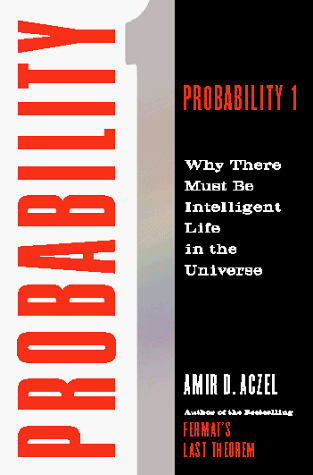
The best-selling author of Fermat's Last Theorem integrates probability theory with the latest scientific findings from the Hubble telescope and the Mars missions to argue for the existence of intelligent life beyond Earth. 50,000 first printing. $50,000 ad/promo. Tour.
"synopsis" may belong to another edition of this title.
About the Author
Amir D. Aczel, Ph.D. grew up on a ship and was navigating straits in the Mediterranean long before he could drive a car. The author of Fermat's Last Theorem, God's Equation, The Mystery of the Aleph, and Probability 1, he lives with his wife and daughter in the Boston area and teaches at Bentley College.
Reviews
Probability 1, meaning a certainty that the thing will happen, is what mathematician and probability theorist Aczel assigns to the discovery of intelligent life elsewhere in the universe. The idea is very old; Aczel quotes Epicurus (341-270 B.C.) as saying there are many worlds, all with "living creatures and plants and other things we see in this world." Recent discoveries of planets orbiting stars other than the sun increase the odds. Astronomer Frank D. Drake, long involved with the search for extraterrestrial intelligence, has formulated an equation: N = N* fp ne fl fi fc L, where N stands for the number of civilizations in our galaxy capable of communicating with other civilizations. N* is the number of stars in the galaxy (billions in the Milky Way), fp the percentage of stars with planets (debatable but high), ne the number of planets with environments favorable to life (roughly 10 percent), fl the fraction of planets with life (guesswork but perhaps with a probability of 0.1 or 0.2), fi the proportion of those planets on which intelligent life has evolved (again guesswork, with probabilities ranging from 0.1 to 0.5), fc the fraction of planets able to communicate with other civilizations by radio or some other means (inestimable until Earth receives such a communication), and L for the longevity of the civilization. Drake believes that N may be as high as 10,332; the late Carl Sagan put it at about a million. Aczel's quest is for intelligent life anywhere else in the universe, not just in our galaxy. Here he is dealing with almost incomprehensibly big numbers. "Our galaxy has about 300 billion stars (although some estimates are lower), and let's assume there are 100 billion galaxies in the universe." Hence, even though the probability of life around any one star is extremely small, the compound probability with such vast numbers of stars to consider rises to 1.
Life on other worlds, long a staple of sci-fi thrillers, is now the stuff of serious science. Aczel (Fermat's Last Theorem, 1996) brings a statistician's tools to bear on the evidence. Enrico Fermi once asked, ``Why, if there is intelligent life elsewhere, haven't they contacted us?'' One response to this paradox is Frank Drake's equation for the number of civilizations that might exist capable of communicating with other civilizations. For in a universe billions of years old, nearly infinite in extent, it - s inconceivable that our world is the only one to be inhabited. And yet, flying-saucer cultists aside, there is no credible evidence of Earth's being visited by aliens. (One likely reason for this lies in the daunting distance between stars, which makes expeditions beyond a race's home system too expensive for even a very advanced civilization to undertake.) Most of the other evidence argues that there are planets around other stars, where the chemical reactions necessary for life (notably, the spontaneous formation of DNA) can take place. We also have evidence (in the form of Martian meteorites) that the spread of these chemicals from one world to another is moderately commonplace. Aczel stops to consider the central philosophical question raised by Einstein and the quantum theorists (i.e., whether the universe is random or deterministic); he clears up a few misconceptions about probability before applying probability theory to an assessment of the value of Drake's equation. His conclusion, that at least one planet besides Earth almost certainly bears life, will seem inevitable to anyone who has followed his arguments. Lively writing and the ability to work scientific history smoothly into the narrative make this a very useful addition to the growing body of work on a fascinating subject. (Author tour) -- Copyright ©1998, Kirkus Associates, LP. All rights reserved.
A top science author (e.g., Fermat's Last Theorum, LJ 10/15/96) looks at the evidence for life beyond Earth.
Copyright 1998 Reed Business Information, Inc.
Excerpt. © Reprinted by permission. All rights reserved.
Preface
ON THE EVENING OF February 26, 1998, I was standing on a beach in Aruba with a group of astronomers. Earlier that afternoon, between 2:11 and 2:14 P.M., we had watched the day turn into night as a total solar eclipse passed over the island. We were all still excited from the awesome event we had witnessed only a few hours earlier, and we were now looking at stars and galaxies and a nebula that remained in the sky from a giant supernova explosion witnessed by the Chinese a thousand years ago. As we were talking animatedly about these mysterious objects of the night sky, standing around the large telescope, some of the vacationers at the resort-who had not come here to witness an eclipse or view the stars-came over out of curiosity. After a few moments, one of them moved closer to the telescope and asked Daryl, the astronomer, if she could look through it. He was thrilled to comply and offered to show her and her companion a double star system or a nebula or a beautiful cluster of fifty brilliant red and blue stars called the Jewel Box. "No, no," she said, waving her hand and smiling. "Could you maybe show us some planets... with life on them?"
I walked away down the sand. The quest for life outside Earth seemed more intense now as we approach the third millennium. The woman's wish to see planets with life only served to emphasize this point, which has been made in newspapers and science magazines and television-not to mention announcements from NASA about the findings from the Galileo spacecraft, which may have detected evidence for liquid water under the ice cover of Jupiter's moon Europa. Could we finally be on the verge of discovering extraterrestrial life? All this speculation was very exciting for me. I had just finished the manuscript of a book about the probability that life exists on some distant planet in orbit around a star not too different from the Sun-our own star, whose magnificence I now appreciated more than ever, having seen it disappear as by magic behind the Moon and reappear on the other side. Now standing under the bright winter stars, I was thinking about how this adventure started for me.
Just before Labor Day in 1997, I called Jane Isay, executive editor at Harcourt Brace in New York, to ask her if she would be interested in publishing my next book. I had lots of ideas, but Jane liked none of them. So we talked about many other subjects: mathematics and science and probability. And then Jane asked: "How would you like to write a book about the probability of life in outer space?" and she proceeded to tell me how Carl Sagan had wanted to write a book about this topic but for some reason it never materialized, and he passed away. "These are big shoes to step into," I remember saying. "Just try," she answered. I was intrigued.
For a long time, researching this book, I was skeptical. And as I considered the science involved: chemistry and DNA and biology and geology and physics and astronomy, the prospects did not look any more promising.
Then, almost at the last minute, I turned my attention to probability theory. And here, something happened that surprised me. Probability is not an intuitive area. Often, people think they have an answer, but mathematically it does not hold, and something else proves to be true. Mathematics is the key to probability theory, and the math always wins-sometimes despite our intuition. And the mathematics and probability theory always pointed in one direction: the probability of life in outer space is one, just as Carl Sagan had believed. This book will take you through my journey of discovery leading to this conclusion.
"About this title" may belong to another edition of this title.
Search results for Probability 1: Why There Must Be Intelligent Life in...

Stock Image
Probability 1
Seller: World of Books (was SecondSale), Montgomery, IL, U.S.A.
Seller rating 5 out of 5 stars

Hardback. Condition: Good. For thousands of years, it was the visionaries and writers who argued that we cannot be alone-that there is intellegent life in the universe. Now, with the discoveries of the Hubble Telescope, data emerging from Mars, and knowledge about life at the extremes, scientists are taking up where they left off. Amir Aczel, author of Fermat's Last Theorem, pulls together everyting science has discovered, and mixes in proabability theory, to argure the case for the existence of intelligent life beyond this planet. Probability 1 is an extraordinary tour de force in which the author draws on cosmology, math, and biology to tell the rollicking good story of scientists tackling important scientific questions that help answer this fundamental question. What is the probability of intelligent life in the universe? Read this book, and you'll be convinced, by the power of the argument and the excitement of the science. Seller Inventory # 00108294077
Stock Image
Probability 1
Seller: World of Books (was SecondSale), Montgomery, IL, U.S.A.
Seller rating 5 out of 5 stars
Hardback. Condition: Very Good. For thousands of years, it was the visionaries and writers who argued that we cannot be alone-that there is intellegent life in the universe. Now, with the discoveries of the Hubble Telescope, data emerging from Mars, and knowledge about life at the extremes, scientists are taking up where they left off. Amir Aczel, author of Fermat's Last Theorem, pulls together everyting science has discovered, and mixes in proabability theory, to argure the case for the existence of intelligent life beyond this planet. Probability 1 is an extraordinary tour de force in which the author draws on cosmology, math, and biology to tell the rollicking good story of scientists tackling important scientific questions that help answer this fundamental question. What is the probability of intelligent life in the universe? Read this book, and you'll be convinced, by the power of the argument and the excitement of the science. Seller Inventory # 00107714449
Stock Image
Probability 1: Why There Must Be Intelligent Life in the Universe
Published by
Houghton Mifflin Harcourt (edition First Edition), 1998
ISBN 10: 0151003769
ISBN 13: 9780151003761
Used
Hardcover
First Edition
Seller: BooksRun, Philadelphia, PA, U.S.A.
Seller rating 5 out of 5 stars
Hardcover. Condition: Very Good. First Edition. With dust jacket. It's a well-cared-for item that has seen limited use. The item may show minor signs of wear. All the text is legible, with all pages included. It may have slight markings and/or highlighting. Seller Inventory # 0151003769-11-1-29
Stock Image
Probability 1: Why There Must Be Intelligent Life in the Universe
Published by
Houghton Mifflin Harcourt, 1998
ISBN 10: 0151003769
ISBN 13: 9780151003761
Used
Hardcover
Seller: Half Price Books Inc., Dallas, TX, U.S.A.
Seller rating 5 out of 5 stars
hardcover. Condition: Very Good. Connecting readers with great books since 1972! Used books may not include companion materials, and may have some shelf wear or limited writing. We ship orders daily and Customer Service is our top priority! Seller Inventory # S_474500419
Stock Image
Probability 1: Why There Must Be Intelligent Life in the Universe
Published by
Houghton Mifflin Harcourt, 1998
ISBN 10: 0151003769
ISBN 13: 9780151003761
Used
Hardcover
Seller: HPB-Diamond, Dallas, TX, U.S.A.
Seller rating 5 out of 5 stars
hardcover. Condition: Very Good. Connecting readers with great books since 1972! Used books may not include companion materials, and may have some shelf wear or limited writing. We ship orders daily and Customer Service is our top priority! Seller Inventory # S_478953459
Stock Image
Probability 1: Why There Must Be Intelligent Life in the Universe
Published by
Houghton Mifflin Harcourt, 1998
ISBN 10: 0151003769
ISBN 13: 9780151003761
Used
Hardcover
Seller: ThriftBooks-Dallas, Dallas, TX, U.S.A.
Seller rating 5 out of 5 stars
Hardcover. Condition: Very Good. No Jacket. Missing dust jacket; May have limited writing in cover pages. Pages are unmarked. ~ ThriftBooks: Read More, Spend Less. Seller Inventory # G0151003769I4N01
Stock Image
Probability 1: Why There Must Be Intelligent Life in the Universe
Published by
Houghton Mifflin Harcourt, 1998
ISBN 10: 0151003769
ISBN 13: 9780151003761
Used
Hardcover
Seller: ThriftBooks-Dallas, Dallas, TX, U.S.A.
Seller rating 5 out of 5 stars
Hardcover. Condition: Very Good. No Jacket. May have limited writing in cover pages. Pages are unmarked. ~ ThriftBooks: Read More, Spend Less. Seller Inventory # G0151003769I4N00
Stock Image
Probability 1: Why There Must Be Intelligent Life in the Universe
Published by
Houghton Mifflin Harcourt, 1998
ISBN 10: 0151003769
ISBN 13: 9780151003761
Used
Hardcover
Seller: ThriftBooks-Atlanta, AUSTELL, GA, U.S.A.
Seller rating 5 out of 5 stars
Hardcover. Condition: Very Good. No Jacket. Former library book; May have limited writing in cover pages. Pages are unmarked. ~ ThriftBooks: Read More, Spend Less. Seller Inventory # G0151003769I4N10
Stock Image
Probability 1 : Why There Must Be Intelligent Life in the Universe
Published by
Houghton Mifflin Harcourt Publishing Company, 1998
ISBN 10: 0151003769
ISBN 13: 9780151003761
Used
Hardcover
Seller: Better World Books, Mishawaka, IN, U.S.A.
Seller rating 5 out of 5 stars
Condition: Good. Former library copy. Pages intact with minimal writing/highlighting. The binding may be loose and creased. Dust jackets/supplements are not included. Includes library markings. Stock photo provided. Product includes identifying sticker. Better World Books: Buy Books. Do Good. Seller Inventory # 3130613-6
Stock Image
Probability 1: Why There Must Be Intelligent Life in the Universe
Published by
Houghton Mifflin Harcourt, 1998
ISBN 10: 0151003769
ISBN 13: 9780151003761
Used
Hardcover
Seller: HPB-Ruby, Dallas, TX, U.S.A.
Seller rating 5 out of 5 stars
hardcover. Condition: Very Good. Connecting readers with great books since 1972! Used books may not include companion materials, and may have some shelf wear or limited writing. We ship orders daily and Customer Service is our top priority! Seller Inventory # S_485045052