
Items related to Half Empty, Half Full: The Psychological Roots of Optimism
Synopsis
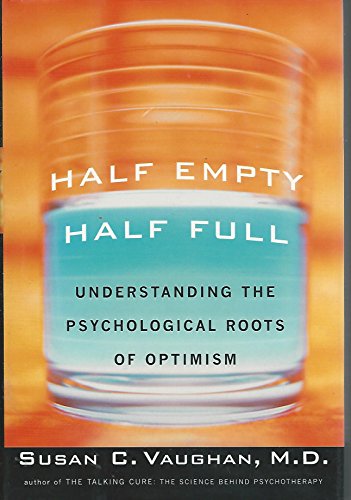
The author, a renowned research psychoanalyst, challenges the idea that optimism is genetic, arguing instead that experiences in the first three years of life often shape the neural pathways in the brain.
"synopsis" may belong to another edition of this title.
About the Author
Susan C. Vaughan, M.D., is assistant professor of psychiatry at the Columbia University College of Physicians and Surgeons. A graduate of Harvard and Columbia University, she is the recipient of numerous research awards and the author of The Talking Cure. Dr. Vaughan also writes frequently for Harper's Bazaar. She lives in Manhattan.
Reviews
In this account of the development and treatment of pessimism, Vaughan (The Talking Cure; Viagra) contends that a pessimistic personality results from an individual's earliest experiences of frustration. These lead to the formation of cortical loops in the brain that encode the physiological basis for the expectation of disappointment and an overall negative outlook. Although temperamental traits are often viewed as intractable, Vaughan argues that psychotherapy aimed at promoting a sense of self-control over negative emotional states "can gradually chip away at long ingrained cortical patterns and gradually replace pessimism with optimism." But what is pessimism? Is it a truly unique form of psychopathology? By linking pessimism to original parent-child interactions, Vaughan implicitly ties it to "basic mistrust" or an "insecure attachment." However, Vaughan does not explain how "pessimism" differs from the depression and anger that have traditionally been associated with early experiences of frustration. This lack of rigor is accentuated by prose in which such stock phrases as "the ties that bind" or "pushing the envelope" stand for concrete descriptions of the problem of affective disorder and its treatment. Written for a general audience, this book lacks the conceptual clarity necessary for understanding psychological despair.
Copyright 2000 Reed Business Information, Inc.
According to Vaughan (psychiatry, Columbia; The Talking Cure), optimism is not an innate personality trait--one's ability to modify emotions and moods determines it. Early childhood experiences shape neural circuits in the brain, forming the basis for mood modulation in later life. Reviewing current research in psychology and neurology, Vaughan demonstrates that it is possible to change the impact of these early experiences, reshape brain circuitry, and develop an "illusion of control" over negative feelings and internal states. As an example of such self-mastery, Vaughan cites the late Jean- Dominique Bauby (The Diving Bell and the Butterfly), who suffered a severe stroke that paralyzed his body but left his mind undamaged. Although Bauby could only communicate by blinking his left eye, he refused to succumb to self-pity and depression and remained optimistic. Vaughan writes in a clear, though repetitive, style. Recommended for popular psychology collections.
-Lucille M. Boone, San Jose P.L., CA
Copyright 2000 Reed Business Information, Inc.
With so many recent books on depression, it is refreshing to see one on optimism. Psychiatrist Vaughan believes that "optimism is the result of an internal process of illusion building," not inflexible biology. Individuals can learn how to look at life and problems in an optimistic manner, and this skill can help them in their approaches to relationships, themselves, work, etc. Parents can play major roles in teaching children to be resilient and forge positive and workable, not Pollyannaish, attitudes. It isn't so much a matter of what one thinks about as of how one thinks about it. Vaughan draws widely on her patients' stories to demonstrate how creating and using optimism can help one overcome many difficulties. She often makes her points strikingly, as when she proposes imagining the Empire State Building enshrouded in fog and asks whether it means the tower is no longer there and whether the right way of thinking about it can restore it. With its presentation of both theory and practice, Vaughan's guide should help many readers. William Beatty
Copyright © American Library Association. All rights reserved
"About this title" may belong to another edition of this title.
Search results for Half Empty, Half Full: The Psychological Roots of Optimism

Stock Image
Half Empty, Half Full: How to Take Control and Live Life as an Optimist
Published by
Harcourt Brace International, 2000
ISBN 10: 0151004013
ISBN 13: 9780151004010
Used
Hardcover
Seller: World of Books (was SecondSale), Montgomery, IL, U.S.A.
Seller rating 5 out of 5 stars

Hardback. Condition: Good. Seller Inventory # 00074383545
Stock Image
Half Empty, Half Full: How to Take Control and Live Life as an Optimist
Published by
Harcourt Brace International, 2000
ISBN 10: 0151004013
ISBN 13: 9780151004010
Used
Hardcover
Seller: World of Books Inc, Montgomery, IL, U.S.A.
Seller rating 4 out of 5 stars

Hardback. Condition: Good. Seller Inventory # CIN0151004013G
Stock Image
Half Empty, Half Full: The Psychological Roots of Optimism
Published by
Houghton Mifflin Harcourt (edition 1), 2000
ISBN 10: 0151004013
ISBN 13: 9780151004010
Used
Hardcover
Seller: BooksRun, Philadelphia, PA, U.S.A.
Seller rating 5 out of 5 stars
Hardcover. Condition: Very Good. 1. It's a well-cared-for item that has seen limited use. The item may show minor signs of wear. All the text is legible, with all pages included. It may have slight markings and/or highlighting. Seller Inventory # 0151004013-11-1
Stock Image
Half Empty, Half Full: The Psychological Roots of Optimism
Published by
Houghton Mifflin Harcourt, 2000
ISBN 10: 0151004013
ISBN 13: 9780151004010
Used
Hardcover
Seller: Basement Seller 101, Cincinnati, OH, U.S.A.
Seller rating 5 out of 5 stars
hardcover. Condition: Good. Seller Inventory # 230519040
Stock Image
Half Empty, Half Full: The Psychological Roots of Optimism
Published by
Houghton Mifflin Harcourt, 2000
ISBN 10: 0151004013
ISBN 13: 9780151004010
Used
Hardcover
Seller: ThriftBooks-Dallas, Dallas, TX, U.S.A.
Seller rating 5 out of 5 stars
Hardcover. Condition: Good. No Jacket. Missing dust jacket; Pages can have notes/highlighting. Spine may show signs of wear. ~ ThriftBooks: Read More, Spend Less. Seller Inventory # G0151004013I3N01
Stock Image
Half Empty, Half Full: The Psychological Roots of Optimism
Published by
Houghton Mifflin Harcourt, 2000
ISBN 10: 0151004013
ISBN 13: 9780151004010
Used
Hardcover
Seller: Wonder Book, Frederick, MD, U.S.A.
Seller rating 5 out of 5 stars
Condition: Very Good. Very Good condition. Like New dust jacket. A copy that may have a few cosmetic defects. May also contain light spine creasing or a few markings such as an owner's name, short gifter's inscription or light stamp. Seller Inventory # J08O-00269
Stock Image
Half Empty, Half Full : The Psychological Roots of Optimism
Published by
Houghton Mifflin Harcourt Publishing Company, 2000
ISBN 10: 0151004013
ISBN 13: 9780151004010
Used
Hardcover
First Edition
Seller: Better World Books, Mishawaka, IN, U.S.A.
Seller rating 5 out of 5 stars
Condition: Very Good. 1st Edition. Former library copy. Pages intact with possible writing/highlighting. Binding strong with minor wear. Dust jackets/supplements may not be included. Includes library markings. Stock photo provided. Product includes identifying sticker. Better World Books: Buy Books. Do Good. Seller Inventory # 13983985-6
Stock Image
Half Empty, Half Full : The Psychological Roots of Optimism
Published by
Houghton Mifflin Harcourt Publishing Company, 2000
ISBN 10: 0151004013
ISBN 13: 9780151004010
Used
Hardcover
First Edition
Seller: Better World Books, Mishawaka, IN, U.S.A.
Seller rating 5 out of 5 stars
Condition: Good. 1st Edition. Former library copy. Pages intact with minimal writing/highlighting. The binding may be loose and creased. Dust jackets/supplements are not included. Includes library markings. Stock photo provided. Product includes identifying sticker. Better World Books: Buy Books. Do Good. Seller Inventory # 2225999-6
Stock Image
Half Empty, Half Full: The Psychological Roots of Optimism
Published by
Houghton Mifflin Harcourt, 2000
ISBN 10: 0151004013
ISBN 13: 9780151004010
Used
Hardcover
Seller: HPB-Ruby, Dallas, TX, U.S.A.
Seller rating 5 out of 5 stars
hardcover. Condition: Very Good. Connecting readers with great books since 1972! Used books may not include companion materials, and may have some shelf wear or limited writing. We ship orders daily and Customer Service is our top priority! Seller Inventory # S_477374301
Stock Image
Half Empty, Half Full: The Psychological Roots of Optimism
Published by
Houghton Mifflin Harcourt, 2000
ISBN 10: 0151004013
ISBN 13: 9780151004010
Used
Hardcover
Seller: Half Price Books Inc., Dallas, TX, U.S.A.
Seller rating 5 out of 5 stars
hardcover. Condition: Very Good. Connecting readers with great books since 1972! Used books may not include companion materials, and may have some shelf wear or limited writing. We ship orders daily and Customer Service is our top priority! Seller Inventory # S_469583644