
Items related to It's the Little Things: The Everyday Interactions...
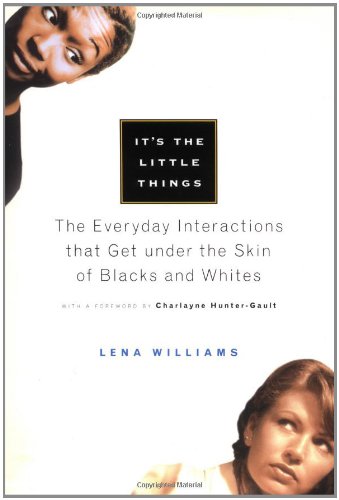
It's the Little Things: The Everyday Interactions That Get under the Skin of Blacks and Whites - Hardcover
Synopsis
Provides a witty close-up look at the small behaviors and habits that create barriers and misunderstandings between blacks and whites, drawing on personal experience and case studies to reveal the various misconceptions and to explain what they mean and how to avoid them. 50,000 first printing.
"synopsis" may belong to another edition of this title.
About the Author
Lena Williams is a twenty-five-year veteran of the New York Times. Currently covering sports, she is the senior delegate of the Author's Guild at the New York Times. Her article "It's the Little Things" won the National Association of Black Journalists award for feature writing. She lives in New York City.
Reviews
If black Americans are doing better (on a statistical basis) and some commentators downplay the significance of race, why does there remain such interracial tension? New York Times journalist Williams, expanding on a much-talked-about 1997 article, suggests that the problem lies with the "microaggressions" inherent in everyday interactionsAsome intentional, others not. Some examples: the white folk who claim not to see color, Williams notes, often ignore the possibility that blackness can be valued. Meanwhile, no one claims not to see gender. Whites who casually address blacks by their first names don't recognize the long history of demeaning blacks by first-name address. White-run parties at school that don't acknowledge black music leave the black minority uncomfortable. Despite the book's subtitle, this is mostly about black attitudes; white voices are given a chapterAmany say they hate it when blacks turn "innocuous things into a racial guilt trip"Aand Williams and some of her black respondents acknowledge their own episodic racial hostilities. Another chapter gives voice to non-black minorities. Much of this book rings true for the groups interviewedAWilliams's black informants are mostly middle-classA but some of her generalizations seem over the top: for example, that "no respectable black person would ever arrive at a party on time." And sadly, even some examples she cites might be interpreted from opposite directions: is the white who refuses to sit next to a black youth on a two-person subway seat practicing racial hostility, as she suggests, or trying to avoid it? Despite these flaws, Williams's provocative book is sure to stimulate much discussion with its candid depiction of race relations.
Copyright 2000 Reed Business Information, Inc.
Never mind the subject of affirmative action, there are a myriad of everyday misunderstandings that occur between black and white Americans that roil race relations. Williams, a reporter for the New York Times, speaks from experience about a range of annoying to dangerous incidences that are caused by the lack of understanding between the races. Williams examines the arenas of the workplace, public places, school, home, social settings, and the media. She recounts incidents from the mundane to the infamous--the Charles Stuart and Susan Smith cases where whites accused fictitious black men of murder and kidnapping when they themselves were guilty. But Williams mostly focuses on daily situations: black people unable to get a cab or service at a restaurant, being followed in a store, or having difficulty selling a home unless they disguise their ownership. Williams also gives whites a say in the awkwardness of interaction between the races for fear of saying or doing something offensive. Revealing, sometimes amusing, look at the sad state of race relations. Vanessa Bush
Copyright © American Library Association. All rights reserved
"About this title" may belong to another edition of this title.
Search results for It's the Little Things: The Everyday Interactions...

Stock Image
It's the Little Things: The Everyday Interactions That Get under the Skin of Blacks and Whites
Seller: World of Books (was SecondSale), Montgomery, IL, U.S.A.
Seller rating 5 out of 5 stars

Hardback. Condition: Good. Seller Inventory # 00107329466
Stock Image
It's the Little Things: The Everyday Interactions That Get under the Skin of Blacks and Whites
Seller: World of Books (was SecondSale), Montgomery, IL, U.S.A.
Seller rating 5 out of 5 stars
Hardback. Condition: Very Good. Seller Inventory # 00109464763
Stock Image
It's the Little Things: The Everyday Interactions That Get under the Skin of Blacks and Whites
Seller: Gulf Coast Books, Cypress, TX, U.S.A.
Seller rating 5 out of 5 stars
Hardcover. Condition: Good. Seller Inventory # 0151004072-3-16875488
Seller Image
It's the Little Things: The Everyday Interactions That Get under the Skin of Blacks and Whites
Published by
Houghton Mifflin Harcourt, 2000
ISBN 10: 0151004072
ISBN 13: 9780151004072
Used
Hardcover
Seller: Greenworld Books, Arlington, TX, U.S.A.
Seller rating 5 out of 5 stars
Condition: very_good. Fast Free Shipping â" Very Good condition book with a firm cover and clean pages. Shows normal use and some light wear or limited notes markings. A solid, nice copy to enjoy. Seller Inventory # GWV.0151004072.VG
Stock Image
It's the Little Things: The Everyday Interactions That Get under the Skin of Blacks and Whites
Seller: World of Books Inc, Montgomery, IL, U.S.A.
Seller rating 4 out of 5 stars

Hardback. Condition: Good. Seller Inventory # CIN0151004072G
Stock Image
It's the Little Things: The Everyday Interactions That Get under the Skin of Blacks and Whites
Seller: World of Books Inc, Montgomery, IL, U.S.A.
Seller rating 4 out of 5 stars
Hardback. Condition: Very Good. Seller Inventory # CIN0151004072VG
Stock Image
It's the Little Things: The Everyday Interactions That Get under the Skin of Blacks and Whites
Published by
Houghton Mifflin Harcourt, 2000
ISBN 10: 0151004072
ISBN 13: 9780151004072
Used
Hardcover
First Edition
Seller: The Maryland Book Bank, Baltimore, MD, U.S.A.
Seller rating 5 out of 5 stars
hardcover. Condition: Very Good. 1st Edition. Used - Very Good. Seller Inventory # 15-B-1-0124
Stock Image
It's the Little Things: The Everyday Interactions That Get under the Skin of Blacks and Whites
Published by
Houghton Mifflin Harcourt, 2000
ISBN 10: 0151004072
ISBN 13: 9780151004072
Used
Hardcover
Seller: ThriftBooks-Dallas, Dallas, TX, U.S.A.
Seller rating 5 out of 5 stars
Hardcover. Condition: Very Good. No Jacket. May have limited writing in cover pages. Pages are unmarked. ~ ThriftBooks: Read More, Spend Less. Seller Inventory # G0151004072I4N00
Stock Image
It's the Little Things : The Everyday Interactions That Get under the Skin of Blacks and Whites
Published by
Houghton Mifflin Harcourt Publishing Company, 2000
ISBN 10: 0151004072
ISBN 13: 9780151004072
Used
Hardcover
Seller: Better World Books, Mishawaka, IN, U.S.A.
Seller rating 5 out of 5 stars
Condition: Good. Former library copy. Pages intact with minimal writing/highlighting. The binding may be loose and creased. Dust jackets/supplements are not included. Includes library markings. Stock photo provided. Product includes identifying sticker. Better World Books: Buy Books. Do Good. Seller Inventory # 4512893-6
Stock Image
It's the Little Things: The Everyday Interactions That Get under the Skin of Blacks and Whites
Published by
Houghton Mifflin Harcourt, 2000
ISBN 10: 0151004072
ISBN 13: 9780151004072
Used
Hardcover
Seller: Textbook Bookie, Little Rock, AR, U.S.A.
Seller rating 5 out of 5 stars
Hardcover. Condition: Very Good. Book in Very Good condition. Seller Inventory # 9780151004072-very_good