
Items related to Gods of War, Gods of Peace: How the Meeting of Native...
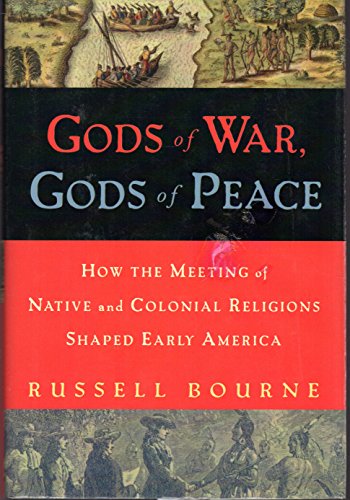
Gods of War, Gods of Peace: How the Meeting of Native and Colonial Religions Shaped Early America - Hardcover
Synopsis
Comparing Native American and early colonial politics, history, and religion, a noted historian provides an in-depth exploration into how these two very different groups influenced each other and how this interchange helped shape the foundation for modern culture. 17,500 first printing.
"synopsis" may belong to another edition of this title.
About the Author
Russell Bourne is the author of several books on American and Native American history and has worked as an editor at American Heritage and the Smithsonian Institution. He is a member of the Institute for American Indian Studies and lives in Ithaca, New York, and Castine, Maine.
Reviews
In 1802, Thomas Jefferson praised Handsome Lake, a Seneca prophet, for preaching moral reform among the Iroquois people; Handsome Lake, he said, was "favored by the Divine spirit," and would be instrumental in creating harmony between new Americans and Native Americans. Yet, as historian Bourne (Floating West: The Erie and Other American Canals) points out, such harmony was never to be. With dexterity and eloquence, Bourne weaves his considerable research into a compelling narrative of the ways in which Native American religions both meshed and clashed with those of the settlers. More than any other historian of this period, Bourne demonstrates the vitality of Native American belief systems: their ethics of individual and communal behavior, social and gender codes, and deep faith in the divine. As he traces the complicated and often bloody relations between such disparate religious and cultural communities, he points to the teachings of missionaries such as John Eliot, who tried to accept the Native Americans on their own religious terms even as he tried to convert them to Christianity, and the attempts of many of the native leaders, such as Pequot William Apess, to incorporate Christianity into their own beliefs in a rich synthesis. It was, he writes, a time when the two "religions shuddered, gave good for good and bad for bad, and changed in order to survive." By the early 19th century, however, hopes for religious and cultural accord were dashed by the acquisitiveness of the settlers, who thought little of forcing Native Americans from their lands in the name of God and Manifest Destiny. Bourne's excellent book tells a powerful tale of how two deeply religious cultures failed to achieve harmony, but "were battered into becoming Americans of unceasingly, creatively interacting beliefs." 8 pages of b&w photos, maps not seen by PW.
Copyright 2002 Cahners Business Information, Inc.
Bourne (Floating West) explores the religious interactions of Anglo Americans and Native Americans from 1635 through the 1830s and shows how their religions influenced each other in the shaping of the new nation. Focusing on key figures, he expands the usual list of Roger Williams, Jonathan Edwards, John Eliot, Pontiac, Handsome Lake, and Tecumseh to include Hobomock, Samson Occom, Joseph Brant, Samuel Kirkland, and William Apess, among others. The book's strength is in Bourne's descriptions of the religious encounters from both perspectives, as he aptly captures the varying viewpoints and accompanying cultural contexts of each of the leaders and their communities. He is less successful in analyzing the connections between these personalities and their religious encounters to broader societal changes and a deeper understanding of American identity. Still, this work offers a highly readable and valuable depiction of the possibilities and tragic failures of early American history as influenced and even created by religious faith. Recommended for public libraries. Jan Blodgett, Davidson Coll., NC
Copyright 2002 Cahners Business Information, Inc.
Excerpt. © Reprinted by permission. All rights reserved.
Chapter 1THE Devilish Interaction OF Two ReligionsPresident thomas jefferson, having recently hosted and grandly entertained a Seneca prophet in Washington, wrote to him in 1802 that he did, indeed, seem to have been "favored by the Divine spirit." Because Jefferson himself was a rationalist who felt little personal empathy for traditional religionists, it might seem out of character for him to salute a Native American leader in such words and to speak of divinity. But this was no obscure villager to whom Jefferson was writing and certainly no naive shaman; this was the dynamic and articulate Handsome Lake, who, fired by an intense sense of godly purpose, had spent the years after the American Revolution preaching moral reform among the Iroquois peoples. Appropriate and careful words were necessary. The president, sincerely admiring Handsome Lake's teachings (if only because they stressed his own favorite theme: family farming), praised "the great reformation" that the prophet was undertaking. Yet what made this exchange between two notable Americans of the Republic's early years truly remarkable was the final phrase in Jefferson's letter. He wrote of Handsome Lake and his people, "You are our brethren of the same land, we wish you your prosperity as brethren should do. Farewell." It was as if the archbishops of two national churches in neighboring countries were nodding genially across a frontier at each other with enduring and mutual respect. How different American history would have been if that fraternal spirituality had actually conditioned the events of the centuries to follow. Congenial brethren of the same continent was not at all what Native Americans and Euro-Americans were destined to be. For neither colonial nor postcolonial Americans would ever extend sufficient respect to the religious beliefs of the Algonquian and Iroquois people whom they encountered on the early frontier-least of all any understanding that Native American religious concepts were evolving in a way closely related to the developments of their own frontier denominations. There was no doubt about one mutual factor among people on each side of the racial barrier: Their religions inspired them, consoled them, united them. Furthermore, in those very, very different American religions there was also a certain commonality: a belief in rituals, even in the imminent reappearance of a messiah, and certainly in men like Handsome Lake who were so charged with godly energy that they seemed nearly gods themselves. No wonder Jefferson felt moved to remark, in the spirit of the Enlightenment, how favored the Seneca prophet was by the "divine spirit." No wonder, also, that Jefferson, even while focusing on a program of quite secular objectives for his nation, saw the usefulness of religion. Perhaps it would be better to say that Jefferson saw religion-and those who practiced it progressively, like Handsome Lake-as one of the most likely tools for advancement in the United States. In that same letter of November 3, 1802, he referred to the Seneca prophet as an "instrument of so happy a change," and forecast that, in recognition of the advances he had helped make, his "children's children, from generation to generation [would] repeat your name with love and gratitude forever." With what scorn Native Americans today (some of whom, among the Iroquois, remain devoted members of the church founded by Handsome Lake) recall Jefferson's prediction of eternal harmony resulting from cultural change.Contact AND ConversionYet, for all its disappointments and complexities, for all its economic and political aspects, the cultural contact between Anglo-Americans and Native Americans in the past three centuries becomes most understandable when seen as an intrinsically religious encounter. That is the purpose of this book: to assist the reader in entering the time when gods and demons seemed to contend with each other, when prophets and apostles explained the disturbances of the cosmos, and when to be religious was normative. The book's clock starts ticking shortly before the hour in 1635 when the recently arrived Puritans of Massachusetts decreed that church attendance was compulsory for all citizens, under penalty of fines and imprisonment. Though the Puritans would soon become the lesser fraction of their colony's population, they would continue to set the philosophical tone. It was in religious terms that the early Pilgrims and Puritans evaluated the anxious Algonquian who had greeted them-reaching the peculiar conclusion that the aborigines must be one of the lost tribes of Israel. Otherwise, how would they relate to the Bible, in which all was revealed? Additionally, it seemed probable to the Puritans that the Indians had been corrupted by the Devil, who now worked through them to frustrate the founding of the New Jerusalem. There were, to be sure, a host of Pilgrims and several Puritans to whom the contacted Native Americans seemed worthy of respect and regard, particularly for their morality and their spiritual qualities. Plymouth's Governor Edward Winslow, for example, expressed admiration for the courage and integrity of the Wampanoag people's pnieses, religiously active warrior-counselors. Most outspoken of these open-minded English settlers was the renegade John Morton, known for his remark that the Algonquian of Massachusetts were "more full of humanity" than the stern-backed, parochial English who were then arriving by the shipful. But it was Roger Williams, Separatist clergyman and founder of Rhode Island, who perceived most accurately the religious nature of his particular neighbors, the Narragansett. As portrayed in chapter 4, those haughty and populous Algonquian had remained untouched by either white men's plagues or other tribes' rivalries, protected they believed by their god Cautantowwit (or Kiehtan), whose ancestral home was thought to have been in the southwestern part of the continent. They welcomed Roger Williams among them, in part because of his natural respectfulness, in part because he proved to be a good trader of goods between them and the English settlements. For Roger Williams's own purposes-which included gaining a greater sense of God's design by studying the natives and securing land for himself and his followers-he entered upon a methodical analysis of Narragansett religion and language. This occurred at a time when many of the Christians in the settler communities were responding to the New World's opportunities by becoming more interested in how to improve their lots than by how to save their souls. To such backsliders into moralistic individualism and to us in later years Williams wrote, "He that questions whether God made the world, the Indians will teach him." Copyright © 2002 by Russell Bourne All rights reserved. No part of this publication may be reproduced or transmitted in any form or by any means, electronic or mechanical, including photocopy, recording, or any information storage and retrieval system, without permission in writing from the publisher.Requests for permission to make copies of any part of the work should be mailed to the following address: Permissions Department, Harcourt, Inc., 6277 Sea Harbor Drive, Orlando, Florida 32887-6777.
"About this title" may belong to another edition of this title.
Search results for Gods of War, Gods of Peace: How the Meeting of Native...

Stock Image
Gods of War, Gods of Peace: How the Meeting of Native and Colonial Religions Shaped Early America
Published by
Houghton Mifflin Harcourt, 2002
ISBN 10: 015100501X
ISBN 13: 9780151005017
Used
Hardcover
Seller: New Legacy Books, Annandale, NJ, U.S.A.
Seller rating 5 out of 5 stars

hardcover. Condition: Good. The dust jacket shows normal wear. Fast shipping and order satisfaction guaranteed. A portion of your purchase benefits Non-Profit Organizations, First Aid and Fire Stations! Seller Inventory # mon0000164050
Stock Image
Gods of War, Gods of Peace: How the Meeting of Native and Colonial Religions Shaped Early America
Published by
Houghton Mifflin Harcourt (edition 1), 2002
ISBN 10: 015100501X
ISBN 13: 9780151005017
Used
Hardcover
Seller: BooksRun, Philadelphia, PA, U.S.A.
Seller rating 5 out of 5 stars
Hardcover. Condition: Very Good. 1. With dust jacket. It's a well-cared-for item that has seen limited use. The item may show minor signs of wear. All the text is legible, with all pages included. It may have slight markings and/or highlighting. Seller Inventory # 015100501X-8-1-29
Stock Image
Gods of War, Gods of Peace : How the Meeting of Native and Colonial Religions Shaped Early America
Published by
Houghton Mifflin Harcourt Publishing Company, 2002
ISBN 10: 015100501X
ISBN 13: 9780151005017
Used
Hardcover
First Edition
Seller: Better World Books, Mishawaka, IN, U.S.A.
Seller rating 5 out of 5 stars
Condition: Very Good. 1st Edition. Former library copy. Pages intact with possible writing/highlighting. Binding strong with minor wear. Dust jackets/supplements may not be included. Includes library markings. Stock photo provided. Product includes identifying sticker. Better World Books: Buy Books. Do Good. Seller Inventory # 4488018-75
Stock Image
Gods of War, Gods of Peace : How the Meeting of Native and Colonial Religions Shaped Early America
Published by
Houghton Mifflin Harcourt Publishing Company, 2002
ISBN 10: 015100501X
ISBN 13: 9780151005017
Used
Hardcover
First Edition
Seller: Better World Books, Mishawaka, IN, U.S.A.
Seller rating 5 out of 5 stars
Condition: Very Good. 1st Edition. Pages intact with possible writing/highlighting. Binding strong with minor wear. Dust jackets/supplements may not be included. Stock photo provided. Product includes identifying sticker. Better World Books: Buy Books. Do Good. Seller Inventory # 8511412-6
Stock Image
Gods of War, Gods of Peace: How the Meeting of Native and Colonial Religions Shaped Early America
Published by
Houghton Mifflin Harcourt, 2002
ISBN 10: 015100501X
ISBN 13: 9780151005017
Used
Hardcover
Seller: ThriftBooks-Atlanta, AUSTELL, GA, U.S.A.
Seller rating 5 out of 5 stars
Hardcover. Condition: Very Good. No Jacket. Former library book; May have limited writing in cover pages. Pages are unmarked. ~ ThriftBooks: Read More, Spend Less. Seller Inventory # G015100501XI4N10
Stock Image
Gods of War, Gods of Peace: How the Meeting of Native and Colonial Religions Shaped Early America
Published by
Houghton Mifflin Harcourt, 2002
ISBN 10: 015100501X
ISBN 13: 9780151005017
Used
Hardcover
Seller: ThriftBooks-Dallas, Dallas, TX, U.S.A.
Seller rating 5 out of 5 stars
Hardcover. Condition: Very Good. No Jacket. May have limited writing in cover pages. Pages are unmarked. ~ ThriftBooks: Read More, Spend Less. Seller Inventory # G015100501XI4N00
Stock Image
Gods of War, Gods of Peace: How the Meeting of Native and Colonial Religions Shaped Early America
Published by
Houghton Mifflin Harcourt, 2002
ISBN 10: 015100501X
ISBN 13: 9780151005017
Used
Hardcover
Seller: ThriftBooks-Dallas, Dallas, TX, U.S.A.
Seller rating 5 out of 5 stars
Hardcover. Condition: Very Good. No Jacket. Former library book; May have limited writing in cover pages. Pages are unmarked. ~ ThriftBooks: Read More, Spend Less. Seller Inventory # G015100501XI4N10
Stock Image
Gods of War, Gods of Peace: How the Meeting of Native and Colonial Religions Shaped Early America
Published by
Houghton Mifflin Harcourt, 2002
ISBN 10: 015100501X
ISBN 13: 9780151005017
Used
Hardcover
Seller: HPB-Emerald, Dallas, TX, U.S.A.
Seller rating 5 out of 5 stars
hardcover. Condition: Very Good. Connecting readers with great books since 1972! Used books may not include companion materials, and may have some shelf wear or limited writing. We ship orders daily and Customer Service is our top priority! Seller Inventory # S_458109174
Stock Image
Gods of War, Gods of Peace: How the Meeting of Native and Colonial Religions Shaped Early America
Seller: OUT-OF-THE-WAY BOOKS, North Adams, MI, U.S.A.
Seller rating 4 out of 5 stars

Hardcover. Condition: As New. Dust Jacket Condition: Like New. First Edition. Like new hard cover edition with like new dust jacket. 1st Edition. Clean. Tight binding. No markings. 425 pages. Seller Inventory # SKU0009804
Seller Image
Gods of War, Gods of Peace: How the Meeting of Native and Colonial Religions Shaped Early America
Published by
Houghton Mifflin Harcourt, 2002
ISBN 10: 015100501X
ISBN 13: 9780151005017
Used
Hardcover
Seller: MERS Goodwill, Saint Louis, MO, U.S.A.
Seller rating 5 out of 5 stars
Condition: acceptable. Used - Acceptable: All pages and the cover are intact, but shrink wrap, dust covers, or boxed set case may be missing. Pages may include limited notes, highlighting, or minor water damage but the text is readable. Pages may include limited notes and highlighting, but the text cannot be obscured or unreadable. Any access codes or passwords originally included with the book may be expired, used or no longer valid. Image is stock photo and cover art edition may be different than pictured. Seller Inventory # MERV.015100501X.A