
Items related to The Riddle of the Compass: The Invention That Changed...
Synopsis
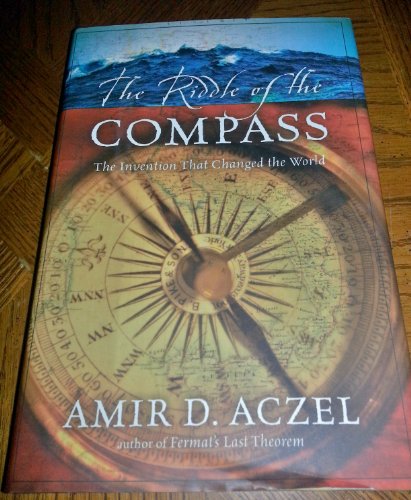
The best-selling author of Fermat's Last Theorem and God's Equation discusses the twelfth-century invention of the compass; its dramatic influence on navigation and the rise of Italian sea power; and its impact on the development of world trade and the Age of Discovery. 35,000 first printing.
"synopsis" may belong to another edition of this title.
About the Author
Amir D. Aczel, Ph.D., science writer par excellence, grew up on a ship and was navigating straits in the Mediterranean long before he could drive a car. The author of Fermat's Last Theorem, God's Equation, and Probability 1, he lives with his wife and daughter in the Boston area and teaches at Bentley College.
Reviews
The compass, Aczel says, was "the most important technological invention since the wheel" because its contribution to navigation "allowed goods to be transported efficiently and reliably across the seas and opened up the world to maritime exploration." Inspired by that thought, Aczel (associate professor of mathematics at Bentley College) set out to trace the history of the device. "The compass," he found, "was invented in antiquity in China, where it did not immediately improve navigation but was used in feng shui." It was the mariners of Amalfi, then a maritime city-state in Italy, who around 1300 transformed the instrument into the compass we know today. Citing it and other devices that only gradually found their technological niche, Aczel concludes that it "seems to be a law of nature that a technology is developed and then waits a long time for people to discover their need for it, rather than the other way around."
Editors of Scientific American
Adult/High School-Prior to the invention of the compass, a merchant or sailor who wished to cross a large body of water was forced to navigate by studying the winds and stars or by never sailing out of the sight of land. Long ocean voyages were impossible and even sailing the Mediterranean could be a lengthy and hazardous voyage. The compass changed all of this. Mariners could now strike out on an azimuth and have a reasonable chance of arriving at their destination. This led to the Age of Exploration and the expansion of the European kingdoms into economic empires. Yet as important as the compass is, its origins are shrouded in mystery. The small town of Amalfi, Italy, claims to be the birthplace of the inventor of the compass, but China has an even stronger case. Aczel examines the myths, legends, and facts behind the dispute and provides a logical, although not indisputable, conclusion on which nation can claim the compass as its own. He also provides a layman's overview of the development of navigation from the earliest days to the 15th century. Although the author is primarily known for his scientific books, Riddle of the Compass contains little or no jargon and a minimum of scientific terminology. A worthwhile and interesting addition.
Robert Burnham, R. E. Lee High School, Springfield, VA
Copyright 2002 Cahners Business Information, Inc.
Despite its brevity, this book covers its topic completely. In this detailed history, Aczel (God's Equation; Bentley Coll.) takes us back in time to Amalfi, Italy, where between 1295 and 1302 the compass as we know it was developed. Aczel points out, however, that the actual discovery of materials that followed magnetic lines, or at least consistently pointed in a specific direction (south), is attributed to the Chinese in 1040. The story of the compass is also the story of navigation, which the author admirably combines. Debunking the myth that sailors followed the coastlines of countries until they met their desired location, the author describes how they navigated the open seas using the sun, stars, wind, and even the migration of birds. While this book is not a page-turner, it is an accurate account of the important historical events that lead to the compass's development. Tellingly, Aczel grew up on a ship and was navigating straits in the Mediterranean long before he could drive a car. Recommended for public as well as academic libraries whose readers want to go beyond the account generally given in an encyclopedia.
- James Olson, Northeastern Illinois Univ., Chicago
Copyright 2001 Reed Business Information, Inc.
In Amalfi, Italy, civic pride surrounds Flavio Gioia, purportedly the inventor of the magnetic compass circa 1300. Alas for Amalfianos desiring to honor their native son with a statue on the six hundredth anniversary of his invention, a spoilsport wrote articles disputing Flavio's very existence, let alone his creation of one of the most revolutionary instruments ever. Nevertheless, the statue stands, a lodestone, so to speak, of Aczel's flowing account of who devised the compass and what it hath wrought. As might be expected, fragmentary documents allow no definitive credit to be bestowed, but Aczel relates that Chinese records describing magnetic compasses predate by more than a century Flavio's supposed brainstorm. In addition, it's possible that Marco Polo brought back an example of the amazing direction-finder. Whatever the truth, the magnetic compass, used in conjunction with a 16-point diagram of the winds, allowed the Venetians to navigate the Mediterranean in winter, begetting increased wealth and ushering in the age of exploration. A delightful, wide-ranging ramble that will entertain history and technology buffs. Gilbert Taylor
Copyright © American Library Association. All rights reserved
"About this title" may belong to another edition of this title.
Search results for The Riddle of the Compass: The Invention That Changed...

Stock Image
The Riddle of the Compass: The Invention That Changed the World
Published by
Houghton Mifflin Harcourt, 2001
ISBN 10: 0151005060
ISBN 13: 9780151005062
Used
Hardcover
Seller: World of Books (was SecondSale), Montgomery, IL, U.S.A.
Seller rating 5 out of 5 stars

Condition: Good. Item in good condition. Textbooks may not include supplemental items i.e. CDs, access codes etc. Seller Inventory # 00058798710
Seller Image
The Riddle of the Compass: The Invention That Changed the World
Published by
Houghton Mifflin Harcourt, 2001
ISBN 10: 0151005060
ISBN 13: 9780151005062
Used
Hardcover
Seller: Greenworld Books, Arlington, TX, U.S.A.
Seller rating 5 out of 5 stars
Condition: good. Fast Free Shipping â" Good condition. It may show normal signs of use, such as light writing, highlighting, or library markings, but all pages are intact and the book is fully readable. A solid, complete copy that's ready to enjoy. Seller Inventory # GWV.0151005060.G
Stock Image
The Riddle of the Compass: The Invention That Changed the World
Published by
Houghton Mifflin Harcourt, 2001
ISBN 10: 0151005060
ISBN 13: 9780151005062
Used
Hardcover
Seller: More Than Words, Waltham, MA, U.S.A.
Seller rating 5 out of 5 stars
Condition: Very Good. . Former Library book. All orders guaranteed and ship within 24 hours. Before placing your order for please contact us for confirmation on the book's binding. Check out our other listings to add to your order for discounted shipping. Seller Inventory # WAL-N-4f-002223
Stock Image
The Riddle of the Compass: The Invention That Changed the World
Published by
Houghton Mifflin Harcourt (edition 1), 2001
ISBN 10: 0151005060
ISBN 13: 9780151005062
Used
Hardcover
Seller: BooksRun, Philadelphia, PA, U.S.A.
Seller rating 5 out of 5 stars
Hardcover. Condition: Very Good. 1. With dust jacket. It's a well-cared-for item that has seen limited use. The item may show minor signs of wear. All the text is legible, with all pages included. It may have slight markings and/or highlighting. Seller Inventory # 0151005060-8-18-29
Stock Image
The Riddle of the Compass: The Invention That Changed the World
Published by
Houghton Mifflin Harcourt, 2001
ISBN 10: 0151005060
ISBN 13: 9780151005062
Used
Hardcover
First Edition
Seller: The Maryland Book Bank, Baltimore, MD, U.S.A.
Seller rating 5 out of 5 stars
hardcover. Condition: Very Good. 1st Edition. Used - Very Good. Seller Inventory # 2-X-4-0638
Stock Image
The Riddle of the Compass: The Invention That Changed the World
Published by
Houghton Mifflin Harcourt, 2001
ISBN 10: 0151005060
ISBN 13: 9780151005062
Used
Hardcover
Seller: ThriftBooks-Phoenix, Phoenix, AZ, U.S.A.
Seller rating 5 out of 5 stars
Hardcover. Condition: Very Good. No Jacket. May have limited writing in cover pages. Pages are unmarked. ~ ThriftBooks: Read More, Spend Less. Seller Inventory # G0151005060I4N00
Stock Image
The Riddle of the Compass: The Invention That Changed the World
Published by
Houghton Mifflin Harcourt, 2001
ISBN 10: 0151005060
ISBN 13: 9780151005062
Used
Hardcover
Seller: ThriftBooks-Atlanta, AUSTELL, GA, U.S.A.
Seller rating 5 out of 5 stars
Hardcover. Condition: Very Good. No Jacket. May have limited writing in cover pages. Pages are unmarked. ~ ThriftBooks: Read More, Spend Less. Seller Inventory # G0151005060I4N00
Stock Image
The Riddle of the Compass: The Invention That Changed the World
Published by
Roundhouse Publishing Ltd, 2001
ISBN 10: 0151005060
ISBN 13: 9780151005062
Used
Hardcover
Seller: World of Books Inc, Montgomery, IL, U.S.A.
Seller rating 4 out of 5 stars

Hardback. Condition: Good. The story of the compass is shrouded in mystery and myth, yet most will agree it begins around the time of the birth of Christ in ancient China. A mysterious lodestone whose powers affected metal was known to the Chinese emperor. When this piece of metal was suspended in water, it always pointed north. This unexplainable occurrence led to the stone's use in feng shui, the Chinese art of finding the right location. However, it was the Italians, more than a thousand years later, who discovered the ultimate destiny of the lodestone and unleashed its formidable powers. In Amalfi sometime in the twelfth century, the compass was born, crowning the Italians as the new rulers of the seas and heralding the onset of the modern world. Retracing the roots of the compass and sharing the fascinating story of navigation through the ages, The Riddle of the Compass is Aczel at his most entertaining and insightful. Seller Inventory # CIN0151005060G
Stock Image
The Riddle of the Compass: The Invention That Changed the World
Published by
Houghton Mifflin Harcourt, 2001
ISBN 10: 0151005060
ISBN 13: 9780151005062
Used
Hardcover
Seller: Wonder Book, Frederick, MD, U.S.A.
Seller rating 5 out of 5 stars
Condition: Very Good. Very Good condition. Good dust jacket. A copy that may have a few cosmetic defects. May also contain light spine creasing or a few markings such as an owner's name, short gifter's inscription or light stamp. Seller Inventory # A16A-04515
Stock Image
The Riddle of the Compass : The Invention That Changed the World
Published by
Houghton Mifflin Harcourt Publishing Company, 2001
ISBN 10: 0151005060
ISBN 13: 9780151005062
Used
Hardcover
Seller: Better World Books: West, Reno, NV, U.S.A.
Seller rating 5 out of 5 stars
Condition: Very Good. Pages intact with possible writing/highlighting. Binding strong with minor wear. Dust jackets/supplements may not be included. Stock photo provided. Product includes identifying sticker. Better World Books: Buy Books. Do Good. Seller Inventory # 38783713-6