
Items related to All Souls Day
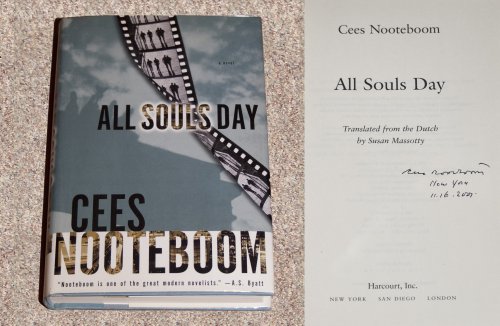
Synopsis
Riddled with grief and desperately trying to start a new life after the death of his wife and child, a Dutch documentary filmmaker arrives in Berlin, a city rife with history, at the end of the twentieth century, where he encounters an enigmatic young Dutch-Berber woman named Elik--a meeting that leads him on a journey to Madrid. 20,000 first printing.
"synopsis" may belong to another edition of this title.
About the Author
Born in 1933 in the Hague, Cees Nooteboom is one of Europe's most popular and widely translated writers. He lives in Amsterdam and Minorca, Spain.
Reviews
There's a scene in Nooteboom's latest novel that functions like the keynote to a score. Arno Tieck, an old German scholar, tells the well-known story of Hegel's remark, after he "heard the distant roar of Napoleon's cannons from his study in Jena," that history was already over. While this was a stimulating observation in Hegel's time, almost 200 years later it seems more like an observation about cultural exhaustion. Arthur Daane, a 42-year-old Dutch documentary filmmaker living in Berlin, is indeed weary. His wife, Roelfje, and his son, Thomas, died in a plane crash. He keeps company with four friends (Arno; Arno's sister-in-law, Zenobia Stejn; a stout Russian physicist; and Victor, a Dutch sculptor) who exchange bon mots in Berlin restaurants. Popular topics with this crowd are the guilt of the Germans, the difference between German and Dutch character, and Berlin's multiple layers of history. Arthur is whisked from this dishearteningly abstract atmosphere by a fierce young Spanish-Dutch student, Elik Oranje. Elik is a beautiful woman with "Berber eyes, " a distinctive scar on her right cheekbone and very mysterious habits. Arthur is a bit tepid for amour fou, but their affair is passionate. He breaks her spell for a while by accepting a job to make a film in Estonia, and then in Japan, but when she heads for Spain, Arthur eventually follows. Nooteboom's attempt at an intellectual novel is worthy of respect, but Arthur and his friends are frustratingly static in their habits and thoughts, their perorations inflated with hot air. More enervating than invigorating, the book fails to communicate the vitality of a life of thought.
Copyright 2001 Cahners Business Information, Inc.
When Arthur Daane, a Dutch documentary filmmaker, isn't flying off to Guatemala or Estonia, he takes to the streets of Berlin, shooting footage of its scarred history and ongoing reconstruction—"pieces of a giant puzzle only he would be able to fit together." Daane, who has lost his family in a plane crash, is trying to rebuild his own life among a polyglot circle of friends who meet at Schultze's Weinstube to talk about Hegel and the fine distinctions between types of sausage. A chance encounter with a mysteriously scarred young woman inspires a reawakening of passion—with shattering consequences. Not the least of the novel's satisfactions is the deftness with which Nooteboom incorporates signposts of Western high culture into his densely observant narrative, from Homer to Walter Benjamin—whom Daane, the indefatigable walker, wants to document in a film entitled "The Soles of Memory."
Copyright © 2005 The New Yorker
Alone after losing his wife and young son in a plane crash, Nooteboom's moody hero, the peripatetic Dutch documentary filmmaker Arthur Daane, seeks tough assignments in the world's bloodiest trouble spots. On his own time, he wanders the "guilty city" of Berlin, filming such ordinary phenomena as footsteps in the snow or a tree that has seen many a human life begin and end. A reticent man, he has remarkably eloquent friends, including the kind philosopher Arno, the emotionally extravagant physicist Zenobia, and Victor, a sculptor who works in stone. All are gentle souls devoted to parsing the vagaries of history, the poetry of science, and the nuances of art, and all witness the cataclysmic effect Elik--a clenched-tight woman with a harrowing past, a scar on her face, and fury in her soul--has on monkish Arthur. Internationally acclaimed Dutch novelist Nooteboom's gorgeously meditative tale considers the pressures the dead exert on the living, the impossibility of truly coming to terms with evil, the precious "acts of preservation" performed by artists and historians, and the quiet heroics of individual lives lived in a world perpetually poised on the brink of chaos. Donna Seaman
Copyright © American Library Association. All rights reserved
This is an imposing and richly nuanced novel by acclaimed Dutch writer Nooteboom. In a book that is part love story, part novel of ideas, Nooteboom tells a poignant story about two unlikely lovers while also exploring complex questions related to history, memory, and personal loss. Set in Berlin, a city ideally suited for such a meditation, the book resonates with great power and emotion. Protagonists Arthur and Elik are haunted by personal calamities. Arthur, philosophical and quiet, is a documentary filmmaker attempting to recover from the loss of his wife and child in a plane accident. Elik, impulsive and mysterious, is a graduate student who is still deeply troubled by a traumatic childhood incident. Desperately lonely, they are, unfortunately, able to achieve only fleeting moments of tenderness and understanding together. This is a very accomplished novel that demands to be read at its own paceslowly, with each detail savored. Readers who bring the requisite patience to this endeavor will be richly rewarded. Enthusiastically recommended for all libraries.Patrick Sullivan, Manchester Community Coll., CT
Copyright 2001 Cahners Business Information, Inc.
"About this title" may belong to another edition of this title.
Search results for All Souls Day

Stock Image
All Souls Day: A Novel
Seller: Hourglass Books, Vancouver, BC, Canada
Seller rating 5 out of 5 stars

Hardcover. Condition: Very Good+. Dust Jacket Condition: Very Good+, Not Price Clipped. American First. Complete letter line from A to K; minor wear; otherwise a solid, clean copy with no marking or underlining; collectible condition; dust jacket is protected by a mylar cover. Book. Seller Inventory # 012152
Stock Image
All Souls Day
Published by
Houghton Mifflin Harcourt, 2001
ISBN 10: 0151005664
ISBN 13: 9780151005666
Used
Hardcover
Seller: BookHolders, Towson, MD, U.S.A.
Seller rating 5 out of 5 stars
Condition: Good. [ No Hassle 30 Day Returns ][ Ships Daily ] [ Underlining/Highlighting: NONE ] [ Writing: NONE ] [ Edition: First ] Publisher: Houghton Mifflin Harcourt Pub Date: 12/5/2001 Binding: Hardcover Pages: 352 First edition. Seller Inventory # 6886603
Stock Image
All Souls Day
Published by
Houghton Mifflin Harcourt (edition First Edition), 2001
ISBN 10: 0151005664
ISBN 13: 9780151005666
Used
Hardcover
First Edition
Seller: BooksRun, Philadelphia, PA, U.S.A.
Seller rating 5 out of 5 stars
Hardcover. Condition: Very Good. First Edition. With dust jacket. It's a well-cared-for item that has seen limited use. The item may show minor signs of wear. All the text is legible, with all pages included. It may have slight markings and/or highlighting. Seller Inventory # 0151005664-8-1-29
Seller Image
All Souls Day
Published by
Houghton Mifflin Harcourt, 2001
ISBN 10: 0151005664
ISBN 13: 9780151005666
Used
Hardcover
Seller: Zoom Books East, Glendale Heights, IL, U.S.A.
Seller rating 5 out of 5 stars
Condition: good. Book is in good condition and may include underlining highlighting and minimal wear. The book can also include "From the library of" labels. May not contain miscellaneous items toys, dvds, etc. . We offer 100% money back guarantee and 24 7 customer service. Seller Inventory # ZEV.0151005664.G
Seller Image
All Souls Day
Published by
Houghton Mifflin Harcourt, 2001
ISBN 10: 0151005664
ISBN 13: 9780151005666
Used
Hardcover
Seller: Bay State Book Company, North Smithfield, RI, U.S.A.
Seller rating 5 out of 5 stars
Condition: very_good. Seller Inventory # BSM.18RRL
Seller Image
All Souls Day
Published by
Houghton Mifflin Harcourt, 2001
ISBN 10: 0151005664
ISBN 13: 9780151005666
Used
Hardcover
Seller: Books for Life, LAUREL, MD, U.S.A.
Seller rating 5 out of 5 stars
Condition: very_good. Book is in very good condition. Clean with little to no signs of wear or markings highlights. Seller Inventory # LFM.8TIF
Seller Image
All Souls Day
Published by
Houghton Mifflin Harcourt, 2001
ISBN 10: 0151005664
ISBN 13: 9780151005666
Used
Hardcover
Seller: Zoom Books Company, Lynden, WA, U.S.A.
Seller rating 5 out of 5 stars
Condition: very_good. Book is in very good condition and may include minimal underlining highlighting. The book can also include "From the library of" labels. May not contain miscellaneous items toys, dvds, etc. . We offer 100% money back guarantee and 24 7 customer service. Seller Inventory # ZBV.0151005664.VG
Seller Image
All Souls Day
Published by
Houghton Mifflin Harcourt, 2001
ISBN 10: 0151005664
ISBN 13: 9780151005666
Used
Hardcover
Seller: ZBK Books, Carlstadt, NJ, U.S.A.
Seller rating 5 out of 5 stars
Condition: very_good. Fast & Free Shipping â" Very Good condition book with a firm cover and clean pages. Shows normal use and some light wear or limited notes markings. A solid, nice copy to enjoy. Seller Inventory # ZWV.0151005664.VG
Stock Image
All Souls Day
Published by
Houghton Mifflin Harcourt Publishing Company, 2001
ISBN 10: 0151005664
ISBN 13: 9780151005666
Used
Hardcover
Seller: Better World Books, Mishawaka, IN, U.S.A.
Seller rating 5 out of 5 stars
Condition: Good. 1st U.S. ed. Former library copy. Pages intact with minimal writing/highlighting. The binding may be loose and creased. Dust jackets/supplements are not included. Includes library markings. Stock photo provided. Product includes identifying sticker. Better World Books: Buy Books. Do Good. Seller Inventory # 3130299-6
Stock Image
All Souls Day
Published by
Houghton Mifflin Harcourt Publishing Company, 2001
ISBN 10: 0151005664
ISBN 13: 9780151005666
Used
Hardcover
Seller: Better World Books: West, Reno, NV, U.S.A.
Seller rating 5 out of 5 stars
Condition: Good. 1st U.S. ed. Former library copy. Pages intact with minimal writing/highlighting. The binding may be loose and creased. Dust jackets/supplements are not included. Includes library markings. Stock photo provided. Product includes identifying sticker. Better World Books: Buy Books. Do Good. Seller Inventory # 3130299-6