
Items related to Bay of Tigers: An Odyssey through War-torn Angola
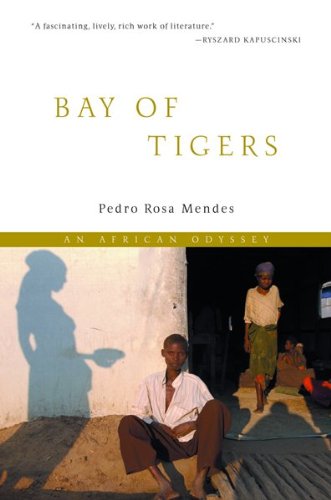
Synopsis
In 1997, Pedro Rosa Mendes traveled across Africa--6,000 miles from the west to the east coast, from Angola to Mozambique--on trains with no windows, no doors, no seats, on wrecks of trucks and buses, on boats and motorcycles.
In war-torn Angola, a country where land mines outnumber people, Mendes found long lines of villagers waiting for shock treatment to neutralize the phantom pain in amputated limbs, an apothecary's tent purveying boiled mucumbi bark to combat scurvy lesions in the mouth, and trains crowded with people eating salted fish and drinking beer, swapping tales of local sorcerers who can turn into snakes. He interviewed international relief workers and corrupt local officials, widows and orphans, soldiers and survivors, piecing together a rich portrait no history or travel book can match.
In war-torn Angola, a country where land mines outnumber people, Mendes found long lines of villagers waiting for shock treatment to neutralize the phantom pain in amputated limbs, an apothecary's tent purveying boiled mucumbi bark to combat scurvy lesions in the mouth, and trains crowded with people eating salted fish and drinking beer, swapping tales of local sorcerers who can turn into snakes. He interviewed international relief workers and corrupt local officials, widows and orphans, soldiers and survivors, piecing together a rich portrait no history or travel book can match.
"synopsis" may belong to another edition of this title.
About the Authors
Pedro Rosa Mendes is a Portuguese journalist and writer. His dispatches from Zaire, Angola, Rwanda, and Afghanistan have earned him widespread renown in Europe. Bay of Tigers is his first book.
Pedro Rosa Mendes is a Portuguese journalist and writer. His dispatches from Zaire, Angola, Rwanda, and Afghanistan have earned him widespread renown in Europe. Bay of Tigers is his first book.
Reviews
Four decades of civil war have left Angola a shattered country, an unpublicized catastrophe where land mines outnumber people and children play with surface-to-air missiles. Mendes went there in 1997, a Portuguese journalist investigating his nation's former colony. This extraordinary, difficult book is a record of the horrors he found: an infant without a face, a young beggar who resembles a little five-year-old man, amputees lining up for electroshock therapy. The book's structure is as chaotic as the country. Mendes forgoes any kind of conventional approach, lurching backward and forward through time, switching points of view, quickly introducing then discarding characters. It would be frustrating if it weren't done with such evident purpose: the fractured, phantasmagoric depiction of a world gone mad. Mendes has a gift for wry observation (a colonel blissfully sleeping the sleep of his rank) and surreal imagery (a plush animal dangles crucified from the wire), both of which well suit his subject. Equally valuable is Mendes's evident compassion for those he encounters. His description of a blind musician patching a guitar with chewing gum, for instance, tells much about the musician, but also reveals Mendes's superb observational skills. The book's principal drawback is that it doesn't supply the context of postcolonial African history. Those who don't have that i.e., most people will find the book tough going. (A glossary offers some help, but it's not enough.) Still, Mendes has crafted a unique, frightening book. Composed equally of journalism, oral history and even magic realism, it shows how people can endure and even prevail despite their government's best efforts to keep them down.
Copyright 2003 Reed Business Information, Inc.
Mendes, a Portuguese journalist, shares his experiences and impressions of the horrors to be found in a nation that has been so long engaged in internal and external conflicts. Violence in this war-torn coastal nation has evolved from fighting for freedom from Portugal, to civil war, to cold-war proxy in tensions between the U.S and Cuba, and now into a kind of madness. Angola has a sizable population of amputees, with artificial limbs fashioned from plumbing fixtures and abandoned plastic and wood; it is a nation where the wrong political affiliation can be fatal. Mendes exposes the suffering of the indigenous population, the bulk of the casualties of war, dying from mine explosions or living with limb deficiencies. Angolan children are turned into auxiliary warriors, fighting to eat and live. He also exposes the many European expatriates, living more comfortable lives in strife-worn Angola than they could secure at home. This odyssey is a revealing look at the lives and deaths in a nation that is more often ignored in world news. Vernon Ford
Copyright © American Library Association. All rights reserved
Excerpt. © Reprinted by permission. All rights reserved.
In every inch of this ground is the last moment of my life. I can contemplate my last moment as far as the eye can see. It's the reason they transport me only at night. They're preserving me. I don't mind. Right now it is night, and there is much of it. It is always at night that I find myself restless. I have stopped feeling fear, because fear has deserted me, becoming an external territory. An enormous lack of stability: I have nothing to cling to, and that can be fatal. The ground, the road, the savanna, the country: fear is a map and the obligation it imposes. I don't know how many days' wide it is. We are crossing it at night. Crossing fear through the night is the only thing I have.
I can also tell you that I'm sleepy, cold, and possessed of absolute calm. Later I'll speak of a small crate of wine waiting to be drunk, tea leaves, and salt. There is also a precious cassette of Marilyn Monroe, with Billie Holiday waiting her turn before the end of the show.
In Menongue, the head of the CARE mine-clearing project in the Cuando Cubango Province showed me a map in very small scale that occupied an entire wall. A mosaic of military charts glued side by side, it was infested with red pins. There were also hand-drawn rectangles of red. And small blue flags, almost all of them around Menongue and along one bank of the Cuebe River, some inches to the southeast.
"The red ones are minefields. Not all of them are here, there's lots more. These are the ones we've identified. The rectangles are strategic locations that were surrounded by mines, such as barracks, powder magazines, and the airport. The blue ones are the areas that have been cleared of mines. Since June we've removed 24,000 from that zone. We store them in an old barracks that belonged to the Cuban logistical team, behind the Catholic mission. Then we destroy them, the way we're doing now: 3,000 on Friday, 860 on Saturday. And then there's the insanity of explosives in private homes. A few days back, a person came to see us because he was remodeling his house, and when the masons started digging in the yard, they discovered eighty-two mortars. You never know when they'll be needed..."
A single blue line leads to Menongue, starting at Bié. There are two more small lines with no outlet, toward the south as far as Caiundo, as far east as Cuíto Cuanavale. That is the extent of land communications, in a territory larger than Portugal.
"What about this blue rectangle along the riverbank?"
"It's the beach on the right side of the dam. The UNAVEM soldiers swim there.* The other side is still mined. They swim only halfway across."
"Where's the road south of Caiundo, on the way to Jamba?"
"There isn't one."
"In Luanda they told me there might be one."
"There's no road, and what there is is completely mined. We've managed to clear the road as far as Caiundo, nothing else. You still can't walk on the shoulder. Some time back, there was an accident with a truck that tried to back up. People died in the back of the truck, which is the way they travel here. South of Caiundo the minefields haven't even been located. UNITA and the government haven't given us the maps. No one takes that road, not even UNAVEM armored transports."
"How do the NGOs there get around?"
"There are no NGOs down there. There is nobody! Most of the province was never recognized by the Mission. Do I make myself clear?"
"But my plan is to get to Zambia through there. By way of Jamba. There's no other road."
"I'm telling you there isn't any road! No one is authorized to leave from Caiundo. Go back and catch a plane to Luanda and from there to Zambia, if it's so important to you."
At the office entrance, the CARE personnel had bamboo shelves with a display of some of the types of mines and explosives found in the city. There are Russian mines, Cuban, South African, and Chinese mines. Some carry instructions engraved by the manufacturer to ensure proper placement: "This side toward the enemy." The most dangerous are the Chinese plastic mines.
"I'm going to Caiundo. To try to get through."
"In three days you'll be back here telling me I was right. And if you're not, believe me, it'll be because you're dead. In three days you'll be back on the plane to Luanda. Retrace your steps and don't cause problems for us."
I didn't see him again. At the top of the street is the train station that no longer has any trains; they used to arrive from Namibe and Lubango, in the war years, loaded with ammunition and massacres. At the bottom is the river, and before that, the End of the World, a discotheque. It's closed, either because of its redundant name or because it's bankrupt. I left, heading down.
The last instant, therefore. Through the night. There is no scenery, no villages, no people around fires, or elephants silhouetted against the sky. I could speak of such things, I was hoping to, but it would be a lie. There is no horizon, nothing that stands out in relief, no time, no direction. Everything is compressed into the two frames of the windshield. We advance upon a tribe of ghosts illuminated by the headlights. They return to darkness when we run them over, to the deafening sound of the engine. Bushes, rabbits, faces, bats, lullabies, a zoo full of memories.
Our conveyance is a Kamaz. Soviet manufacture.
They used to make some colossal vehicles: a keel with four-wheel drive (each tire the height of a man) to cut through the stubborn sand, the currents of savannas, Cuando Cubango's unbridged rivers.
The right door has no glass. It needs it. The Kamaz charges forth into the cold and the vegetation like a blinded buffalo, with sudden lunges and jolts of fury. We struggle for hours in a network of giant thistles. The trees are of medium size but solid. They block our way, lashing against the truck with brutal power, the rhythm of waves in a storm. The thorns are tough, unbreakable. When the bumpers fracture their spine to the root and we leave them behind, they rain blows on us from every side, scratching against the metal of the chassis like fingernails. In the cab, my feet are burning from them. Little by little, the thorns tear at the arm of my coat before they fall to the ground (I see them in a sliver of the mirror). They have already pierced my skin and caught an ear in the process: my neck bristles with that knifelike flora. I don't dare remove my hood.
The lieutenant colonel is in the middle seat, sleeping the sleep of his rank. I envy him and elbow him aside because he is pushing me toward the thorns. I defend myself by reflex, no longer able to feel my body.
Three days ago, or two, maybe four, it doesn't matter, we had to take apart the jeep's engine. We were in the middle of a mined stretch between Caiundo and Cuangar. The jeep in the middle of the sand, the parts in the middle of the sand, two guerrilla fighters lying down with oil on their arms and sand in the oil. An entire day to clean the engine. The colonel, smoking, told me about the day he stepped on a mine. He felt the click on the sole of his foot and instantly froze. He cried at the top of his lungs. Get me out of here. It was an old Portuguese mine. With them, one second separates the click from the explosion. The click activates the mine. The explosion occurs when the pressure from above is released. Desperation and survival have only that one second to act. The colonel asked for a stick, which they tossed to him. Weeping and sweating, he inserted it beneath the toe of his boot and applied pressure so he could remove his foot without setting off the mine. Then he leaped forward onto the ground. The mine went off behind him. He was in a state of shock for several days. Nothing else. The two of us looked at his feet: intact. Hungry, we gathered twigs, carefully treading on the parallel tracks of the jeep, and boiled a pot of tea. I passed around the small white bag they'd given me in Menongue, and we sweetened it. The colonel took a sip and spat. The bag was table salt.
Every twenty minutes someone is killed or maimed in this world by an antipersonnel mine. There are more than one hundred million mines buried in seventy countries, close to a tenth of them in Angola. In Cuando Cubango, where it is believed 45 percent of Angola's mines are located, mines outnumber people. There were not a lot of people to begin with, and in recent years many have died.
Above our ears and above the dolorous noise, a guerrilla with his Bedouin head wrapped in a rag acts as copilot, shouting through the rear window of the Kamaz, which has no glass.
"To the left at that tree...At that one, to the left. Then to the right...To the right at the bramble bush...To the right, through the sand...To the right, the right! Back, go back! Now that way, straight ahead."
We hope that the copilot knows the terrain well. That his mask of youth conceals the face of a seasoned veteran of war. That he knows the minefields because he helped plant them.
"Right!"
We hope that this is not the first time he has crossed this field in the only way possible, by slashing through the undergrowth.
"Left!"
And we hope that he has done this at night.
"Right!"
And we especially hope that he has no desire to commit suicide. Not a speck of such desire, in this night that never ends.
"We're there! Wake up."
I have no words. My eyelids are heavy with sleep, and the northern lights are exploding in my brain.
"I couldn't sleep. Did you notice that we were being watched?"
Everywhere, a roaring that doesn't seem to come from the engine. "This side toward the enemy."
Dirico is the name the map gives this place, but where have we arrived at? The coordinates are ephemeral. My birthday was yesterday, therefore today must still be yesterday. I get out of the Kamaz with bruised hands and bump into two mirages: a house in ruins and a river in the depths of the savanna. It is the sight of water that I dream about now, there on the cold cement, grabbing the dream in my hands: my two feet like stone but intact.
"Marilyn." Those fearful, fantastic aerial bombs that a Portuguese captain showed me; they are waiting to be destroyed. Six-foot cylinders that have not exploded, rusting in the grasses of Menongue, with graffiti in French: JE T'AIME, BRIGITTE!
© 1999, Pedro Rosa Mendes e Publicacoes Dom Quixote.
English translation copyright © 2003 by Clifford Landers
All rights reserved. No part of this publication may be reproduced or
transmitted in any form or by any means, electronic or mechanical, including
photocopy, recording, or any information storage and retrieval system,
without permission in writing from the publisher.
Requests for permission to make copies of any part of the work
should be mailed to the following address: Permissions Department,
Harcourt Inc., 6277 Sea Harbor Drive, Orlando, Florida 32887-6777.
"About this title" may belong to another edition of this title.
Search results for Bay of Tigers: An Odyssey through War-torn Angola

Stock Image
Bay of Tigers: An Odyssey through War-torn Angola
Seller: World of Books (was SecondSale), Montgomery, IL, U.S.A.
Seller rating 5 out of 5 stars

Condition: Acceptable. Item in acceptable condition! Textbooks may not include supplemental items i.e. CDs, access codes etc. Seller Inventory # 00105824350
Stock Image
Bay of Tigers : An African Odyssey
Published by
Houghton Mifflin Harcourt Publishing Company, 2003
ISBN 10: 0151006555
ISBN 13: 9780151006557
Used
Hardcover
Seller: Better World Books, Mishawaka, IN, U.S.A.
Seller rating 5 out of 5 stars
Condition: Good. Former library copy. Pages intact with minimal writing/highlighting. The binding may be loose and creased. Dust jackets/supplements are not included. Includes library markings. Stock photo provided. Product includes identifying sticker. Better World Books: Buy Books. Do Good. Seller Inventory # GRP30129036
Stock Image
Bay of Tigers : An African Odyssey
Published by
Houghton Mifflin Harcourt Publishing Company, 2003
ISBN 10: 0151006555
ISBN 13: 9780151006557
Used
Hardcover
Seller: Better World Books, Mishawaka, IN, U.S.A.
Seller rating 5 out of 5 stars
Condition: Very Good. Pages intact with possible writing/highlighting. Binding strong with minor wear. Dust jackets/supplements may not be included. Stock photo provided. Product includes identifying sticker. Better World Books: Buy Books. Do Good. Seller Inventory # 9733179-6
Stock Image
Bay of Tigers: An Odyssey through War-torn Angola
Published by
Houghton Mifflin Harcourt, 2003
ISBN 10: 0151006555
ISBN 13: 9780151006557
Used
Hardcover
Seller: ThriftBooks-Dallas, Dallas, TX, U.S.A.
Seller rating 5 out of 5 stars
Hardcover. Condition: As New. No Jacket. Pages are clean and are not marred by notes or folds of any kind. ~ ThriftBooks: Read More, Spend Less. Seller Inventory # G0151006555I2N00
Stock Image
Bay of Tigers: An Odyssey through War-torn Angola
Published by
Houghton Mifflin Harcourt, 2003
ISBN 10: 0151006555
ISBN 13: 9780151006557
Used
Hardcover
Seller: ThriftBooks-Atlanta, AUSTELL, GA, U.S.A.
Seller rating 5 out of 5 stars
Hardcover. Condition: Good. No Jacket. Former library book; Pages can have notes/highlighting. Spine may show signs of wear. ~ ThriftBooks: Read More, Spend Less. Seller Inventory # G0151006555I3N10
Stock Image
Bay of Tigers: An Odyssey through War-torn Angola
Published by
Houghton Mifflin Harcourt, 2003
ISBN 10: 0151006555
ISBN 13: 9780151006557
Used
Hardcover
Seller: HPB-Diamond, Dallas, TX, U.S.A.
Seller rating 5 out of 5 stars
hardcover. Condition: Very Good. Connecting readers with great books since 1972! Used books may not include companion materials, and may have some shelf wear or limited writing. We ship orders daily and Customer Service is our top priority! Seller Inventory # S_442164563
Stock Image
Bay of Tigers: An Odyssey through War-torn Angola
Published by
Houghton Mifflin Harcourt, 2003
ISBN 10: 0151006555
ISBN 13: 9780151006557
Used
Hardcover
Seller: Half Price Books Inc., Dallas, TX, U.S.A.
Seller rating 5 out of 5 stars
hardcover. Condition: Very Good. Connecting readers with great books since 1972! Used books may not include companion materials, and may have some shelf wear or limited writing. We ship orders daily and Customer Service is our top priority! Seller Inventory # S_444268934
Stock Image
Bay of Tigers: An African Odyssey
Seller: World of Books Inc, Montgomery, IL, U.S.A.
Seller rating 4 out of 5 stars

Hardback. Condition: Fair. Seller Inventory # CIN0151006555A
Stock Image
Bay of Tigers: An Odyssey through War-torn Angola
Published by
Houghton Mifflin Harcourt, 2003
ISBN 10: 0151006555
ISBN 13: 9780151006557
Used
Hardcover
Seller: Amazing Books Pittsburgh, Pittsburgh, PA, U.S.A.
Seller rating 5 out of 5 stars
hardcover. Condition: Very Good. clean, sturdy, and unmarked - rw. Seller Inventory # Sq38848
Stock Image
Bay of Tigers: An Odyssey through War-torn Angola Mendes, Pedro Rosa and Landers, Clifford E.
Published by
Houghton Mifflin Harcourt, 2003
ISBN 10: 0151006555
ISBN 13: 9780151006557
Used
Hardcover
Seller: digger-dogger, CHESHIRE, CT, U.S.A.
Seller rating 2 out of 5 stars

Condition: As New. In great condition. Minor cover wear. Seller Inventory # 8G_12012021_7