
Items related to Anything Can Happen: Notes on My Inadequate Life and...
Synopsis
Filled with humorous observation of modern life, this witty take on dinner parties, pets, and other occasions for bared fangs takes readers on a tour of the petty cruelties that lie waiting just beneath the thin veneer of civilization. 50,000 first printing.
"synopsis" may belong to another edition of this title.
About the Authors
Winner of a Robert F. Kennedy Prize, a Peabody Award, an Emmy, and two Polk awards, Roger Rosenblatt is University Professor of Writing at Long Island University Southampton College. He writes essays for Time magazine and for The NewsHour with Jim Lehrer. He lives in Manhattan and Quogue, Long Island.
Winner of a Robert F. Kennedy Prize, a Peabody Award, an Emmy, and two Polk awards, Roger Rosenblatt is University Professor of Writing at Long Island University Southampton College. He writes essays for Time magazine and for The NewsHour with Jim Lehrer. He lives in Manhattan and Quogue, Long Island.
Reviews
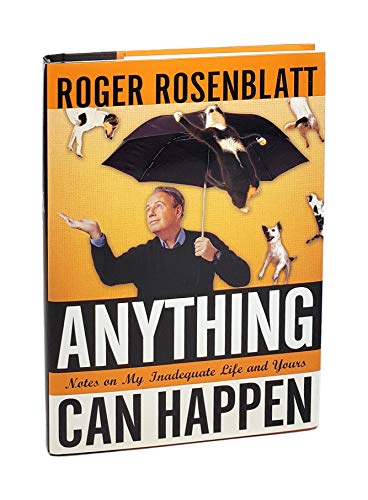
"Lyndon Johnson badgered Hubert Humphrey into killing a deer on a visit to Johnson's Texas ranch, then he sent the vice president the severed head of the animal to remind him of his power over him. That's really all there is to it." So begins "Tyranny for Beginners," one of the 60 or so short meditations on less dramatic forms of powerlessness-political, economic and otherwise. The best pieces here are significantly more scathing, and more offhandedly probing, than anything Rosenblatt does for his "essays" on PBS's Newshour with Jim Lehrer. "Dogstoevsky" satirizes the morbidity of realistic Russian fiction, while "What Bothers Me" indirectly demonstrates how it does matter if banks fail in Yonkers. Both pieces are fuzzy in concept and execution, but their very formlessness gives them a kind of immediacy. A few longer pieces are interspersed among one- and two-page snippets. The tale of how Rosenblatt (Where We Stand) and his brother pretended to be the switchboard operators at the legendary Luchow's restaurant documents human gullibility. "My Stump Speech" and "Things One Would Like to See in the Movies" send up political cliches and cinematic ones respectively. Consumer society takes it on the chin in "How I Turned into the Westin" and "The Bathroom for You." The best is nearly the last, as well as the longest; after you read "Ashley Montana Goes Ashore in the Caicos," celebrity journalism in particular and pop culture in general will never quite sound the same. The cover shows it raining cats and dogs, not inappropriately.
Copyright 2003 Reed Business Information, Inc.
Popular Time essayist and NPR NewsHour commentator Rosenblatt's latest collection of humorous vignettes is a hit-and-miss affair. His longer pieces--at that only two or three pages--are the most successful, perhaps because he takes a little time to chew on a theme, like a dog working a bone. "With Narcissus in the Aquarium" is a good example: "I can't see my reflection for the fish," Narcissus opines--perhaps the best line in the book--and Rosenblatt follows with a catalog of the briny delights that irritate his self-obsessed companion, struggling to get a peak at his own mug. On the other hand, Rosenblatt's attempts at one-liners tend to fall flat, as if Pascal had been crossed with Henny Youngman, to the benefit of neither. One is never quite sure whether Rosenblatt's self-deprecating style is a kind of reverse snobbery (his petty frustrations become indictments of a world not worthy of him), but either way, sometimes it's funny and sometimes it's lame. Just like life. Ilene Cooper
Copyright © American Library Association. All rights reserved
Excerpt. © Reprinted by permission. All rights reserved.
Take Two
I'd like to do that again, if I could, Mr. DeMille.
We haven't got all day.
I know, I'm sorry. But I think I could make it work so much better this time. One more take?
The first was fine. Time is money.
Yes, yes. Time is money. But there is so much more I could bring to the lines with a second try. I've been thinking about the part a lot. Me as a child, for instance. I was much happier than I played it. You know? And the cruelty of my folks? Their blunders? Their neglect? That wasn't exactly right, either. They were just people, you know? I probably haven't done much better as a parent.
Or worse.
Or worse! Exactly! That's what I mean, Mr. DeMille. If I could just do it over, I would make a few corrections. The marriage scenes, the scenes at work. And I wouldn't thrash around as if I regretted every move I'd ever made, either. You know? That's just acting. I didn't come close to regretting much in my life. I really liked my life. I was just wallowing in a mood.
Like the rest of us.
You said it, Mr. DeMille. Like the rest of us. And as for the lonely times-the times I dwelt on?-well, they were also the most useful. You know? Like those Sunday afternoons in winter when I wandered the city like a ghost. I played those scenes as if I'd been abandoned forever when the truth was that the time by myself made me self-confident, kind of brave. So, you see, if I could...
Do you realize what you're talking about? You're talking about reshooting the whole picture! You must be nuts!
I just don't want to leave the wrong impression.
Everybody leaves the wrong impression, kiddo. Don't worry your pretty little head about it. Oh, wow. The story was better than you played it. Happier, kinder, sweeter. Big deal.
That's it, Mr. DeMille. That's what I mean.
And if we rolled again, you'd play it happier, kinder, sweeter.
I would! I would!
And get it right this time.
Absolutely!
Know what your trouble is, kid?
What, Mr. DeMille? What's my trouble?
You don't know bupkis about movies.
My Bear
My bear is of the polar variety. He squats at the other end of my kitchen table every morning, and he stares at me with his black, black eyes. He does not move, but I hear his even snorting. Gnnn, gnnn, gnnn. Like that, in a low guttural snort that is neither threatening nor amiable. If my kitchen window is open, the breeze will flutter the tips of his white fur. He is seven or eight feet tall (I haven't measured). There is nothing immediately alarming about him; yet, once I sit down, I am afraid to move.
He has something to do with my innermost fears-anyone can see that. Or with my mood swings. Once I suggested to him that he might be a bipolar bear, but he showed no amusement. I offered him Frosted Flakes one morning, too. I do not think that bears have a sense of humor.
I cannot recall when he first appeared-some years ago, certainly. It was not in the morning that I first saw him but rather one midnight, when, for lack of sleep, I came downstairs for a snack of Jell-O and there he was, glowing white in the light of a full moon. I sat and stared at him as he stared at me. Eventually, I got sleepy and retired.
Lately, he has stirred from the kitchen, where he spends his days, and has moved up to the bedroom at night, where he squats at the foot of my bed. He seems to wish to be with me night and day. I do not know what it is about me that attracts him. If he wanted to kill me, he could have done that long ago. Bears may look cute, but they are ferocious. One swipe of the paw and I would be scattered around the room like so many pieces of paper.
One night I decided to flatter him, but it made no impression. One night I presented a philosophical monologue to him-something that yoked the fates of bears and men together in harmony. He did not so much as blink. One night I cursed him out. I don't know where I got the courage, but I even raised my hand to him. I hardly need tell you that there was no reaction.
Here's my problem: If he establishes his influence in my household, as he has pretty much done already, how long will it be before he follows me outside? How long before he accompanies me to the newsstand or the grocer's? Think of the awkwardness, the embarrassment. He is not Harvey, after all; he's not invisible. And he is certainly not sweet-natured or wise. Soon, no one will come near me out of fright.
I am thinking of calling the ASPCA. Perhaps tomorrow, or the day after that. My bear is an unwanted animal, is he not? It is the business of the ASPCA, their duty, to take unwanted animals and treat them humanely. I would not want him hurt. Yes, I will definitely call the ASPCA by the end of the week, or early next at the latest, and tell them to please rid me of my bear, my beautiful big white polar bear.
Lecture to One Suffering YetAnother Identity Crisis
You strive to know yourself, and you are convinced that such knowledge derives from certain anticipations, from knowing how you will react if she does this, if he does that, or if this reward comes your way, or that calamity. You believe that self-knowledge comes from practice: You know how you will behave if you are rejected or if you have a surfeit of success because it has all happened before. You repeat yourself. That's who you are.
Or, if you know your limitations, you will say: "I know how much I can drink or how far I will go." And you'll call that knowing yourself-as if you were a car with so much gasoline inside you or a bottle with a definite capacity.
Or you'll focus on your taste or appetites. "That simply isn't me," you'll say, while trying on a hat. "Not me. I'm a different sort of hat." And that's true. You are a different hat, of a certain size and material, to be worn in one kind of weather and not another.
Or you believe that you are several selves-a torch singer, a bruiser, a lewd woman, a mouse of a man. You're not everybody, of course. No one is everybody. But you're several people. You know that. So you love your several selves. That's who you are. Or you hate your several selves and see yourself as the enemy. That's who you are.
There is another way of looking at this question of identity. Find a point outside yourself-less idiosyncratic, less self-referential, more connected to people you have never met. It isn't hard, really.
In a hotel recently, I saw a cardboard sign posted on an easel in the lobby announcing a meeting that day of a group involved with the economics of veterinary medicine. The event was titled "Practice and Progress." In the upper right-hand corner of the sign was a yellow Post-it note that read PUT THIS UP IMMEDIATELY!
And I pictured the person to whom that Post-it was directed-he or she who waited for orders from hotel management to put up cardboard signs for hotel meetings. And having received the orders, that person acted on them promptly, lest he or she lose the job and paycheck to someone who followed orders faster and better. So this person, whoever he or she was, would, upon receipt of the daily orders, position the poster on the easel in the center of the hotel lobby where all could see it, especially those involved with the organization on the economics of veterinary medicine.
And he or she, consciously or unconsciously, would also leave the yellow Post-it in the upper right-hand corner as a sign, however small, that he or she existed at all.
Once I had pictured this person, I knew who I was.
Copyright © 2003 by Roger Rosenblatt
All rights reserved. No part of this publication may be reproduced
or transmitted in any form or by any means, electronic or mechanical,
including photocopy, recording, or any information storage and retrieval system, without permission in writing from the publisher.
Requests for permission to make copies of any part of
the work should be mailed to the following address:
Permissions Department, Harcourt, Inc.,
6277 Sea Harbor Drive, Orlando, Florida 32887-6777.
"About this title" may belong to another edition of this title.
Search results for Anything Can Happen: Notes on My Inadequate Life and...

Stock Image
Anything Can Happen: Notes on My Inadequate Life and Yours
Published by
Houghton Mifflin Harcourt, 2003
ISBN 10: 0151008663
ISBN 13: 9780151008667
Used
Hardcover
Seller: Wonder Book, Frederick, MD, U.S.A.
Seller rating 5 out of 5 stars

Condition: Good. Good condition. Very Good dust jacket. A copy that has been read but remains intact. May contain markings such as bookplates, stamps, limited notes and highlighting, or a few light stains. Seller Inventory # G05B-02604
Stock Image
Anything Can Happen: Notes on My Inadequate Life and Yours
Published by
Houghton Mifflin Harcourt, 2003
ISBN 10: 0151008663
ISBN 13: 9780151008667
Used
Hardcover
Seller: St Vincent de Paul of Lane County, Eugene, OR, U.S.A.
Seller rating 5 out of 5 stars
Condition: Good. hardcover 100% of proceeds go to charity! Good condition with all pages in tact. Item shows signs of use and may have cosmetic defects. Seller Inventory # G-02-5650
Stock Image
Anything Can Happen: Notes on My Inadequate Life and Yours
Published by
Houghton Mifflin Harcourt, 2003
ISBN 10: 0151008663
ISBN 13: 9780151008667
Used
Hardcover
Seller: ThriftBooks-Atlanta, AUSTELL, GA, U.S.A.
Seller rating 5 out of 5 stars
Hardcover. Condition: Very Good. No Jacket. May have limited writing in cover pages. Pages are unmarked. ~ ThriftBooks: Read More, Spend Less. Seller Inventory # G0151008663I4N00
Stock Image
Anything Can Happen : Notes on My Inadequate Life and Yours
Published by
Houghton Mifflin Harcourt Publishing Company, 2003
ISBN 10: 0151008663
ISBN 13: 9780151008667
Used
Hardcover
Seller: Better World Books, Mishawaka, IN, U.S.A.
Seller rating 5 out of 5 stars
Condition: Good. Pages intact with minimal writing/highlighting. The binding may be loose and creased. Dust jackets/supplements are not included. Stock photo provided. Product includes identifying sticker. Better World Books: Buy Books. Do Good. Seller Inventory # 39939515-75
Stock Image
Anything Can Happen: Notes on My Inadequate Life and Yours
Published by
Harcourt Brace & Co., Orlando, Florida, U.S.A., 2003
ISBN 10: 0151008663
ISBN 13: 9780151008667
Used
Hardcover
First Edition
Seller: UHR Books, Hollis Center, ME, U.S.A.
Seller rating 5 out of 5 stars
Hard Cover. Condition: Very Good. Dust Jacket Condition: Very Good. Stated First Edition. Clean and tight copy Size: 8vo - over 7¾" - 9¾" tall. Seller Inventory # Pb3318
Stock Image
Anything Can Happen: Notes on My Inadequate Life and Yours
Published by
Houghton Mifflin Harcourt, 2003
ISBN 10: 0151008663
ISBN 13: 9780151008667
Used
Hardcover
Seller: Housing Works Online Bookstore, New York, NY, U.S.A.
Seller rating 5 out of 5 stars
Hardcover. Condition: Good. 1. Light general wear. May have light notes/highlighting. shelf wear. bumped edges. Hardcover. Seller Inventory # EF5-03185-IN
Stock Image
Anything Can Happen: Notes on My Inadequate Life and Yours
Published by
Houghton Mifflin Harcourt, 2003
ISBN 10: 0151008663
ISBN 13: 9780151008667
Used
Hardcover
First Edition
Signed
Seller: Wonder Book, Frederick, MD, U.S.A.
Seller rating 5 out of 5 stars
Condition: Very Good. Signed Copy First edition copy. . Like New dust jacket. Inscribed to Safire by author on front endpage. In protective mylar cover. From the collection of American author, columnist, journalist, and presidential speechwriter William Safire. Seller Inventory # G15OS-00531
Stock Image
Anything Can Happen
Seller: Majestic Books, Hounslow, United Kingdom
Seller rating 4 out of 5 stars

Condition: New. pp. 192. Seller Inventory # 95427396
Buy New
US$ 11.77
US$ 8.62 shipping
Ships from United Kingdom to U.S.A.
Ships from United Kingdom to U.S.A.
Quantity: 1 available
Seller Image
Anything Can Happen: Notes on My Inadequate Life and Yours
Seller: Bidonlivre, Saint-Lambert, QC, Canada
Seller rating 5 out of 5 stars
Hardcover. Condition: As New. Dust Jacket Condition: As New. 1st Edition. 8vo, bdg, dj, As New. Seller Inventory # 3324
Buy Used
US$ 10.87
US$ 13.00 shipping
Ships from Canada to U.S.A.
Ships from Canada to U.S.A.
Quantity: 1 available
Stock Image
Anything Can Happen: Notes on My Inadequate Life and Yours
Published by
Harcourt, 2003
ISBN 10: 0151008663
ISBN 13: 9780151008667
Used
Hardcover
First Edition
Signed
Seller: Black Cat Books, Shelter Island, NY, U.S.A.
Seller rating 4 out of 5 stars
Hardcover. Condition: Very Good. Dust Jacket Condition: Very Good. 1st Edition. Hardbound in dust jacket. Signed & inscribed by Roger Rosenblatt to the previous owner on the front free end page. 1st edition. Inscribed by Author(s). Seller Inventory # 73098