
Items related to A Brilliant Solution: Inventing the American Constitution
Synopsis
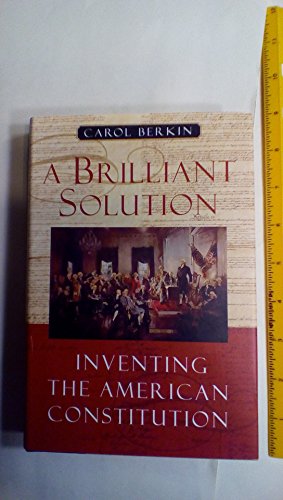
We know--and love--the story of the American Revolution, from the Declaration of Independence to Cornwallis's defeat. But the Articles of Confederation, our first government, was a disaster. This crisis caused a group of men to journey to Philadelphia in 1787 to create a lasting and more stable government.
The lawyers and politicians, some famous and others just ordinary men, had no great expectations for the document they were fashioning. Somehow, in the amalgam of ideas, argument, and compromise, a great thing happened: A constitution and a form of government were created that have served us well. Carol Berkin tells the story of that amazing summer in Philadelphia, and makes you feel as if you were there, listening to the arguments, getting to know the framers, and appreciating the difficult and critical decisions being made.
Retelling a story that is more hallowed than understood, Berkin brings us into the world of eighteenth-century America and shows us the human side of a great accomplishment.
The lawyers and politicians, some famous and others just ordinary men, had no great expectations for the document they were fashioning. Somehow, in the amalgam of ideas, argument, and compromise, a great thing happened: A constitution and a form of government were created that have served us well. Carol Berkin tells the story of that amazing summer in Philadelphia, and makes you feel as if you were there, listening to the arguments, getting to know the framers, and appreciating the difficult and critical decisions being made.
Retelling a story that is more hallowed than understood, Berkin brings us into the world of eighteenth-century America and shows us the human side of a great accomplishment.
"synopsis" may belong to another edition of this title.
About the Author
Carol Berkin is a professor of American history at CUNY, and deputy executive officer in the Ph.D. program in history. She has written five scholarly books and contributed to several collections of articles and textbooks. Berkin was the commentator for the A&E series Founding Fathers and the upcoming series Founding Brothers. She lives in New York.
From the Back Cover
"Carol Berkin has now written the liveliest and most concise account yet of the adoption of the Constitution. With unflagging verve, she sweeps readers along as she introduces the players, canvasses the issues, and explains the critical decisions. And she manages the neat and difficult trick of presenting the framers of the Constitution as living, breathing, calculating politicians while simultaneously capturing the deep seriousness of their debates and achievements. The result is a sparkling, fast-paced, and always engaging introduction to the modern world's first great exercise in constitutional invention."-- Jack N. Rakove, Pulitzer Prize-winning author of James Madison and the Creation of the American Republic
"A story all modern Americans need to know--the exciting and true tale of our nation's origins, as narrated by one of our best historians."--Professor Mary Beth Norton, Cornell University
"A story all modern Americans need to know--the exciting and true tale of our nation's origins, as narrated by one of our best historians."--Professor Mary Beth Norton, Cornell University
From the Inside Flap
"Carol Berkin has now written the liveliest and most concise account yet of the adoption of the Constitution. With unflagging verve, she sweeps readers along as she introduces the players, canvasses the issues, and explains the critical decisions. And she manages the neat and difficult trick of presenting the framers of the Constitution as living, breathing, calculating politicians while simultaneously capturing the deep seriousness of their debates and achievements. The result is a sparkling, fast-paced, and always engaging introduction to the modern world's first great exercise in constitutional invention."-- Jack N. Rakove, Pulitzer Prize-winning author of James Madison and the Creation of the American Republic
"A story all modern Americans need to know--the exciting and true tale of our nation's origins, as narrated by one of our best historians."--Professor Mary Beth Norton, Cornell University
"A story all modern Americans need to know--the exciting and true tale of our nation's origins, as narrated by one of our best historians."--Professor Mary Beth Norton, Cornell University
Reviews
Adult/High School-Berkin begins her well-organized, fast-moving account with a vivid description of the problems faced by the former colonies in 1786. The loss of protection by the British navy had crippled trade with other nations. The army that had protected the settlers moving westward no longer defended them. Military campaigns had left devastated areas populated by the penniless and homeless. The new government had an empty treasury and no authority to replenish it. In response to worsening economic conditions, and the panic inspired by Shay's Rebellion, the Confederation announced a convention of delegates to be held in Philadelphia. The debates, compromises, decisions, and astonishing successes of this remarkable group of men constitute the central theme of this book. Readers get to know these fascinating Americans through succinct character sketches that reveal their thoughts, fears, and aspirations; plentiful quotes from letters, speeches, and diaries enliven the descriptions. The book closes with biographical essays on each of the delegates, summarizing their previous and later activities, and the texts of the Articles of Confederation and the U.S. Constitution.
Kathy Tewell, Chantilly Regional Library, VA
Copyright 2003 Reed Business Information, Inc.
For the newly independent United States, the years just after the Revolution were the best of times and the worst of times: though the states celebrated their newfound freedom, they did not have a strong central government that would bind them together. Between 1776 and 1787, the proud new nation faced economic crisis, military weakness and interstate conflict problems so enormous they almost dashed all hopes for a future unified country. Yet, as historian Berkin so engagingly illustrates, James Madison, George Washington and a handful of others met in Philadelphia in 1787 to frame a creative answer to the political impasse. Berkin (First Generations: Women in Colonial America) wonderfully reveals the conflicts and compromises that characterized the drafting of the Constitution. She chronicles the development of the document itself, recording the details of each of the articles of the Constitution, for instance, and demonstrating the framers' belief in the primacy of the legislative branch. She also portrays the deep disagreements between Madison's Federalists and the states' rights advocates, such as George Mason and Edmund Randolph of Virginia, both of whom refused to sign the Constitution and swore to fight against its ratification in their state. Most important, Berkin emphasizes that the framers saw the Constitution as a working document, one that would require revision as the country grew. With the sensibilities of a novelist, Berkin tells a fast-paced story full of quirky and sympathetic characters, capturing the human dimensions of the now legendary first Constitutional Convention.
Copyright 2002 Cahners Business Information, Inc.
With this concise and masterly book, Berkin (history, CUNY; First Generations: Women in Colonial America) joins the upper ranks of popular historians. Her account of the Constitutional Convention in the summer of 1787 brings to mind Catherine Drinker Bowen's Miracle at Philadelphia and the works of Garry Wills (Inventing America; Explaining America). Like Bowen, Berkin uses a novelistic approach to convey the personalities of the delegates and the mood of those intense, sweltering days. Like Wills, she reworks dense political texts and interprets complicated historical events for a general audience. The cast of main characters (Washington, Hamilton, Madison, Franklin, Mason, Dickinson, et al.) may be familiar to most readers, but Berkin devotes equal attention to the maneuverings of the lesser-known delegates. As the central issues are debated (the election and powers of the executive, the extent of state sovereignty) and the "Great Compromise" emerges from the work of the Committee on Postponed Matters, the delegates' achievement is shown to be nothing short of spectacular. Berkin draws on a careful reading of the primary texts and major historical studies for this work, yet her book is devoid of footnotes. Instead, a "Note on Sources" serves as a bibliographic essay. Most readers won't mind this a bit. Appended are brief biographical sketches of the delegates, as well as the text of the Constitution and the Articles of Confederation. Highly recommended for public and academic libraries. Thomas A. Karel, Franklin & Marshall Coll. Lib., Lancaster, PA
Copyright 2002 Cahners Business Information, Inc.
A genre unto itself, books about the Constitutional Convention of 1787 boast all manner of treatments, from Charles Beard's quasi-Marxist An Economic Interpretation of the Constitution (1913) to the celebratory Miracle at Philadelphia by Catherine Drinker Bowen (1966). Therefore, historian Berkin, who has previously written on women in the colonial and revolutionary era, faces the challenge of having her book measured against classic works. In the main, she treats the conventioneers as experienced politicians worried by the malfunctioning government. But their worries varied: small-state delegates felt maltreated by large states; in Massachusetts, Shays' Rebellion revived a distrust of unrestrained democracy; and a few nationalists fretted about America's international impotence. Berkin's account emphasizes the importance of the delegates' anxieties, showing how they insinuated themselves into some of the compromises, such as the equality of the states in the Senate. Shrewd at integrating biographical detail on the delegates into their debates, Berkin fares well in comparison with previous historians on the topic. Gilbert Taylor
Copyright © American Library Association. All rights reserved
Excerpt. © Reprinted by permission. All rights reserved.
CHAPTER ONE
The Call for a Convention
"Our present federal government is a name, a shadow"
THE YEAR WAS 1786. It was the tenth anniversary of the Declaration of Independence and the third year of life in a new nation, but political leaders everywhere feared there was little cause to celebrate. Dark clouds and a suffocating gloom seemed to have settled over the country, and these men understood that something had gone terribly wrong. From his plantation in Virginia, George Washington lamented the steady stream of diplomatic humiliations suffered by the young Republic. Fellow Virginian James Madison talked gravely of mortal diseases afflicting the confederacy. In New Jersey William Livingston confided to a friend his doubt that the Republic could survive another decade. From Massachusetts the bookseller turned Revolutionary strategist, Henry Knox, declared, "Our present federal government is a name, a shadow, without power, or effect." And feisty, outspoken John Adams, serving as the American minister to Great Britain, observed his nation's circumstances with more than his usual pessimism. The United States, he declared, was doing more harm to itself than the British army had ever done. Alexander Hamilton, John Jay, James Monroe, Robert Morris-in short, men from every state-agreed that a serious crisis had settled upon the nation. The question was could they do anything to save their country?
It seemed like only yesterday that these same men, along with Americans everywhere, had greeted the future brightly. In 1783 Americans had looked forward confidently to reaping the benefits of independence. British political oppression, with its threat to natural rights and traditional liberties, had come to an end, and with it the challenge to America's most dearly held principle, "No taxation without representation." In every colony turned state, lawmaking was safely in the hands of a representative assembly, and a guarantee of citizens' rights was written into most state constitutions. British economic oppression had ended as well. Free from the restraints imposed by British navigation, or trade, laws, American shippers, farmers, and planters looked forward to selling tobacco and wheat directly to foreign nations, and entrepreneurs looked forward to manufacturing finished products for sale to markets abroad. New Englanders were equally optimistic, for John Adams's dogged persistence had won them the right to fish the outer banks of Newfoundland. Independence also meant that the rich farmlands west of the Appalachians were at last open to settlement, good news for ordinary farmers and perhaps even better news for major speculators like George Washington, the Lees of Virginia, and even Benjamin Franklin, who owned shares in large land companies.
Unfortunately, each of these blessings soon proved to have a darker side. True, the restrictions and injustices suffered in the colonial era had been eliminated but so, too, had many of the advantages of membership in the British empire. An independent American merchant marine was free to carry American products to the ports of their choosing, but they no longer enjoyed the protection of the British navy on the high seas. New England fishermen had won the right to fish off Newfoundland, but they had lost the guaranteed British Caribbean markets for their catch. Chesapeake tobacco planters had renounced their debts to Scottish merchants and English consignment agents when they declared independence, but in the process they had lost their most reliable sources of credit. And settlers faced no barriers to westward migration, but they could no longer rely on a well-trained and well-equipped army when Indians attacked. Slowly, Americans realized their new dilemma: Who would provide the protection colonists once found in the sheltering arms of their mother country?
The pessimism slowly engulfing men from Maine to Georgia was intensified by the lingering postwar depression in the South and in New England. Two major British military campaigns had left the Carolinas in shambles, with scores of homeless and penniless still to be cared for. Rice planters had to replace much of their labor force as hundreds of slaves had run away or found refuge in British army camps. Farther north peace, not war, had dealt the crushing blow to New England's economy. Despairing, idle fishermen could be seen in every seaport town, helpless in the face of British trade restrictions against them in the West Indies. Local agriculture fared no better. Far from the battlefield during most of the Revolution, New England farmers had expanded their production to meet the demands for food in other regions. Now that farming had resumed in every state, New Englanders were scrambling to meet mortgage payments for land they had cleared and planted during the Revolution. A wave of foreclosures and evictions swept across the western counties of Massachusetts, and local prisons soon overflowed with debtors. In Berkshire and Hampshire Counties, the busiest workers were local carpenters, called upon to construct larger jails.
These nagging economic problems had not brought Americans closer together. Wherever one looked, the competing interests of creditors and debtors, rural farmers and urban merchants, artisans and importers, acted as centrifugal forces, dividing the nation. While state governments debated what to do, private citizens took matters into their own hands. Disgruntled Vermont farmers, who had declared their independence from New York in 1777, demanded that the new American government, the Confederation Congress, recognize their statehood. More disturbing was the news that in New Jersey, South Carolina, Pennsylvania, Virginia, and Maryland, backcountry farmers were rising up in armed rebellion and had to be controlled by militia units.
Relationships among the states were no better. In the aftermath of the Revolution, real political power resided in these state governments. Animated by a heartfelt ill will and rivalry, state legislators missed no opportunity to exploit the weakness of their neighbors. They rushed to enact tariffs and trade barriers, replacing the hated British restrictions with restrictions of their own. New Jersey had gone so far as to create its own customs service, an ironic tribute to the regulatory system of its former British rulers. Virginia's penalties for avoiding its interstate import duties would have impressed even the most venal British customs men. With duties to pay at every state border, even the most intrepid merchant or shipper found interstate commerce a nightmare. States with natural advantages made every effort to abuse those without them. Virginia and South Carolina cheerfully squeezed what they could out of hapless North Carolina. Meanwhile, New York and Pennsylvania, both blessed with major ports, imposed steep duties on all goods destined for neighboring states. James Madison described New Jersey, trapped between the two states, as "a cask tapped at both ends." Connecticut also fell victim to New York's greed. Tired of being victimized, Connecticut and New Jersey were rumored to be planning a joint assault on New York.
Other sovereign rights claimed by the states hurt domestic trade. Each state insisted on issuing its own currency, and, thus, a New Yorker sending goods to South Carolina ran a gauntlet of ever-fluctuating exchange rates before his wares reached their final destination. By 1785 the conflict and chaos created by thirteen independent mercantile systems was obvious, yet calls for commercial cooperation that year and the following year were met with suspicion, resistance-and a decided lack of interest.
The solution to these problems, and others, would seem to modern Americans to be the task of the national government. But in 1786 the national government was ill equipped to handle even the smallest crisis. Many of the men who created that government now realized how badly flawed it was. Indeed, it was this faltering, floundering government that threatened, in Washington's view, to condemn America to appear as a "humiliating and contemptible figure...in the annals of mankind."
America's first constitution, the Articles of Confederation, had been written by the Second Continental Congress soon after the Declaration of Independence was signed. Pennsylvania lawyer John Dickinson was called upon to produce the first draft of the document, but the conservative Dickinson's inclination toward a strong central government did not sit well with his fellow Revolutionaries. Congress made short shrift of the document Dickinson presented, systematically editing out any suggestion that the Confederation would enjoy any real power over the states. Where Dickinson's version began with a firm declaration that the "Colonies unite themselves so as never to be divided by any Act whatever," the amended version began with the equally firm declaration that "each state retains its sovereignty, freedom, and independence."
It was not hard to understand why a congress sitting in 1776 preferred a "firm league of friendship" rather than a potent central government. What, after all, was the country waging war against but the tyranny of centralized power? And what were they fighting for but to secure the absolute sovereignty of their local representative assemblies? For these Revolutionaries, the rallying cry of "No taxation without representation" had meaning only in the context of their local colonial assemblies, now free from the oppression of the British Parliament and the British king. The Revolution was not one battle for independence but thirteen-proof that a profound localism still trumped any embryonic identity as "Americans." These identities were, after all, relational: Patrick Henry, John Adams, and Richard Henry Lee were Americans when they contrasted themselves with the citizens, government officials, and soldiers of England, but at home, when they looked to their own right and left, they were Virginians, New Jerseyites, Connecticut men. Thus, when Patrick Henry declared in 1774 that he was no longer a Virginian but an Ame...
The Call for a Convention
"Our present federal government is a name, a shadow"
THE YEAR WAS 1786. It was the tenth anniversary of the Declaration of Independence and the third year of life in a new nation, but political leaders everywhere feared there was little cause to celebrate. Dark clouds and a suffocating gloom seemed to have settled over the country, and these men understood that something had gone terribly wrong. From his plantation in Virginia, George Washington lamented the steady stream of diplomatic humiliations suffered by the young Republic. Fellow Virginian James Madison talked gravely of mortal diseases afflicting the confederacy. In New Jersey William Livingston confided to a friend his doubt that the Republic could survive another decade. From Massachusetts the bookseller turned Revolutionary strategist, Henry Knox, declared, "Our present federal government is a name, a shadow, without power, or effect." And feisty, outspoken John Adams, serving as the American minister to Great Britain, observed his nation's circumstances with more than his usual pessimism. The United States, he declared, was doing more harm to itself than the British army had ever done. Alexander Hamilton, John Jay, James Monroe, Robert Morris-in short, men from every state-agreed that a serious crisis had settled upon the nation. The question was could they do anything to save their country?
It seemed like only yesterday that these same men, along with Americans everywhere, had greeted the future brightly. In 1783 Americans had looked forward confidently to reaping the benefits of independence. British political oppression, with its threat to natural rights and traditional liberties, had come to an end, and with it the challenge to America's most dearly held principle, "No taxation without representation." In every colony turned state, lawmaking was safely in the hands of a representative assembly, and a guarantee of citizens' rights was written into most state constitutions. British economic oppression had ended as well. Free from the restraints imposed by British navigation, or trade, laws, American shippers, farmers, and planters looked forward to selling tobacco and wheat directly to foreign nations, and entrepreneurs looked forward to manufacturing finished products for sale to markets abroad. New Englanders were equally optimistic, for John Adams's dogged persistence had won them the right to fish the outer banks of Newfoundland. Independence also meant that the rich farmlands west of the Appalachians were at last open to settlement, good news for ordinary farmers and perhaps even better news for major speculators like George Washington, the Lees of Virginia, and even Benjamin Franklin, who owned shares in large land companies.
Unfortunately, each of these blessings soon proved to have a darker side. True, the restrictions and injustices suffered in the colonial era had been eliminated but so, too, had many of the advantages of membership in the British empire. An independent American merchant marine was free to carry American products to the ports of their choosing, but they no longer enjoyed the protection of the British navy on the high seas. New England fishermen had won the right to fish off Newfoundland, but they had lost the guaranteed British Caribbean markets for their catch. Chesapeake tobacco planters had renounced their debts to Scottish merchants and English consignment agents when they declared independence, but in the process they had lost their most reliable sources of credit. And settlers faced no barriers to westward migration, but they could no longer rely on a well-trained and well-equipped army when Indians attacked. Slowly, Americans realized their new dilemma: Who would provide the protection colonists once found in the sheltering arms of their mother country?
The pessimism slowly engulfing men from Maine to Georgia was intensified by the lingering postwar depression in the South and in New England. Two major British military campaigns had left the Carolinas in shambles, with scores of homeless and penniless still to be cared for. Rice planters had to replace much of their labor force as hundreds of slaves had run away or found refuge in British army camps. Farther north peace, not war, had dealt the crushing blow to New England's economy. Despairing, idle fishermen could be seen in every seaport town, helpless in the face of British trade restrictions against them in the West Indies. Local agriculture fared no better. Far from the battlefield during most of the Revolution, New England farmers had expanded their production to meet the demands for food in other regions. Now that farming had resumed in every state, New Englanders were scrambling to meet mortgage payments for land they had cleared and planted during the Revolution. A wave of foreclosures and evictions swept across the western counties of Massachusetts, and local prisons soon overflowed with debtors. In Berkshire and Hampshire Counties, the busiest workers were local carpenters, called upon to construct larger jails.
These nagging economic problems had not brought Americans closer together. Wherever one looked, the competing interests of creditors and debtors, rural farmers and urban merchants, artisans and importers, acted as centrifugal forces, dividing the nation. While state governments debated what to do, private citizens took matters into their own hands. Disgruntled Vermont farmers, who had declared their independence from New York in 1777, demanded that the new American government, the Confederation Congress, recognize their statehood. More disturbing was the news that in New Jersey, South Carolina, Pennsylvania, Virginia, and Maryland, backcountry farmers were rising up in armed rebellion and had to be controlled by militia units.
Relationships among the states were no better. In the aftermath of the Revolution, real political power resided in these state governments. Animated by a heartfelt ill will and rivalry, state legislators missed no opportunity to exploit the weakness of their neighbors. They rushed to enact tariffs and trade barriers, replacing the hated British restrictions with restrictions of their own. New Jersey had gone so far as to create its own customs service, an ironic tribute to the regulatory system of its former British rulers. Virginia's penalties for avoiding its interstate import duties would have impressed even the most venal British customs men. With duties to pay at every state border, even the most intrepid merchant or shipper found interstate commerce a nightmare. States with natural advantages made every effort to abuse those without them. Virginia and South Carolina cheerfully squeezed what they could out of hapless North Carolina. Meanwhile, New York and Pennsylvania, both blessed with major ports, imposed steep duties on all goods destined for neighboring states. James Madison described New Jersey, trapped between the two states, as "a cask tapped at both ends." Connecticut also fell victim to New York's greed. Tired of being victimized, Connecticut and New Jersey were rumored to be planning a joint assault on New York.
Other sovereign rights claimed by the states hurt domestic trade. Each state insisted on issuing its own currency, and, thus, a New Yorker sending goods to South Carolina ran a gauntlet of ever-fluctuating exchange rates before his wares reached their final destination. By 1785 the conflict and chaos created by thirteen independent mercantile systems was obvious, yet calls for commercial cooperation that year and the following year were met with suspicion, resistance-and a decided lack of interest.
The solution to these problems, and others, would seem to modern Americans to be the task of the national government. But in 1786 the national government was ill equipped to handle even the smallest crisis. Many of the men who created that government now realized how badly flawed it was. Indeed, it was this faltering, floundering government that threatened, in Washington's view, to condemn America to appear as a "humiliating and contemptible figure...in the annals of mankind."
America's first constitution, the Articles of Confederation, had been written by the Second Continental Congress soon after the Declaration of Independence was signed. Pennsylvania lawyer John Dickinson was called upon to produce the first draft of the document, but the conservative Dickinson's inclination toward a strong central government did not sit well with his fellow Revolutionaries. Congress made short shrift of the document Dickinson presented, systematically editing out any suggestion that the Confederation would enjoy any real power over the states. Where Dickinson's version began with a firm declaration that the "Colonies unite themselves so as never to be divided by any Act whatever," the amended version began with the equally firm declaration that "each state retains its sovereignty, freedom, and independence."
It was not hard to understand why a congress sitting in 1776 preferred a "firm league of friendship" rather than a potent central government. What, after all, was the country waging war against but the tyranny of centralized power? And what were they fighting for but to secure the absolute sovereignty of their local representative assemblies? For these Revolutionaries, the rallying cry of "No taxation without representation" had meaning only in the context of their local colonial assemblies, now free from the oppression of the British Parliament and the British king. The Revolution was not one battle for independence but thirteen-proof that a profound localism still trumped any embryonic identity as "Americans." These identities were, after all, relational: Patrick Henry, John Adams, and Richard Henry Lee were Americans when they contrasted themselves with the citizens, government officials, and soldiers of England, but at home, when they looked to their own right and left, they were Virginians, New Jerseyites, Connecticut men. Thus, when Patrick Henry declared in 1774 that he was no longer a Virginian but an Ame...
"About this title" may belong to another edition of this title.
Search results for A Brilliant Solution: Inventing the American Constitution

Stock Image
A Brilliant Solution: Inventing the American Constitution
Seller: Orion Tech, Kingwood, TX, U.S.A.
Seller rating 5 out of 5 stars

hardcover. Condition: Good. Seller Inventory # 0151009481-3-37397005
Stock Image
A Brilliant Solution: Inventing the American Constitution
Seller: World of Books (was SecondSale), Montgomery, IL, U.S.A.
Seller rating 5 out of 5 stars
Hardback. Condition: Good. If you've ever wondered how a group of 18th-century soldiers, farmers, lawyers and businessmen managed to come up with our miracle of a Constitution . . . Berkin explains it in her exciting re-creation.-The Star-Ledger (Newark) We know the story of the American Revolution, from the Declaration of Independence to Cornwallis's defeat. But our first government ended in disaster, leaving the budding country in a terrible crisis. When a group of men traveled to Philadelphia in the summer of 1787 to save a nation in danger of collapse, they had no great expectations for the meeting that would make history and lead to a constitution and a government that have outlasted their highest hopes. Revisiting original documents and using her deep knowledge of eighteenth-century history and politics, Carol Berkin reveals the human strength behind our country's great constitution. Take s a f re s h l ook at the much-trampled ground of Philadelphia in 1787. Drops the, 'It all came down to us written on a stone tablet' pose and goes into all the confusion, paranoia and luck involved.-MOLY IVINS, The Seattle Times C A R O L B E R K I N is a professor of American History at Baruch College and the Ph.D. program in History at the Graduate Center of the City University of New York. The author of five books, Berkin was a commentator for the PBS documentary Benjamin Franklin. Seller Inventory # 00106634024
Stock Image
A Brilliant Solution: Inventing the American Constitution
Seller: World of Books (was SecondSale), Montgomery, IL, U.S.A.
Seller rating 5 out of 5 stars
Hardback. Condition: Very Good. If you've ever wondered how a group of 18th-century soldiers, farmers, lawyers and businessmen managed to come up with our miracle of a Constitution . . . Berkin explains it in her exciting re-creation.-The Star-Ledger (Newark) We know the story of the American Revolution, from the Declaration of Independence to Cornwallis's defeat. But our first government ended in disaster, leaving the budding country in a terrible crisis. When a group of men traveled to Philadelphia in the summer of 1787 to save a nation in danger of collapse, they had no great expectations for the meeting that would make history and lead to a constitution and a government that have outlasted their highest hopes. Revisiting original documents and using her deep knowledge of eighteenth-century history and politics, Carol Berkin reveals the human strength behind our country's great constitution. Take s a f re s h l ook at the much-trampled ground of Philadelphia in 1787. Drops the, 'It all came down to us written on a stone tablet' pose and goes into all the confusion, paranoia and luck involved.-MOLY IVINS, The Seattle Times C A R O L B E R K I N is a professor of American History at Baruch College and the Ph.D. program in History at the Graduate Center of the City University of New York. The author of five books, Berkin was a commentator for the PBS documentary Benjamin Franklin. Seller Inventory # CIN0151009481VG
Seller Image
A Brilliant Solution: Inventing the American Constitution
Seller: 3Brothers Bookstore, Egg harbor township, NJ, U.S.A.
Seller rating 5 out of 5 stars
Condition: good. Former library copy. Books may contain some notes and highlighting. Supplements such as Access Codes, Cd's Dust Jackets, etc. are not guaranteed with used book purchases. Seller Inventory # EVV.0151009481.G
Seller Image
A Brilliant Solution: Inventing the American Constitution
Seller: Greenworld Books, Arlington, TX, U.S.A.
Seller rating 5 out of 5 stars
Condition: very_good. Fast Free Shipping â" Very Good condition book with a firm cover and clean pages. Shows normal use and some light wear or limited notes markings. A solid, nice copy to enjoy. Seller Inventory # GWV.0151009481.VG
Seller Image
A Brilliant Solution: Inventing the American Constitution
Seller: Greenworld Books, Arlington, TX, U.S.A.
Seller rating 5 out of 5 stars
Condition: good. Fast Free Shipping â" Good condition. It may show normal signs of use, such as light writing, highlighting, or library markings, but all pages are intact and the book is fully readable. A solid, complete copy that's ready to enjoy. Seller Inventory # GWV.0151009481.G
Stock Image
A Brilliant Solution: Inventing the American Constitution
Seller: More Than Words, Waltham, MA, U.S.A.
Seller rating 5 out of 5 stars
Condition: Very Good. A bright, square, and overall a nice copy. Seller Inventory # BOS-T-13g-01665
Stock Image
A Brilliant Solution: Inventing the American Constitution
Seller: Half Price Books Inc., Dallas, TX, U.S.A.
Seller rating 5 out of 5 stars
hardcover. Condition: Very Good. Connecting readers with great books since 1972! Used books may not include companion materials, and may have some shelf wear or limited writing. We ship orders daily and Customer Service is our top priority! Seller Inventory # S_480587091
Stock Image
A Brilliant Solution: Inventing the American Constitution
Seller: World of Books Inc, Montgomery, IL, U.S.A.
Seller rating 4 out of 5 stars

Hardback. Condition: Good. If you've ever wondered how a group of 18th-century soldiers, farmers, lawyers and businessmen managed to come up with our miracle of a Constitution . . . Berkin explains it in her exciting re-creation.-The Star-Ledger (Newark) We know the story of the American Revolution, from the Declaration of Independence to Cornwallis's defeat. But our first government ended in disaster, leaving the budding country in a terrible crisis. When a group of men traveled to Philadelphia in the summer of 1787 to save a nation in danger of collapse, they had no great expectations for the meeting that would make history and lead to a constitution and a government that have outlasted their highest hopes. Revisiting original documents and using her deep knowledge of eighteenth-century history and politics, Carol Berkin reveals the human strength behind our country's great constitution. Take s a f re s h l ook at the much-trampled ground of Philadelphia in 1787. Drops the, 'It all came down to us written on a stone tablet' pose and goes into all the confusion, paranoia and luck involved.-MOLY IVINS, The Seattle Times C A R O L B E R K I N is a professor of American History at Baruch College and the Ph.D. program in History at the Graduate Center of the City University of New York. The author of five books, Berkin was a commentator for the PBS documentary Benjamin Franklin. Seller Inventory # CIN0151009481G
Stock Image
A Brilliant Solution: Inventing the American Constitution
Seller: World of Books Inc, Montgomery, IL, U.S.A.
Seller rating 4 out of 5 stars
Hardback. Condition: Very Good. If you've ever wondered how a group of 18th-century soldiers, farmers, lawyers and businessmen managed to come up with our miracle of a Constitution . . . Berkin explains it in her exciting re-creation.-The Star-Ledger (Newark) We know the story of the American Revolution, from the Declaration of Independence to Cornwallis's defeat. But our first government ended in disaster, leaving the budding country in a terrible crisis. When a group of men traveled to Philadelphia in the summer of 1787 to save a nation in danger of collapse, they had no great expectations for the meeting that would make history and lead to a constitution and a government that have outlasted their highest hopes. Revisiting original documents and using her deep knowledge of eighteenth-century history and politics, Carol Berkin reveals the human strength behind our country's great constitution. Take s a f re s h l ook at the much-trampled ground of Philadelphia in 1787. Drops the, 'It all came down to us written on a stone tablet' pose and goes into all the confusion, paranoia and luck involved.-MOLY IVINS, The Seattle Times C A R O L B E R K I N is a professor of American History at Baruch College and the Ph.D. program in History at the Graduate Center of the City University of New York. The author of five books, Berkin was a commentator for the PBS documentary Benjamin Franklin. Seller Inventory # CIN0151009481VG