
Items related to The Great Philosophers: The Disturbers : Descartes...
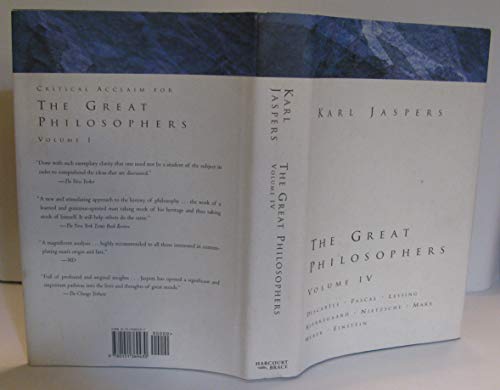
The Great Philosophers: The Disturbers : Descartes Pascal Lessing Kierkegaard Nietzsche : Philosophers in Other Realms : Einstein Weber Marx - Hardcover
Synopsis
The fourth and final volume of a late modern philosopher's critical study discusses the contributions of Descartes, Pascal, Kierkegaard, Nietzsche, Weber, Marx, and Einstein, and notes the various influences on their theories.
"synopsis" may belong to another edition of this title.
About the Author
Karl Jaspers (1883-1969), a founder of existentialism, studied law and medicine at the University of Heidelberg in Germany, and received his M.D. in 1909. He taught psychiatry and philosophy at the University of Heidelberg, and philosophy at the University of Basel in Switzerland. His books include Psychology of World Views, and Philosophy.
Reviews
The "great awakeners," according to German existentialist philospher Karl Jaspers (1883-1969), are those thinkers who anticipated the crises of their age, exposing conventions as defunct in order to recall us to ourselves. The awakeners he probes in these challenging, highly personal essays-Blaise Pascal, Soren Kierkegaard, Friedrich Nietzsche, Gotthold Lessing-all grew from the soil of Christianity (Nietzsche's negation of Christianity betrays his ties to Christian standards, Jaspers argues). In this fourth and final volume of his ambitious survey of philosophy, Jaspers attacks the scientific dogmatism of Descartes and the political dogmatism of Marx. He views Einstein as a revolutionary scientist but severely limited in his insights into social and political complexities. German sociologist Max Weber (who died in 1920), prescient analyst of bureaucracy and mass movements, emerges here as an exemplar of his age but, paradoxically, an ineffectual figure who hardly touched his time.
Copyright 1994 Reed Business Information, Inc.
Rigorous yet readable notes, sketches, and articles that round out a four-volume panorama of the philosophical pantheon. The eminent existential philosopher Jaspers (18831969) died before he could complete this work. Editors Ermarth and Ehrlich have, however, been able to stitch together a coherent book that, in accordance with Jaspers's plan, primarily covers the philosophers whom he termed ``the disturbers'': thinkers for whom doubt and despair loomed large. Jaspers opens with a discussion of Descartes. A disturber in the probing style of his thought, he stands apart, however, insofar as he compartmentalized issues of faith and philosophy. The other disturbers Jaspers characterizes as ``great awakeners.'' Working the boundaries between philosophy and theology, they sought to think man back to some sense of completeness. These include Pascal, whose famous wager for the existence of God Jaspers critiques at some length; Kierkegaard, the great philosopher of faith, over whom Jaspers lingers longest; and Nietzsche, discussed briefly in part as a counterpoint to Kierkegaard. Interestingly, Jaspers includes a chapter on the 18th- century theoretician and critic Gotthold Ephraim Lessing, declaring his work to be exemplary for its critical discernment. In a short section on ``philosophers in other realms,'' such as the sciences, Jaspers discusses the philosophical import and the (in his view) severe limits of Einstein's thought. Max Weber, in contrast, elicits unstinting praise. The book closes with an appreciation of Marx that subsumes a harsh critique of the Marxist style of disputation. Jaspers makes information about philosophers' lives and the dissemination of their works integral to his accounts of their ideas. Thus a sense of history and of human contingency pervade these pieces. Twenty-five years after its author's death, this is by no means a cutting-edge work--but this great thinker's ruminations on his predecessors have a timeless quality to them. -- Copyright ©1994, Kirkus Associates, LP. All rights reserved.
When Jaspers died in 1969, he left the materials for the third and fourth volumes of his history of human thought. This fourth and final volume (following publication of the third, LJ 9/15/93) brings the history up to the mid-20th century. For each writer he discusses, Jaspers provides a biography, a discussion of major works and themes, and a critical assessment. Since the text is compiled from notes left by Jaspers, the depth of analysis is varied, but the editors have done a commendable job in trying to provide the reader with a feel for what Jaspers proposed to accomplish. It is unfortunate that Jaspers was unable to finish this work before his death; had he done so, it would have earned a well-deserved place among other histories of thought, e.g., Frederick Copleston and Emile Brehier. This work's importance today is founded as much on the eminence of its author as it is on its contents. Recommended for academic libraries supporting broad programs in philosophy and the history of ideas.
Terry Skeats, Bishop's Univ. Lib., Lennoxville, Quebec
Copyright 1994 Reed Business Information, Inc.
Following volume 3, this tome finishes Jaspers' global survey of philosophers; it conveys an unfinished quality due to its being posthumously assembled from his papers. Some of these taciturn jottings resemble lecture notes, but even they display Jaspers' strength as a philosophy teacher, which he was for 60 years in Germany and Switzerland. Here, he only sketchily presents the thought of Weber, Einstein, and Marx, but robustly engages Descartes, Pascal, Lessing, Nietzsche, and Kierkegaard--the latter with "some trepidation"--for Jaspers wonders whether the big K can be taught at all, an existential problem bound to beset a teacher with self-doubt. Yet he bravely forges ahead on Kierkegaard, the longest section of this work, with a biographical profile, summary of works, and analysis of his thought, a format Jaspers applies to each philosopher. He denominates this group collectively as "The Great Awakeners" : they separated man from Christian revelation and salvation and compelled him to face the abyss of his isolation. For these original if chilling thinkers, as for the greats in his prior books, Jaspers was the premier expositor of the century to college students. Larger libraries should see some steady, though not heavy, use of this title over the years. Gilbert Taylor
"About this title" may belong to another edition of this title.
Search results for The Great Philosophers: The Disturbers : Descartes...

Stock Image
The Great Philosophers: The Disturbers : Descartes Pascal Lessing Kierkegaard Nietzsche : Philosophers in Other Realms : Einstein Weber Marx
Published by
Houghton Mifflin Harcourt, 1995
ISBN 10: 0151369437
ISBN 13: 9780151369430
Used
Paperback
Seller: WorldofBooks, Goring-By-Sea, WS, United Kingdom
Seller rating 5 out of 5 stars

Paperback. Condition: Very Good. The book has been read, but is in excellent condition. Pages are intact and not marred by notes or highlighting. The spine remains undamaged. Seller Inventory # GOR006055152
Buy Used
US$ 24.34
US$ 7.41 shipping
Ships from United Kingdom to U.S.A.
Ships from United Kingdom to U.S.A.
Quantity: 1 available
Seller Image
The Great Philosophers: The Disturbers : Descartes Pascal Lessing Kierkegaard Nietzsche : Philosophers in Other Realms : Einstein Weber Marx
Published by
Houghton Mifflin Harcourt, 1995
ISBN 10: 0151369437
ISBN 13: 9780151369430
Used
Hardcover
Seller: Goodwill Industries, Spokane, WA, U.S.A.
Seller rating 5 out of 5 stars
Condition: good. Condition: Good â" Used book with some visible wear. May include stickers on the cover, wear or absence of the dust jacket, wear to the spine or inside cover, slight corner curling, minor staining, and wear along the fore edge. All orders are shipped via UPS Mail Innovations and may take up to 10 business days from the initial scan to be delivered. Seller Inventory # INWV.0151369437.G
Stock Image
Great Philosophers Volume 4 Vol. 4 : Descartes, Pascal, Lessing, Kierkegaard, Nietzsche, Marx, Weber, Einstein
Published by
Houghton Mifflin Harcourt Publishing Company, 1995
ISBN 10: 0151369437
ISBN 13: 9780151369430
Used
Hardcover
Seller: Better World Books, Mishawaka, IN, U.S.A.
Seller rating 5 out of 5 stars
Condition: Good. Former library copy. Pages intact with minimal writing/highlighting. The binding may be loose and creased. Dust jackets/supplements are not included. Includes library markings. Stock photo provided. Product includes identifying sticker. Better World Books: Buy Books. Do Good. Seller Inventory # 2226554-6
Stock Image
Great Philosophers Volume 4: Descartes, Pascal, Lessing, Kierkegaard, Nietzsche, Marx, Weber, Einstein
Seller: BennettBooksLtd, Los Angeles, CA, U.S.A.
Seller rating 5 out of 5 stars
hardcover. Condition: New. In shrink wrap. Looks like an interesting title! Seller Inventory # Q-0151369437
Stock Image
The Great Philosophers: The Disturbers : Descartes Pascal Lessing Kierkegaard Nietzsche : Philosophers in Other Realms : Einstein Weber Marx
Published by
Houghton Mifflin Harcourt, 1995
ISBN 10: 0151369437
ISBN 13: 9780151369430
New
Hardcover
Seller: GoldBooks, Denver, CO, U.S.A.
Seller rating 5 out of 5 stars
Hardcover. Condition: new. New Copy. Customer Service Guaranteed. Seller Inventory # 45C39_49_0151369437
Stock Image
The Great Philosophers: The Disturbers : Descartes Pascal Lessing Kierkegaard Nietzsche : Philosophers in Other Realms : Einstein Weber Marx
Published by
Houghton Mifflin Harcourt, 1995
ISBN 10: 0151369437
ISBN 13: 9780151369430
Used
Hardcover
Seller: YESIBOOKSTORE, MIAMI, FL, U.S.A.
Seller rating 5 out of 5 stars
hardcover. Condition: As New. Seller Inventory # 0151369437-VB