
Synopsis
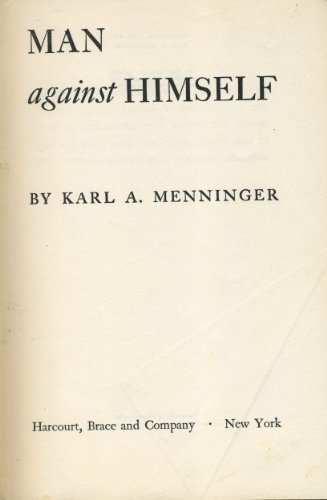
Menninger writes in the preface: 'This book is an attempt to synthesize and to carry forward...the work begun by Ferenczi, Groddeck, Jelliffe, White, Alexander, Simmel, and others.....' 'We have come to see that just as the child must learn to love wisely, so he must learn to hate expeditiously, to turn destructive tendencies away from himself toward enemies that actually threaten him rather than toward the friendly and the defenseless, the more usual victims of destructive energy.' Ironically, 'Man Against Himself' was published in the same year as Chamberlain's pact for 'peace in our time.' How prophetic his words, 'If such is our nature, it were better that we knew it and knew it in all its protean manifestations.' Menninger develops his analysis of our destructive tendencies in six chapters: Destruction, Suicide, Chronic Suicide, Focal Suicide, Organic Suicide, and Reconstruction. 485 pages.
"synopsis" may belong to another edition of this title.
From the Back Cover
In this landmark book the impulse toward self-destructiveness is examined as a misdirection of the instinct for survival, a turning inward of the aggressive behavior developed for self-preservation. The self-imposed illness, despair, even suicide, that result from this conflict are compassionately yet objectively analyzed and documented through case histories. Drawing on the work of such pioneers as Ferenczi, Groddeck, Jelliffe, White, Alexander, and Simmel, Menninger shows that intelligent self-knowledge can bring self-respect and understanding into man's psychological war against himself--on the side of self-preservation.
About the Author
Karl Augustus Menninger (July 22, 1893 - July 18, 1990), born in Topeka, Kansas, was an American psychiatrist and a member of the famous Menninger family of psychiatrists who founded the Menninger Foundation and the Menninger Clinic in Topeka, Kansas.
During his career, Menninger wrote a number of influential books. In his first book, The Human Mind, Menninger argued that psychiatry was a science and that the mentally ill were only slightly different than healthy individuals. In The Crime of Punishment, Menninger argued that crime was preventable through psychiatric treatment; punishment was a brutal and inefficient relic of the past. He advocated treating offenders like the mentally ill.
His subsequent books include The Vital Balance, Man Against Himself and Love Against Hate.
"About this title" may belong to another edition of this title.
Other Popular Editions of the Same Title

Search results for Man Against Himself

Stock Image
Man Against Himself
Seller: ThriftBooks-Dallas, Dallas, TX, U.S.A.
Seller rating 5 out of 5 stars

Hardcover. Condition: Fair. No Jacket. Missing dust jacket; Readable copy. Pages may have considerable notes/highlighting. ~ ThriftBooks: Read More, Spend Less. Seller Inventory # G0151565139I5N01