
Items related to Words With Power: Being a Second Study of The Bible...
Words With Power: Being a Second Study of The Bible and Literature - Hardcover
Book 27 of 27: Collected Works of Northrop Frye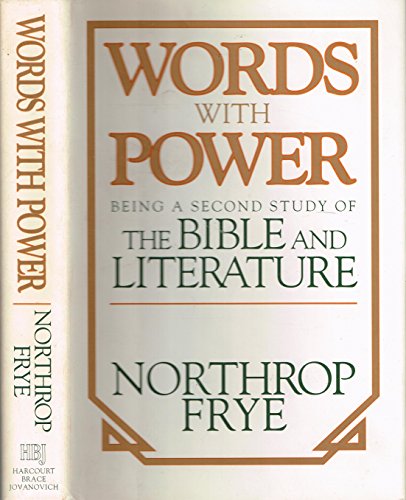
Synopsis
Argues that all mythologies are transmitted and diversified by literature, and discusses the social function of literature and the role of metaphor
"synopsis" may belong to another edition of this title.
Reviews
The Bible is saturated with myth and metaphor, writes Frye. In this sequel to The Great Code: The Bible and Literature , the eminent critic places biblical imagery and narrative structure within the framework of Western literature. He traces Jacob's dream of the ladder (Genesis 28) back to ancient Near Eastern religions, and forward to T. S. Eliot. He reads Moby Dick as a modern reworking of the Bible's leviathan symbolism. He interprets the Tower of Babel as "a cyclical symbol, an example of the rising and falling of great kingdoms," with parallels in Joyce's Finnegans Wake. The first half of this tremendously rich study lays a theoretical groundwork that will interest mainly specialists; the second half delves deeply into biblical stories and metaphors, illuminating their meanings for our time and catching their echoes in Shakespeare, Dante, Shelley, Yeats, Spenser, Eliot and Verlaine.
Copyright 1990 Reed Business Information, Inc.
In his introduction to The Great Code ( LJ 6/1/82), Frye promised a sequel to his work on "the Bible and literature." Here is the promised volume, though it is not an entirely new book. In Part 1, Frye restates his critical position, his structural principle: the identity of mythology and literature. In Part 2, he focuses on specific mythological themes (mountain, garden, cave, furnace) that are variations of the cosmic axis mundi image. Throughout, he demonstrates his interest in the mythological structures that inform literature, including the Bible, instead of simply the literary characteristics of the Bible. While it is undeniable that myths often serve as structuring elements in the Bible, occasionally Frye allows myth criticism to overwhelm the text rather than shed light upon it. Thus there is the risk of forcing the text into the pre-established structure. This aside, there is enlightenment available for readers willing to work through it. Recommended.
- Craig W. Beard, Har ding Univ. Lib., Searcy, Ark.
Copyright 1990 Reed Business Information, Inc.
"About this title" may belong to another edition of this title.
Search results for Words With Power: Being a Second Study of The Bible...

Stock Image
Words With Power: Being a Second Study of The Bible and Literature
Published by
Houghton Mifflin Harcourt P, 1990
ISBN 10: 015198462X
ISBN 13: 9780151984626
Used
Hardcover
Seller: World of Books (was SecondSale), Montgomery, IL, U.S.A.
Seller rating 5 out of 5 stars

Hardback. Condition: Good. Words with Power is the crowning achievement of the latter half of Northrop Frye's career. Portions of the work can be found in Frye's notebooks as far back as the mid-1960s when he had just finished Anatomy of Criticism, and he completed the book shortly before his death in 1991. Beyond summing up his ideas about the relation of the Bible to Western culture, Words with Power boldly confronts a host of questions ranging from the relationship between literature and ideology to the real meaning of words like 'spirit' and 'faith.' The first half of the 'double mirror' structure looks at the language in which the Bible is written, arguing that it is identical to that of myth and metaphor. Frye suggests, therefore, that given this characteristic, the Bible should be read imaginatively rather than historically or doctrinally. However, he is also careful to point out the ways in which the Bible is more than a conventional work of fiction. The second half is an astonishing tour de force in which Frye demonstrates how both the Bible and literature revolve around four primary concerns of human life.This edition goes beyond the original in its documentation of Frye's dazzlingly encyclopedic range of reference. Profound and searching, Words with Power is perhaps the most daring book of Frye's career and one of the most exciting. Seller Inventory # 00106389336
Stock Image
Words with Power : Being a Secondary Study of the Bible and Literature
Published by
Harcourt Trade Publishers, 1990
ISBN 10: 015198462X
ISBN 13: 9780151984626
Used
Hardcover
First Edition
Seller: Better World Books, Mishawaka, IN, U.S.A.
Seller rating 5 out of 5 stars
Condition: Good. 1st ed. Pages intact with minimal writing/highlighting. The binding may be loose and creased. Dust jackets/supplements are not included. Stock photo provided. Product includes identifying sticker. Better World Books: Buy Books. Do Good. Seller Inventory # 4659603-6
Stock Image
Words with Power : Being a Secondary Study of the Bible and Literature
Published by
Harcourt Trade Publishers, 1990
ISBN 10: 015198462X
ISBN 13: 9780151984626
Used
Hardcover
First Edition
Seller: Better World Books, Mishawaka, IN, U.S.A.
Seller rating 5 out of 5 stars
Condition: Good. 1st ed. Former library copy. Pages intact with minimal writing/highlighting. The binding may be loose and creased. Dust jackets/supplements are not included. Includes library markings. Stock photo provided. Product includes identifying sticker. Better World Books: Buy Books. Do Good. Seller Inventory # 3131399-6
Seller Image
Words With Power: Being a Second Study of The Bible and Literature
Seller: Greenworld Books, Arlington, TX, U.S.A.
Seller rating 5 out of 5 stars
Condition: very_good. Fast Free Shipping â" Very Good condition book with a firm cover and clean pages. Shows normal use and some light wear or limited notes markings. A solid, nice copy to enjoy. Seller Inventory # GWV.015198462X.VG
Stock Image
Words With Power: Being a Second Study of The Bible and Literature
Seller: ThriftBooks-Reno, Reno, NV, U.S.A.
Seller rating 5 out of 5 stars
Hardcover. Condition: Good. No Jacket. Missing dust jacket; Pages can have notes/highlighting. Spine may show signs of wear. ~ ThriftBooks: Read More, Spend Less. Seller Inventory # G015198462XI3N01
Stock Image
Words With Power: Being a Second Study of The Bible and Literature
Seller: ThriftBooks-Reno, Reno, NV, U.S.A.
Seller rating 5 out of 5 stars
Hardcover. Condition: Good. No Jacket. Former library book; Missing dust jacket; Pages can have notes/highlighting. Spine may show signs of wear. ~ ThriftBooks: Read More, Spend Less. Seller Inventory # G015198462XI3N11
Stock Image
Words With Power: Being a Second Study of The Bible and Literature
Seller: ThriftBooks-Atlanta, AUSTELL, GA, U.S.A.
Seller rating 5 out of 5 stars
Hardcover. Condition: Good. No Jacket. Missing dust jacket; Pages can have notes/highlighting. Spine may show signs of wear. ~ ThriftBooks: Read More, Spend Less. Seller Inventory # G015198462XI3N01
Stock Image
Words With Power: Being a Second Study of The Bible and Literature
Seller: ThriftBooks-Dallas, Dallas, TX, U.S.A.
Seller rating 5 out of 5 stars
Hardcover. Condition: Good. No Jacket. Former library book; Pages can have notes/highlighting. Spine may show signs of wear. ~ ThriftBooks: Read More, Spend Less. Seller Inventory # G015198462XI3N10
Stock Image
Words With Power: Being a Second Study of The Bible and Literature
Seller: ThriftBooks-Phoenix, Phoenix, AZ, U.S.A.
Seller rating 5 out of 5 stars
Hardcover. Condition: Good. No Jacket. Former library book; Pages can have notes/highlighting. Spine may show signs of wear. ~ ThriftBooks: Read More, Spend Less. Seller Inventory # G015198462XI3N10
Stock Image
Words With Power: Being a Second Study of The Bible and Literature
Seller: ThriftBooks-Dallas, Dallas, TX, U.S.A.
Seller rating 5 out of 5 stars
Hardcover. Condition: Fair. No Jacket. Readable copy. Pages may have considerable notes/highlighting. ~ ThriftBooks: Read More, Spend Less. Seller Inventory # G015198462XI5N00