
Items related to Coppelia
Synopsis
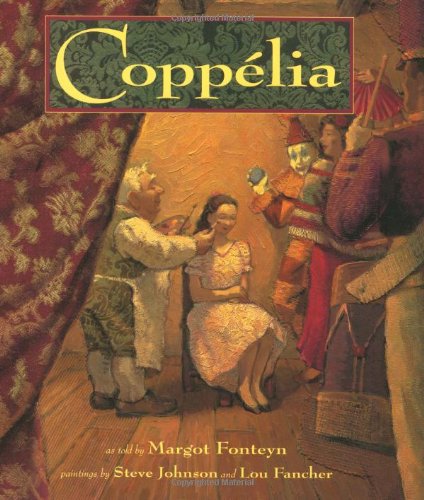
Dame Margot Fonteyn retells the ballet story of Coppelia, a doll so lifelike the she captures the heart of a young villager and the attention of his jealous fiancee, with vibrant, textured paintings that illustrate the power of imagination.
"synopsis" may belong to another edition of this title.
About the Authors
Lou Fancher and Steve Johnson began working together as a creative team in 1986 and have collaborated on more than 50 picture books, including the New York Times bestseller My Many Colored Days by Dr. Seuss. They are recipients of the Society of Illustrators Gold Medal. Visit them online at www.johnsonandfancher.com.
Lou Fancher and Steve Johnson began working together as a creative team in 1986 and have collaborated on more than 50 picture books, including the New York Times bestseller My Many Colored Days by Dr. Seuss. They are recipients of the Society of Illustrators Gold Medal. Visit them online at johnsonandfancher.com.
Reviews
Kindergarten-Grade 5-Who better to tell the story of Coppelia than a "prima ballerina assoluta?" Having danced the starring role many times, Fonteyn has developed a wonderful feel for the characters' personalities. The clever and passionate Swanilda contrasts well with the villain, Dr. Coppelius, the dollmaker who tries to bring his masterpiece to life. His conflicting nature is delightfully portrayed: he is lonely and deserving of sympathy, yet deceitful and wicked in trying to gain his ends; he is comical and a source of amusement to the village, but also the genius creator in love with his creation. Historical notes at the end of the book are brief but highly interesting. The lovely paintings are full of depth and texture enhanced with pieces of richly patterned fabric. There is a golden and sepia tone to them, suggestive of candlelight and late sun. This play of light and shadow effectively gives an illusion of life and movement. It seems the characters really dance about their daily lives, and when they are still, they find their feet naturally falling into classical positions. Pleasingly balanced, the layout consistently poses one white page of text bordered in color against a colorful picture. Purchase Coppelia for your more sophisticated fairy-tale audience or pair it with Leontyne Price's version of Aida (Gulliver, 1990), illustrated by Leo and Diane Dillon, for a gorgeous unit on music and theater.
Torrie Hodgson, Burlington Public Library, WA
Copyright 1998 Reed Business Information, Inc.
Having danced the part of Swanilda herself, the late dancer Fonteyn knew this 19th-century ballet from the inside out. With careful pacing, she recounts the tale of a mysterious dollmaker whose finest creation, a life-size doll named Copp?lia, comes between a young woman and her betrothed. Upon Swanilda's first appearance, as she happily thinks of her fianc?, Franz ("she could barely keep herself from dancing instead of walking"), Fonteyn foreshadows the fateful dance, in which Swanilda, rejected by Franz in favor of Copp?lia, cleverly exposes the illusion and wins back her sweetheart. In an astonishing visual pas de deux, Johnson and Fancher's mixed media artwork gives the pages a rich patina that recalls antique tapestry. Blocks of text are framed in a quilt-like background of fabric scraps that hints at the busy creativity of a dollmaker's studio. The artists carry this theme throughout the book by incorporating brocade and burlap into the illustrations themselves, adding texture and depth alongside bold brushstrokes and scrapework used in applying the oil paint. The European setting, with its half-timbered houses and cobbled streets, is dressed in rich autumnal hues, and an artful use of light and shadow brings a theatrical flair. Balletomanes will appreciate Fonteyn's afterword on the history of Copp?lia, along with the artists' homage to a famous Degas painting with Swanilda, dressed as the doll, dancing about and wreaking havoc. Ages 6-up.
Copyright 1998 Reed Business Information, Inc.
The timeless tale of romance, suspicion, magic, and revenge is freshly retold, focusing on the feelings and actions of the characters: Dr. Copplius as he comes to terms with his artistic gifts and broken dreams; Swanilda as she mischievously attempts to find the ``daughter'' of Dr. Copplius; and Franz as he falls foolishly in love with a doll, but repents and wins Swanilda. The textured paintingsoil painting lavished across nubby tweeds, lace, brocades, and other fabrichighlight the events of this unforgettable story, sure to send balletomanes off in search of the nearest production of the ballet. (Picture book. 6-10) -- Copyright ©1998, Kirkus Associates, LP. All rights reserved.
Ages 5^-8. Delibe's Coppelia, which was inspired by an E. T. A. Hoffman story, is a ballet particularly accessible to children. Doll maker Dr. Coppelius has created a masterpiece and dreams of bringing the realistic-looking doll to life. The doll, Coppelia, sits in the window of Dr. Coppelius' house and draws the admiration of young Franz. Franz's jealous sweetheart, Swanhilda, sneaks into the doll maker's house, dresses in the doll's clothing, and dances around his workshop. Seeing her, the doll maker at first thinks he has succeeded in bringing the doll to life but then finds that he has been deceived. Longer than previous picture-book versions of the tale, this retelling brings out the points of view of Dr. Coppelius, Franz, and Swanhilda and communicates the many dimensions of the story. An afterword fills in the history of the ballet. On each left-hand page, the text appears in a white box surrounded by a border of fabric swatches. On the facing page, a narrow white border frames a large illustration of a scene from the ballet, executed in both oil and material. Other painters have used fabric in paintings, but few have incorporated the cloth so effectively, making it part of the whole rather than an added feature stuck on as a novelty for its color, pattern, or texture. Here, the fabric is painted over in some places and in others left bare. The impressionistic paintings show the characters' personalities and moods through their bodies and gestures, rather than by facial details. Although the suggestion of music underlies the grace and movement of the characters, the illustrations show a story unfolding rather than a ballet in performance. A rich, visual interpretation and a wonderful introduction to a performance of the ballet. Carolyn Phelan
"About this title" may belong to another edition of this title.
Search results for Coppelia

Seller Image
Coppelia
Published by
Houghton Mifflin Harcourt, 1998
ISBN 10: 0152004289
ISBN 13: 9780152004286
Used
Hardcover
Seller: Zoom Books Company, Lynden, WA, U.S.A.
Seller rating 5 out of 5 stars

Condition: very_good. Johnson, Steve; Fancher, Lou (illustrator). Book is in very good condition and may include minimal underlining highlighting. The book can also include "From the library of" labels. May not contain miscellaneous items toys, dvds, etc. . We offer 100% money back guarantee and 24 7 customer service. Seller Inventory # ZBV.0152004289.VG
Stock Image
Coppà lia
Published by
Houghton Mifflin Harcourt Publishing Company, 1998
ISBN 10: 0152004289
ISBN 13: 9780152004286
Used
First Edition
Seller: Better World Books, Mishawaka, IN, U.S.A.
Seller rating 5 out of 5 stars
Condition: Very Good. 1st. Pages intact with possible writing/highlighting. Binding strong with minor wear. Dust jackets/supplements may not be included. Stock photo provided. Product includes identifying sticker. Better World Books: Buy Books. Do Good. Seller Inventory # 10993277-6
Stock Image
Coppà lia
Published by
Houghton Mifflin Harcourt Publishing Company, 1998
ISBN 10: 0152004289
ISBN 13: 9780152004286
Used
First Edition
Seller: Better World Books, Mishawaka, IN, U.S.A.
Seller rating 5 out of 5 stars
Condition: Good. 1st. Former library copy. Pages intact with minimal writing/highlighting. The binding may be loose and creased. Dust jackets/supplements are not included. Includes library markings. Stock photo provided. Product includes identifying sticker. Better World Books: Buy Books. Do Good. Seller Inventory # 3131446-6
Stock Image
Coppelia
Published by
Houghton Mifflin Harcourt, 1998
ISBN 10: 0152004289
ISBN 13: 9780152004286
Used
Hardcover
Seller: Wonder Book, Frederick, MD, U.S.A.
Seller rating 5 out of 5 stars
Condition: Good. Johnson, Steve; Fancher, Lou (illustrator). Good condition. Good dust jacket. A copy that has been read but remains intact. May contain markings such as bookplates, stamps, limited notes and highlighting, or a few light stains. Seller Inventory # J08P-01502
Stock Image
Coppelia
Published by
Houghton Mifflin Harcourt, 1998
ISBN 10: 0152004289
ISBN 13: 9780152004286
Used
Hardcover
Seller: Wonder Book, Frederick, MD, U.S.A.
Seller rating 5 out of 5 stars
Condition: Very Good. Johnson, Steve; Fancher, Lou (illustrator). Very Good condition. Very Good dust jacket. A copy that may have a few cosmetic defects. May also contain light spine creasing or a few markings such as an owner's name, short gifter's inscription or light stamp. Seller Inventory # K10O-00818
Stock Image
Coppelia
Published by
Houghton Mifflin Harcourt (edition First Edition), 1998
ISBN 10: 0152004289
ISBN 13: 9780152004286
Used
Hardcover
First Edition
Seller: BooksRun, Philadelphia, PA, U.S.A.
Seller rating 5 out of 5 stars
Hardcover. Condition: Fair. Johnson, Steve; Fancher, Lou (illustrator). First Edition. With dust jacket. The item might be beaten up but readable. May contain markings or highlighting, as well as stains, bent corners, or any other major defect, but the text is not obscured in any way. Seller Inventory # 0152004289-7-1-29
Seller Image
Coppelia
Published by
Houghton Mifflin Harcourt, 1998
ISBN 10: 0152004289
ISBN 13: 9780152004286
Used
Hardcover
Seller: Goodwill Books, Hillsboro, OR, U.S.A.
Seller rating 5 out of 5 stars
Condition: acceptable. Johnson, Steve; Fancher, Lou (illustrator). Fairly worn, but readable and intact. If applicable: Dust jacket, disc or access code may not be included. Seller Inventory # GICWV.0152004289.A
Stock Image
Coppelia
Published by
Houghton Mifflin Harcourt, 1998
ISBN 10: 0152004289
ISBN 13: 9780152004286
Used
Hardcover
Seller: ThriftBooks-Dallas, Dallas, TX, U.S.A.
Seller rating 5 out of 5 stars
Hardcover. Condition: Good. No Jacket. Johnson, Steve; Fancher, Lou (illustrator). Pages can have notes/highlighting. Spine may show signs of wear. ~ ThriftBooks: Read More, Spend Less. Seller Inventory # G0152004289I3N00
Seller Image
Coppelia
Published by
Houghton Mifflin Harcourt, 1998
ISBN 10: 0152004289
ISBN 13: 9780152004286
Used
Hardcover
Seller: Goodwill Industries, Spokane, WA, U.S.A.
Seller rating 5 out of 5 stars
Condition: good. Johnson, Steve; Fancher, Lou (illustrator). Condition: Good â" Used book with some visible wear. May include stickers on the cover, wear or absence of the dust jacket, wear to the spine or inside cover, slight corner curling, minor staining, and wear along the fore edge. All orders are shipped via UPS Mail Innovations and may take up to 10 business days from the initial scan to be delivered. Seller Inventory # INWV.0152004289.G
Stock Image
Coppelia
Published by
HMH Books for Young Readers, 1998
ISBN 10: 0152004289
ISBN 13: 9780152004286
Used
Hardcover
Seller: HPB-Emerald, Dallas, TX, U.S.A.
Seller rating 5 out of 5 stars
Hardcover. Condition: Very Good. Johnson, Steve; Fancher, Lou (illustrator). Connecting readers with great books since 1972! Used books may not include companion materials, and may have some shelf wear or limited writing. We ship orders daily and Customer Service is our top priority! Seller Inventory # S_486728643