
Items related to October '45: Childhood Memories of War
Synopsis
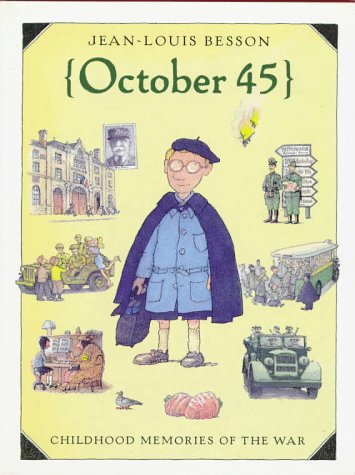
Recounts the World War II experiences of a seven to twelve-year-old French boy from a middle-class Catholic family, describing how he reacted to the changing circumstances
"synopsis" may belong to another edition of this title.
Reviews
Grade 4-8?From their interrupted vacation in Normandy in 1939 through the end of the war in 1945, Besson and his family and friends experienced all the adventure, hardship, sorrow, and exhilaration wartime life in France provided. Much of the tone, impact, and appeal of this illustrated memoir comes from the author's many full-color cartoonlike drawings. Readers follow the war chronologically as the Bessons move to Brittany to avoid the anticipated bombing of Paris, return to the city during the occupation, struggle with rationing, listen to British broadcasts illegally, endure air raids, witness the persecution and deportation of Jewish friends and neighbors, and carry on with everyday life. Besson's memories are strong and his understated telling of events allows readers to form their own feelings about them. This matter-of-fact style requires some sophistication, however. For example, when he tells of the Nazi teachings about how "...to recognize Jews, because we have to be careful of them," some young readers might not pick up the fairly subtle irony. Short chapters, inviting illustrations, and interesting subject matter should guarantee an audience for this book. Like Michael Foreman's War Boy (Arcade, 1990), October 45 is both personal and universal.?Louise L. Sherman, Anna C. Scott School, Leonia, NJ
Copyright 1996 Reed Business Information, Inc.
Gr. 4^-6. Jean-Louis is seven years old when World War II begins and German soldiers occupy his native France. First evacuated to Brittany, then returning to his home in Paris, he describes day-to-day life over the next six years: listening to Uncle Albert's stories of World War I, watching the Germans' trucks and motorcycles roll into town, learning to ride a bicycle, hating the look and smell of gas masks, making do when the only plentiful food is rutabagas, wondering what has happened to the Jewish students taken away one summer vacation, faking ration tickets, watching planes being shot down over Paris, and receiving chewing gum from the American soldiers who liberate the city. Besson's memory for detail gives the story immediacy, expressed in the journal-style text and the charming line-and-watercolor-wash illustrations that appear on every page. Readers will find this a memorable portrait of ordinary life in an extraordinary time and place. In the foreword, Besson acknowledges that for many, the war was "infinitely more cruel," but he offers "as faithful a recollection as possible of what a little boy in France saw and heard during those years when, contrary to popular belief, most people simply waited for the war to end, taking sides neither for the Resistance nor for the collaboration, but rather trying to feed themselves, keep warm, and avoid deprivation as much as possible, simply living through events." Carolyn Phelan
"About this title" may belong to another edition of this title.
Search results for October '45: Childhood Memories of War

Stock Image
October '45: Childhood Memories of War
Published by
Creative Editions (edition First Edition), 1995
ISBN 10: 0152009558
ISBN 13: 9780152009557
Used
Hardcover
First Edition
Seller: BooksRun, Philadelphia, PA, U.S.A.
Seller rating 5 out of 5 stars

Hardcover. Condition: Very Good. Marshall, Rita (illustrator). First Edition. With dust jacket. It's a well-cared-for item that has seen limited use. The item may show minor signs of wear. All the text is legible, with all pages included. It may have slight markings and/or highlighting. Seller Inventory # 0152009558-11-18-29
Stock Image
October '45: Childhood Memories of War
Published by
Creative Editions (edition First Edition), 1995
ISBN 10: 0152009558
ISBN 13: 9780152009557
Used
Hardcover
First Edition
Seller: BooksRun, Philadelphia, PA, U.S.A.
Seller rating 5 out of 5 stars
Hardcover. Condition: Fair. Marshall, Rita (illustrator). First Edition. With dust jacket. The item might be beaten up but readable. May contain markings or highlighting, as well as stains, bent corners, or any other major defect, but the text is not obscured in any way. Seller Inventory # 0152009558-7-1-29
Stock Image
October '45: Childhood Memories of War (Creative Editions)
Seller: Once Upon A Time Books, Siloam Springs, AR, U.S.A.
Seller rating 4 out of 5 stars

Hardcover. Condition: Acceptable. Marshall, Rita (illustrator). This is a used book. It may contain highlighting/underlining and/or the book may show heavier signs of wear . It may also be ex-library or without dustjacket. This is a used book. It may contain highlighting/underlining and/or the book may show heavier signs of wear . It may also be ex-library or without dustjacket. Seller Inventory # mon0000754160
Stock Image
October '45: Childhood Memories of War
Seller: ThriftBooks-Atlanta, AUSTELL, GA, U.S.A.
Seller rating 5 out of 5 stars
Hardcover. Condition: Very Good. No Jacket. Marshall, Rita (illustrator). May have limited writing in cover pages. Pages are unmarked. ~ ThriftBooks: Read More, Spend Less. Seller Inventory # G0152009558I4N00
Stock Image
October '45 : Childhood Memories of the War
Published by
Creative Editions, 1995
ISBN 10: 0152009558
ISBN 13: 9780152009557
Used
Hardcover
First Edition
Seller: Better World Books, Mishawaka, IN, U.S.A.
Seller rating 5 out of 5 stars
Condition: Good. Marshall, Rita (illustrator). 1st. Former library copy. Pages intact with minimal writing/highlighting. The binding may be loose and creased. Dust jackets/supplements are not included. Includes library markings. Stock photo provided. Product includes identifying sticker. Better World Books: Buy Books. Do Good. Seller Inventory # 5049533-6
Stock Image
October '45 : Childhood Memories of the War
Published by
Creative Editions, 1995
ISBN 10: 0152009558
ISBN 13: 9780152009557
Used
Hardcover
First Edition
Seller: Better World Books, Mishawaka, IN, U.S.A.
Seller rating 5 out of 5 stars
Condition: Very Good. Marshall, Rita (illustrator). 1st. Pages intact with possible writing/highlighting. Binding strong with minor wear. Dust jackets/supplements may not be included. Stock photo provided. Product includes identifying sticker. Better World Books: Buy Books. Do Good. Seller Inventory # 6545486-6
Stock Image
October '45: Childhood Memories of War
Seller: HPB-Diamond, Dallas, TX, U.S.A.
Seller rating 5 out of 5 stars
hardcover. Condition: Very Good. Marshall, Rita (illustrator). Connecting readers with great books since 1972! Used books may not include companion materials, and may have some shelf wear or limited writing. We ship orders daily and Customer Service is our top priority! Seller Inventory # S_486286929
Stock Image
October '45: Childhood Memories of War (Creative Editions)
Seller: Library House Internet Sales, Grand Rapids, OH, U.S.A.
Seller rating 5 out of 5 stars
Hardcover. Condition: Good. Dust Jacket Condition: Good. Marshall, Rita (illustrator). Recounts the World War II experiences of a seven to twelve-year-old French boy from a middle-class Catholic family, describing how he reacted to the changing circumstances Former library book. Mylar protector included. Moderate shelf wear. Please note the image in this listing is a stock photo and may not match the covers of the actual item. Ex-Library. Seller Inventory # 123494358
Stock Image
October '45: Childhood Memories of War (Creative Editions)
Published by
Creative Editions December 1995, 1995
ISBN 10: 0152009558
ISBN 13: 9780152009557
Used
Hardcover
Seller: Montclair Book Center, Montclair, NJ, U.S.A.
Seller rating 5 out of 5 stars
Hardcover. Condition: USED Good. Marshall, Rita (illustrator). torn dust jacket. Seller Inventory # 49257
Stock Image
October '45: Childhood Memories of War
Seller: RiverRaisinBooks, Dundee, MI, U.S.A.
Seller rating 5 out of 5 stars
hardcover. Condition: As New. Marshall, Rita (illustrator). Light jacket wear. Inside is mint. Seller Inventory # 240619047