
Items related to The Cure
Synopsis
Gemm 16884, a young boy living in 2407, collides with the past when he finds himself in Strasbourg, Germany in 1348 confronting the antisemitism that sweeps through Europe during the Black Plague. 10,000 first printing.
"synopsis" may belong to another edition of this title.
Reviews
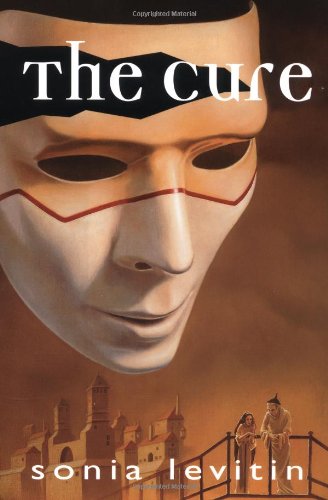
Grade 7-10-Johannes is the 16-year-old son of a moneylender in Strasbourg in 1348. He loves his family, his music, and the butcher's daughter. However, it is difficult to be a Jew in Europe, for discrimination is rampant. Now people are talking of a terrible pestilence that strikes men down, turns them black, and knows no cure but death. As the plague sweeps Europe, it is the Jews who are blamed for poisoning the waters and spreading the disease. Johannes's tragic story is also the story of Gemm 16884, a 16-year-old living in the United Social Alliance, a futuristic society in which "Conformity begets Harmony begets Tranquillity begets Peace begets Universal Good." But Gemm has been having strange dreams and hearing music, strictly forbidden. The Elders believe that transporting Gemm to Strasbourg to suffer the horrors that Johannes endured will cure his love of music forever. But the cure itself is so misguided that it actually backfires, causing Gemm to return with renewed passion and the conviction to change his world. Readers will be fascinated with Gemm's world, where people wear colored silk masks to represent conformity, everybody has a twin, and sex as we know it is a thing of the past. However, the music metaphor does not ring true, and the dissonance of the two worlds is often more disruptive than provocative.
Barbara Auerbach, Brooklyn Public Library, NY
Copyright 1999 Reed Business Information, Inc.
Levitin (The Singing Mountain) handily combines futuristic science fiction and late-medieval Jewish history in a story reminiscent of Lois Lowry's The Giver. In the year 2407, societal tranquillity is maintained by ample servings of serotonin drinks to the genetically engineered population and by careful monitoring to suppress all expressions of individuality or creativity. When the boy Gemm 16884 somehow feels moved to make music, an extinguished art, he is given a choice between being "recycled" (killed) or sent into virtual reality to experience the bad old days as a cure for his deviant desires. Opting for the latter, he finds himself living as Johannes, the 16-year-old son of a Jewish moneylender in 1348 Strasbourg. In steadily more harrowing chapters, Levitin shows a thickening climate of anti-Semitism. As the bubonic plague spreads from the ports of Sicily across Europe, the Jews are accused of poisoning the water supply; whole communities of Jews are massacred. Will Gemm's experience as Johannes deaden his craving for art? That everything about the plot seems inevitable, from Johannes's dreadful martyrdom to Gemm's last-page embrace of humanism, only magnifies the tension: much of the horror of Johannes's plight, for example, comes from the audience's superior awareness of Johannes's certain doom. The author pulls off a nifty featAshe makes a low point in human history the prelude to a crescendo of idealism. Ages 10-up.
Copyright 1999 Reed Business Information, Inc.
Juxtaposing the past and the future, this potent story explores the societal consequences of diversity and individuality. It's 2407 and the almost 16-year-old Gemm 16884 lives in a serene Orwellian society where the denizens are trained to believe that ``diversity begets hostility,'' and that psychological troubles can be banished by sipping on a serotonin shake. But Gemm is not like his kinsmen; he's afflicted with ungovernable emotions and a ``deviant'' passion for music. To avoid being ``recycled,'' he agrees to undergo a frightening cure, a mind-adventure that will make the association of music and the emotions it engenders unbearable. He wakes up in 1348 Strasbourg, Germany, where he's known as Johannes the Jew. Unlike the fairly standard rendering of the future, this part of the story, opening just as the Black Death begins to sweep through the population, fairly pulsates with energy and freshness; it is based on a real event and packed with spine-tingling historical detail. Johannes has to cope with virulent anti-Semitism in a society that is anything but tranquil. Levitin (Yesterday's Child, 1997, etc.) cheats a little to give the future world an upbeat ending, but even so pulls off an unusual mix of science and historical fiction that is as suspenseful and as it is unsettling. (bibliography) (Fiction. 10-14) -- Copyright ©1999, Kirkus Associates, LP. All rights reserved.
It is the twenty-fifth century, and Gemm 16884, who has feelings and emotions, is not in step with the rest of his dystopian society. Offered a choice between "recycling" or a cure that will break him and acceptably remold him, Gemm takes the cure. He is sent to fourteenth-century Strasbourg, where, as a Jew, he is surrounded by virulent anti-Semitism. Gemm's experience in Strasbourg is carefully crafted and emotionally evocative. The culmination of the cure, in which the Jews of Strasbourg are burned to death, is shocking and powerful. The book's weak element is its futuristic framework. Never as fully developed as the historical aspects, the scenes set in the future jar rather than complement the body of the tale. Most poorly integrated is the ending. After Gemm returns to the future, "cured," he tries to conform, but, having known love and pain, he decides he must throw off the mask that (literally) all in his society wear, and sets out to forge a future in which people can experience emotion and thus choose between hatred and love. After what Gemm has experienced in Strasbourg, readers might not be convinced by his logic. Plenty of discussion possibilities here, and, of course, a natural pair with Lowry's The Giver (1993). Ilene Cooper
"About this title" may belong to another edition of this title.
Search results for The Cure

Stock Image
The Cure
Seller: Your Online Bookstore, Houston, TX, U.S.A.
Seller rating 5 out of 5 stars

hardcover. Condition: Fair. Seller Inventory # 0152018271-4-38186637
Seller Image
The Cure
Seller: Zoom Books East, Glendale Heights, IL, U.S.A.
Seller rating 5 out of 5 stars
Condition: very_good. Book is in very good condition and may include minimal underlining highlighting. The book can also include "From the library of" labels. May not contain miscellaneous items toys, dvds, etc. . We offer 100% money back guarantee and 24 7 customer service. Seller Inventory # ZEV.0152018271.VG
Stock Image
The Cure
Seller: New Legacy Books, Annandale, NJ, U.S.A.
Seller rating 4 out of 5 stars

hardcover. Condition: Acceptable. This is a ex library book, stickers and markings accordingly. Fast shipping and order satisfaction guaranteed. A portion of your purchase benefits Non-Profit Organizations, First Aid and Fire Stations! Seller Inventory # mon0000118697
Stock Image
The Cure
Seller: ThriftBooks-Dallas, Dallas, TX, U.S.A.
Seller rating 5 out of 5 stars
Hardcover. Condition: Fair. No Jacket. Missing dust jacket; Readable copy. Pages may have considerable notes/highlighting. ~ ThriftBooks: Read More, Spend Less. Seller Inventory # G0152018271I5N01
Stock Image
The Cure
Seller: ThriftBooks-Reno, Reno, NV, U.S.A.
Seller rating 5 out of 5 stars
Hardcover. Condition: Good. No Jacket. Former library book; Pages can have notes/highlighting. Spine may show signs of wear. ~ ThriftBooks: Read More, Spend Less. Seller Inventory # G0152018271I3N10
Stock Image
The Cure
Seller: ThriftBooks-Atlanta, AUSTELL, GA, U.S.A.
Seller rating 5 out of 5 stars
Hardcover. Condition: Good. No Jacket. Pages can have notes/highlighting. Spine may show signs of wear. ~ ThriftBooks: Read More, Spend Less. Seller Inventory # G0152018271I3N00
Stock Image
The Cure
Seller: ThriftBooks-Dallas, Dallas, TX, U.S.A.
Seller rating 5 out of 5 stars
Hardcover. Condition: Fair. No Jacket. Former library book; Readable copy. Pages may have considerable notes/highlighting. ~ ThriftBooks: Read More, Spend Less. Seller Inventory # G0152018271I5N10
Stock Image
The Cure
Seller: ThriftBooks-Dallas, Dallas, TX, U.S.A.
Seller rating 5 out of 5 stars
Hardcover. Condition: Good. No Jacket. Pages can have notes/highlighting. Spine may show signs of wear. ~ ThriftBooks: Read More, Spend Less. Seller Inventory # G0152018271I3N00
Stock Image
The Cure
Seller: ThriftBooks-Atlanta, AUSTELL, GA, U.S.A.
Seller rating 5 out of 5 stars
Hardcover. Condition: Very Good. No Jacket. Former library book; May have limited writing in cover pages. Pages are unmarked. ~ ThriftBooks: Read More, Spend Less. Seller Inventory # G0152018271I4N10
Stock Image
The Cure
Seller: ThriftBooks-Reno, Reno, NV, U.S.A.
Seller rating 5 out of 5 stars
Hardcover. Condition: Very Good. No Jacket. Former library book; May have limited writing in cover pages. Pages are unmarked. ~ ThriftBooks: Read More, Spend Less. Seller Inventory # G0152018271I4N10