
Items related to Tituba
Synopsis
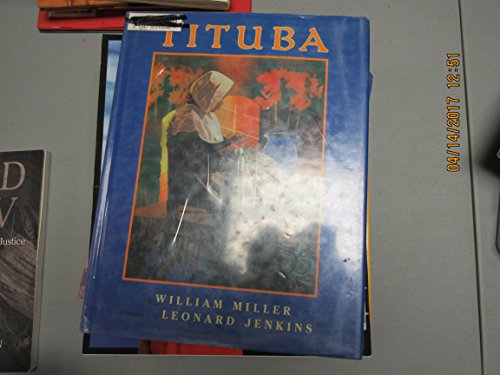
Provides a look at the first woman accused during the crazed witch-hunt in Salem Village in 1692 and examines how she coped with the situation as a result of her folk wisdom being mistakenly perceived as something more than it was.
"synopsis" may belong to another edition of this title.
About the Author
William Miller is a poet and the author of many children's books. He teaches creative writing and African American literature at York College of Pennsylvania.
Leonard Jenkins is a fine artist who has illustrated several children's books, including Walter Dean Myers's Malcolm X: A Fire Burning Brightly. He lives in New York City, where he teaches painting at the School of Visual Arts.
Leonard Jenkins is a fine artist who has illustrated several children's books, including Walter Dean Myers's Malcolm X: A Fire Burning Brightly. He lives in New York City, where he teaches painting at the School of Visual Arts.
Reviews
Grade 2-5-A fictionalized picture book based on the facts of the Salem witch trials. The story suggests that the West Indian slave's exotic tales of the land, people, and beliefs of her beloved island home struck a disturbing chord in the thoughts and dreams of the sheltered Puritan girls for whom she was the caregiver. Tituba is clearly revealed as a victim of the events and of the hysteria of the two girls who not only set the terror in motion but also went on to accuse many others. She is shown as a solitary soul with great reserves of spiritual and emotional strength. The account is complemented by full-page and double-page paintings that tell as much of the story as the text. The art, rendered in spray paint, acrylics, and pastels on museum board, is striking. The strong tones and bold images are evocative of both dreams and of the vivid colors of Barbados. The difficult subject is handled without histrionics, providing a reasonable and sympathetic introduction to the events surrounding the trial and to Tituba herself. An author's note discusses what little is known about the woman. Library of Congress catalogs the book as biographical nonfiction; individual libraries will need to decide whether this re-creation of events meets their criteria for children's biography.
Kathie Meizner, Montgomery County Public Libraries, Chevy Chase, MD
Copyright 2000 Reed Business Information, Inc.
Miller (Zora Hurston and the Chinaberry Tree) offers a poetic, plaintive story about the Barbados-born slave who was accused of witchcraft during the Salem trials of 1692. After enduring the terrors of a voyage to Boston in the hold of a ship, Tituba greatly misses the island, where she told fortunes and communed with mice, macaws and the water spirits. But when she shares memories of her homeland with her master's daughter and niece, Elizabeth and Abigail, they have nightmares that lead to the accusations against Tituba. She originally denies the charges of witchcraft and is thrown into jail; told in court to "Confess or die," Tituba finally concedes the charge but remains jailed for many months. Sold to another master, Tituba comforts five young slaves newly arrived from Barbados, telling them that "A master might own your body, but he can never own your spirit.... Remember what your fathers and mothers told you about the spirit world." While Miller's sympathetic rendering of Tituba is likely to strike a chord with readers, his failure to develop the actions of Elizabeth and Abigail leaves important questions unanswered (Why, for example, do the girls fall to the floor in the courtroom, "writhing like snakes"?). Rendered in spray paint, acrylics and pastels, Jenkins's (Malcolm X: A Fire Burning Brightly) illustrations are occasionally stiff, yet offer effective contrasts between shadow and light and between vivid and somber colors. He affectingly evokes the anguish and loneliness of the title character. Ages 6-9.
Copyright 2000 Reed Business Information, Inc.
Gr. 2-5. In picture-book format, this fictional biography imagines the life of the woman famously accused of witchcraft at the beginning of the Salem Witch Trials. The story follows Tituba from Barbados, where she is a slave, to Boston, where she takes care of a new owner's children. When the children begin to act strangely, she is charged with witchcraft, confesses, and endures months in jail. She is released when another owner buys her, taking her "far from Salem Village." In an introductory note that separates some historical fact from fiction, Miller states that the book is "a creative attempt to tell her story," and throughout, he presents not only events but also Tituba's thoughts and feelings. The drama is extended by Leonard Jenkins' striking paintings. Realistic figures outlined in bright neon colors move through wildly hued and patterned backgrounds, evoking a magical spirit that contrasts well with the oppressive horrors of the story. Young children will need an adult to help with the history and intense subject matter; older children may want to go on to Ann Petry's Tituba of Salem Village (1964). Gillian Engberg
Copyright © American Library Association. All rights reserved
"About this title" may belong to another edition of this title.
Search results for Tituba

Stock Image
Tituba
Published by
Harcourt Brace International, 2000
ISBN 10: 0152018972
ISBN 13: 9780152018979
Used
Hardcover
Seller: World of Books (was SecondSale), Montgomery, IL, U.S.A.
Seller rating 5 out of 5 stars

Hardback. Condition: Very Good. Jenkins, Leonard (illustrator). Story of Tituba, a West Indian slave girl who was unjustly accused of witchcraft at the outset of the Salem, Massachusetts, witch trials. Seller Inventory # 00109226545
Stock Image
Tituba
Published by
Houghton Mifflin Harcourt, 2000
ISBN 10: 0152018972
ISBN 13: 9780152018979
Used
Hardcover
Seller: ThriftBooks-Dallas, Dallas, TX, U.S.A.
Seller rating 5 out of 5 stars
Hardcover. Condition: Very Good. No Jacket. Jenkins, Leonard (illustrator). Former library book; May have limited writing in cover pages. Pages are unmarked. ~ ThriftBooks: Read More, Spend Less. Seller Inventory # G0152018972I4N10
Stock Image
Tituba
Published by
Houghton Mifflin Harcourt, 2000
ISBN 10: 0152018972
ISBN 13: 9780152018979
Used
Hardcover
Seller: ThriftBooks-Atlanta, AUSTELL, GA, U.S.A.
Seller rating 5 out of 5 stars
Hardcover. Condition: Very Good. No Jacket. Jenkins, Leonard (illustrator). Former library book; May have limited writing in cover pages. Pages are unmarked. ~ ThriftBooks: Read More, Spend Less. Seller Inventory # G0152018972I4N10
Stock Image
Tituba
Published by
Houghton Mifflin Harcourt, 2000
ISBN 10: 0152018972
ISBN 13: 9780152018979
Used
Hardcover
Seller: ThriftBooks-Reno, Reno, NV, U.S.A.
Seller rating 5 out of 5 stars
Hardcover. Condition: Very Good. No Jacket. Jenkins, Leonard (illustrator). Former library book; May have limited writing in cover pages. Pages are unmarked. ~ ThriftBooks: Read More, Spend Less. Seller Inventory # G0152018972I4N10
Stock Image
Tituba
Published by
Houghton Mifflin Harcourt Publishing Company, 2000
ISBN 10: 0152018972
ISBN 13: 9780152018979
Used
Hardcover
First Edition
Seller: Better World Books, Mishawaka, IN, U.S.A.
Seller rating 5 out of 5 stars
Condition: Good. Jenkins, Leonard (illustrator). 1st Edition. Former library copy. Pages intact with minimal writing/highlighting. The binding may be loose and creased. Dust jackets/supplements are not included. Includes library markings. Stock photo provided. Product includes identifying sticker. Better World Books: Buy Books. Do Good. Seller Inventory # 3132123-6
Stock Image
Tituba
Published by
Houghton Mifflin Harcourt Publishing Company, 2000
ISBN 10: 0152018972
ISBN 13: 9780152018979
Used
Hardcover
First Edition
Seller: Better World Books, Mishawaka, IN, U.S.A.
Seller rating 5 out of 5 stars
Condition: Very Good. Jenkins, Leonard (illustrator). 1st Edition. Former library copy. Pages intact with possible writing/highlighting. Binding strong with minor wear. Dust jackets/supplements may not be included. Includes library markings. Stock photo provided. Product includes identifying sticker. Better World Books: Buy Books. Do Good. Seller Inventory # 3132124-6
Stock Image
Tituba
Published by
Houghton Mifflin Harcourt, 2000
ISBN 10: 0152018972
ISBN 13: 9780152018979
Used
Hardcover
Seller: HPB-Emerald, Dallas, TX, U.S.A.
Seller rating 5 out of 5 stars
hardcover. Condition: Very Good. Jenkins, Leonard (illustrator). Connecting readers with great books since 1972! Used books may not include companion materials, and may have some shelf wear or limited writing. We ship orders daily and Customer Service is our top priority! Seller Inventory # S_457459519
Stock Image
Tituba
Published by
Harcourt Brace International, 2000
ISBN 10: 0152018972
ISBN 13: 9780152018979
Used
Hardcover
Seller: World of Books Inc, Montgomery, IL, U.S.A.
Seller rating 4 out of 5 stars

Hardback. Condition: Very Good. Jenkins, Leonard (illustrator). Story of Tituba, a West Indian slave girl who was unjustly accused of witchcraft at the outset of the Salem, Massachusetts, witch trials. Seller Inventory # CIN0152018972VG
Stock Image
Tituba
Seller: Library House Internet Sales, Grand Rapids, OH, U.S.A.
Seller rating 4 out of 5 stars
Hardcover. Condition: Good. Dust Jacket Condition: Good. Jenkins, Leonard (illustrator). Story of Tituba, a West Indian slave who was unjustly accused of witchcraft at the outset of the Salem, Massachusetts, witch trials. Former library book. Mylar protector included. Solid binding. Moderate edgewear on the boards. Moderate shelf wear. Please note the image in this listing is a stock photo and may not match the covers of the actual item. Ex-Library. Seller Inventory # 123698139
Stock Image
Tituba Miller, William and Jenkins, Leonard
Published by
HMH Books for Young Readers, 2000
ISBN 10: 0152018972
ISBN 13: 9780152018979
Used
Hardcover
Seller: Ocean Books, Dacula, GA, U.S.A.
Seller rating 5 out of 5 stars
Hardcover. Condition: Good. Jenkins, Leonard (illustrator). Nice ex-library book with protective plastic cover. Sticker on spine, first page, and inside of back cover. Several stamps and marks on the first page. Stamp on title page and black dot on top outer page edges. Pages are crisp and free of marks or tears. Seller Inventory # 9X-DLAL-PL15