
Items related to Something Permanent
Synopsis
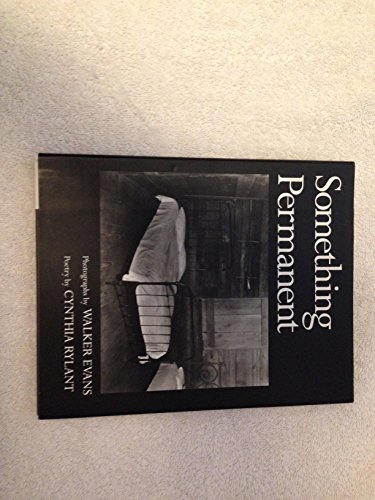
Walker Evans's magnificent black-and-white photographic portraits of the Depression are complemented by a poetic celebration of the lives of ordinary people struggling to survive under extreme conditions.
"synopsis" may belong to another edition of this title.
About the Authors
Cynthia Rylant is a Newbery medalist and the author of many acclaimed books for young people. She's well known for her popular characters for early readers, including Mr. Putter & Tabby and Henry & Mudge. She lives in the Pacific Northwest. www.cynthiarylant.com.
WALKER EVANS (1903-1975) is best known for his striking Depression-era photographs. He served as an editor for both Fortune and Time and was a professor of graphic arts at Yale. His other books include American Photographs and Message from the Interior.
Reviews
Grade 8 Up-Nearly 60 years ago, Walker Evans and James Agee documented the lives of poor Southern sharecroppers. Their efforts resulted in a devastating, legendary account of the Depression, Let Us Now Praise Famous Men. Here, Rylant pairs Evans's photographs with 29 short, lyrical poems. Almost of necessity, her subject matter concerns survival. "House," "Bed," "Rocker," "Utensils," and "Grave" evoke an existence stripped of all but the essential. The poet shows how seemingly inconsequential things-a window box filled with plants, a few prized possessions displayed on a mantel-can spell the difference between hope and despair. Sly humor surfaces as well. Rylant's spare, conversational style matches the spirit of the pictures; her respect for the people whose way of life Evans has captured shines through. Powerful as the words are, the photographs steal the show. They pull viewers back again and again, deepening current notions of pride and endurance. Beautifully designed, the volume is printed on high-quality glossy paper. Each black-and-white, full-page photo is faced by a strategically positioned poem on the opposite page; silver endpapers add a luxuriant touch. Not a comfortable book, Something Permanent will delight and disturb readers.
Ellen D. Warwick, Winchester Public Library, MA
Copyright 1994 Reed Business Information, Inc.
As in Rylant's Soda Jerk , the subjects of this extraordinary and elegantly designed volume are ordinary moments in the lives of ordinary people. Rylant, responding to Evans's famous photographs of America during the Great Depression, pens spare, gem-like poems that tell stories--of a couple hitching a ride to the city, of a barber proud of his shop. Almost devoid of obviously figurative language, the poems are an expressive complement to the poignant images in Evans's ( Let Us Now Praise Famous Men ) stark photographs. Even when the camera focuses on an inanimate object, the poems hone in on the human heart. A photograph of a crooked mantel inspires a description of a woman who "knew about beauty and understood it." A picture of two empty iron beds speak to Rylant of a couple who "would turn toward each other, and, / nestled in the warm breathing / of their other babies, / ease their weary minds / with the sex / they knew would likely make them / poorer / and / richer / all the same time." For the most part, the text deals with experiences and attitudes beyond the understanding of those at the younger end of the target audience, but older readers will respond to the book's eloquent and haunting images of loss, hope and love. Ages 10-up.
Copyright 1994 Reed Business Information, Inc.
Gr. 7-12 Here's a book concept that seems to have Bad Idea written all over it: repackage Walker Evans' photos for the juvenile market. Take a few of Evans' images of southern life during the Depression, tie them to a little poignant poetry by a big-name children's writer (How about Cynthia Rylant? She's from Appalachia, after all), and, presto, you've got Let Us Now Praise Famous Men, kid version.
Sometimes, though, the material is strong enough, and the artists talented enough, to transcend the concept. Evans' photos resist all attempts at pigeonholing. The objects he capturesa slightly sagging bed, several birdhouses, the facade of a filling station, a rocking chairpossess such physical presence, such irreducible reality, that they achieve their own dignity, beyond message. That is not to say, however, that they don't also have their own kind of resonance, suggesting the scope of the human lives lived around them. Here is where Rylant enters the picturefleshing out the intimations offered by the pictures themselves, never reducing the image to a single meaning but always widening the angle of our vision to include more, to see further. And, best of all, the angles Rylant chooses to widen are rarely the ones we expect. Her poem about the sagging bed, for example (see jacket illustration, opposite) begins, Of course it was hard to make love / with the children in the room. What follows is a tenderly erotic lyric about a couple who ease their weary minds / with sex, which makes them poorer / and richer / at the same time.
The literary critic Lionel Trilling argued that James Agee's text in Famous Men suffered from a failure of moral realism, an inability to see the people in Evans' photos as anything but emblems of a sure and simple virtue. Rylant makes no such mistake. The people she finds both in and behind Evans' images are strong and courageous, yes, but they are also weak, petty, and frustrated. The land can be a source of beauty for them, but, more often, it brings only pain: the earth never was nothing / but work.
For students in junior high and high school, the juxtaposition of Evans' photos and Rylant's poems will demonstrate how emotions can be rooted in objects and how, to dig them out, you need to use strong, sturdy words. Bill Ott
"About this title" may belong to another edition of this title.
Search results for Something Permanent

Stock Image
Something Permanent
Published by
Harcourt Childrens Books, 1994
ISBN 10: 0152770909
ISBN 13: 9780152770907
Used
Hardcover
Seller: World of Books (was SecondSale), Montgomery, IL, U.S.A.
Seller rating 5 out of 5 stars

Condition: Good. Item in good condition. Textbooks may not include supplemental items i.e. CDs, access codes etc. Seller Inventory # 00084200829
Stock Image
Something Permanent
Published by
Harcourt Childrens Books, 1994
ISBN 10: 0152770909
ISBN 13: 9780152770907
Used
Hardcover
Seller: World of Books (was SecondSale), Montgomery, IL, U.S.A.
Seller rating 5 out of 5 stars
Condition: Very Good. Item in very good condition! Textbooks may not include supplemental items i.e. CDs, access codes etc. Seller Inventory # 00100462543
Stock Image
Something Permanent
Published by
Harcourt Childrens Books, 1994
ISBN 10: 0152770909
ISBN 13: 9780152770907
Used
Hardcover
Seller: World of Books (was SecondSale), Montgomery, IL, U.S.A.
Seller rating 5 out of 5 stars
Condition: Acceptable. Item in acceptable condition! Textbooks may not include supplemental items i.e. CDs, access codes etc. Seller Inventory # 00105112182
Seller Image
Something Permanent
Published by
Harcourt Childrens Books, 1994
ISBN 10: 0152770909
ISBN 13: 9780152770907
Used
Hardcover
Seller: Greenworld Books, Arlington, TX, U.S.A.
Seller rating 5 out of 5 stars
Condition: good. Fast Free Shipping â" Good condition. It may show normal signs of use, such as light writing, highlighting, or library markings, but all pages are intact and the book is fully readable. A solid, complete copy that's ready to enjoy. Seller Inventory # GWV.0152770909.G
Seller Image
Something Permanent
Published by
Harcourt Childrens Books, 1994
ISBN 10: 0152770909
ISBN 13: 9780152770907
Used
Hardcover
Seller: Greenworld Books, Arlington, TX, U.S.A.
Seller rating 5 out of 5 stars
Condition: very_good. Fast Free Shipping â" Very Good condition book with a firm cover and clean pages. Shows normal use and some light wear or limited notes markings. A solid, nice copy to enjoy. Seller Inventory # GWV.0152770909.VG
Stock Image
Something Permanent
Published by
HMH Books for Young Readers (edition First Edition), 1994
ISBN 10: 0152770909
ISBN 13: 9780152770907
Used
Hardcover
First Edition
Seller: BooksRun, Philadelphia, PA, U.S.A.
Seller rating 5 out of 5 stars
Hardcover. Condition: Very Good. First Edition. With dust jacket. It's a well-cared-for item that has seen limited use. The item may show minor signs of wear. All the text is legible, with all pages included. It may have slight markings and/or highlighting. Seller Inventory # 0152770909-11-18-29
Stock Image
Something Permanent
Published by
Harcourt Trade Publishers, 1994
ISBN 10: 0152770909
ISBN 13: 9780152770907
Used
Hardcover
First Edition
Seller: Better World Books, Mishawaka, IN, U.S.A.
Seller rating 5 out of 5 stars
Condition: Good. 1st Edition. Pages intact with minimal writing/highlighting. The binding may be loose and creased. Dust jackets/supplements are not included. Stock photo provided. Product includes identifying sticker. Better World Books: Buy Books. Do Good. Seller Inventory # 3132885-6
Stock Image
Something Permanent
Published by
Harcourt Trade Publishers, 1994
ISBN 10: 0152770909
ISBN 13: 9780152770907
Used
Hardcover
First Edition
Seller: Better World Books, Mishawaka, IN, U.S.A.
Seller rating 5 out of 5 stars
Condition: Good. 1st Edition. Former library copy. Pages intact with minimal writing/highlighting. The binding may be loose and creased. Dust jackets/supplements are not included. Includes library markings. Stock photo provided. Product includes identifying sticker. Better World Books: Buy Books. Do Good. Seller Inventory # GRP93636589
Stock Image
Something Permanent
Published by
Harcourt Childrens Books, 1994
ISBN 10: 0152770909
ISBN 13: 9780152770907
Used
Hardcover
First Edition
Seller: The Maryland Book Bank, Baltimore, MD, U.S.A.
Seller rating 5 out of 5 stars
hardcover. Condition: Very Good. 1st Edition. Used - Very Good. Seller Inventory # 4-DDD-5-0225
Stock Image
Something Permanent
Published by
Harcourt Childrens Books, 1994
ISBN 10: 0152770909
ISBN 13: 9780152770907
Used
Hardcover
Seller: ThriftBooks-Dallas, Dallas, TX, U.S.A.
Seller rating 5 out of 5 stars
Hardcover. Condition: Very Good. No Jacket. Former library book; May have limited writing in cover pages. Pages are unmarked. ~ ThriftBooks: Read More, Spend Less. Seller Inventory # G0152770909I4N10