
Items related to The Places In Between: A solo 36-day trek through post-Talib...
The Places In Between: A solo 36-day trek through post-Taliban Afghanistan―snowbound villages, wary strangers, and a rescued mastiff named Babur - Softcover
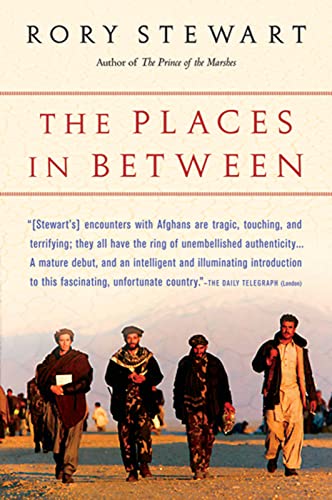
Synopsis
A New York Times Bestseller
"A striding, glorious book . . . A flat-out masterpiece . . . The Places in Between is, in very nearly every sense, too good to be true." —New York Times Book Review
This account of a 36-day walk across Afghanistan, starting just weeks after the fall of the Taliban, is “stupendous. . . an instant travel classic.” (Entertainment Weekly)
In January 2002, Rory Stewart walked across Afghanistan, surviving by his wits, his knowledge of Persian dialects and Muslim customs, and the kindness of strangers. By day he passed through mountains covered in nine feet of snow, hamlets burned and emptied by the Taliban, and communities thriving amid the remains of medieval civilizations. By night he slept on villagers' floors, shared their meals, and listened to their stories of the recent and ancient past. Along the way Stewart met heroes and rogues, tribal elders and teenage soldiers, Taliban commanders and foreign-aid workers. He was also adopted by an unexpected companion—a retired fighting mastiff he named Babur in honor of Afghanistan's first Mughal emperor, in whose footsteps the pair was following.
Through these encounters—by turns touching, confounding, surprising, and funny—Stewart makes tangible the forces of tradition, ideology, and allegiance that shape life in the map's countless places in between.
"synopsis" may belong to another edition of this title.
About the Author
RORY STEWART is the best-selling author of The Places in Between and The Prince of the Marshes. A former director of the Carr Centre for Human Rights Policy and Ryan Professor of Human Rights at Harvard's Kennedy School of Government, he was awarded the Order of the British Empire for services in Iraq. He is the Conservative member of Parliament for Penrith and The Border, a constituency in Northern Cumbria, where he lives with his wife.
From the Back Cover
"Stupendous . . . an instant travel classic."?Entertainment Weekly
In January 2002 Rory Stewart walked across Afghanistan?surviving by his wits, his knowledge of Persian dialects and Muslim customs, and the kindness of strangers. By day he passed through mountains covered in nine feet of snow, hamlets burned and emptied by the Taliban, and communities thriving amid the remains of medieval civilizations. By night he slept on villagers’ floors, shared their meals, and listened to their stories of the recent and ancient past. Along the way Stewart met heroes and rogues, tribal elders and teenage soldiers, Taliban commanders and foreign-aid workers. He was also adopted by an unexpected companion?a retired fighting mastiff he named Babur in honor of Afghanistan's first Mughal emperor, in whose footsteps the pair was following.
Through these encounters?by turns touching, confounding, surprising, and funny?Stewart makes tangible the forces of tradition, ideology, and allegiance that shape life in the map's countless places in between.
Rory Stewart has written for the New York Times Magazine, Granta, and the London Review of Books, and is the author of The Prince of the Marshes. A former infantry officer, diplomat in Indonesia and Yugoslavia, and fellow at Harvard's John F. Kennedy School of Government, he was awarded the Order of the British Empire by the British government for his services in Iraq. He now lives in Kabul, where he has established the Turquoise Mountain Foundation.
Reviews
We never really find out why Stewart decided to walk across Afghanistan only a few months after the Taliban were deposed, but what emerges from the last leg of his two-year journey across Asia is a lesson in good travel writing. By turns harrowing and meditative, Stewart's trek through Afghanistan in the footsteps of the 15th-century emperor Babur is edifying at every step, grounded by his knowledge of local history, politics and dialects. His prose is lean and unsentimental: whether pushing through chest-high snow in the mountains of Hazarajat or through villages still under de facto Taliban control, his descriptions offer a cool assessment of a landscape and a people eviscerated by war, forgotten by time and isolated by geography. The well-oiled apparatus of his writing mimics a dispassionate camera shutter in its precision. But if we are to accompany someone on such a highly personal quest, we want to know who that person is. Unfortunately, Stewart shares little emotional background; the writer's identity is discerned best by inference. Sometimes we get the sense he cares more for preserving history than for the people who live in it (and for whom historical knowledge would be luxury). But remembering Geraldo Rivera's gunslinging escapades, perhaps we could use less sap and more clarity about this troubled and fascinating country.(May)
Copyright © Reed Business Information, a division of Reed Elsevier Inc. All rights reserved.
Stewart, a resident of Scotland, has written for the New York Times Magazine and the London Review of Books, and he is a former fellow at Harvard's John F. Kennedy School of Government. In January 2002, having just spent 16 months walking across Iran, Pakistan, India, and Nepal, Stewart began a walk across Afghanistan from Herat to Kabul. Although the Taliban had been ousted several weeks earlier, Stewart was launching a journey through a devastated, unsettled, and unsafe landscape. The recounting of that journey makes for an engrossing, surprising, and often deeply moving portrait of the land and the peoples who inhabit it. Stewart relates his encounters with ordinary villagers, security officials, students, displaced Taliban officials, foreign-aid workers, and rural strongmen, and his descriptions of the views and attitudes of those he lived with are presented in frank, unvarnished terms. Nation building in Afghanistan remains a work in progress, and this work should help those who wish to understand the complexities of that task. Jay Freeman
Copyright © American Library Association. All rights reserved
Excerpt. © Reprinted by permission. All rights reserved.
The New Civil Service
I watched two men enter the lobby of the Hotel Mowafaq.
Most Afghans seemed to glide up the center of the lobby staircase with their shawls trailing behind them like Venetian cloaks. But these men wore Western jackets, walked quietly, and stayed close to the banister. I felt a hand on my shoulder. It was the hotel manager.
'Follow them.' He had never spoken to me before.
'I'm sorry, no," I said. "I am busy."
'Now. They are from the government."
I followed him to a room on a floor I didn't know existed and he told me to take off my shoes and enter alone in my socks. The two men were seated on a heavy blackwood sofa, beside an aluminum spittoon. They were still wearing their shoes. I smiled. They did not. The lace curtains were drawn and there was no electricity in the city; the room was dark.
'Chi kar mikonid?' (What are you doing?) asked the man in the black suit and collarless Iranian shirt. I expected him to stand and, in the normal way, shake hands and wish me peace. He remained seated.
'salaam aleikum' (Peace be with you), I said, and sat down.
'Waleikum a-salaam. Chi kar mikonid?' he repeated quietly, leaning back and running his fat manicured hand along the purple velveteen arm of the sofa. His bouffant hair and goatee were neatly trimmed. I was conscious of not having shaved in eight weeks.
'I have explained what I am doing many times to His Excellency, Yuzufi, in the Foreign Ministry," I said. "I was told to meet him again now. I am late."
A pulse was beating strongly in my neck. I tried to breathe slowly. Neither of us spoke. After a little while, I looked away.
The thinner man drew out a small new radio, said something into it, and straightened his stiff jacket over his traditional shirt. I didn't need to see the shoulder holster. I had already guessed they were members of the Security Service. They did not care what I said or what I thought of them. They had watched people through hidden cameras in bedrooms, in torture cells, and on execution grounds. They knew that, however I presented myself, I could be reduced. But why had they decided to question me? In the silence, I heard a car reversing in the courtyard and then the first notes of the call to prayer.
'Let's go," said the man in the black suit. He told me to walk in front. On the stairs, I passed a waiter to whom I had spoken. He turned away. I was led to a small Japanese car parked on the dirt forecourt. The car's paint job was new and it had been washed recently. They told me to sit in the back. There was nothing in the pockets or on the floorboards. It looked as though the car had just come from the factory. Without saying anything, they turned onto the main boulevard.
It was January 2002. The American-led coalition was ending its bombardment of the Tora Bora complex; Usama Bin Laden and Mullah Mohammed Omar had escaped; operations in Gardez were beginning. The new government taking over from the Taliban had been in place for two weeks. The laws banning television and female education had been dropped; political prisoners had been released; refugees were returning home; some women were coming out without veils. The UN and the U.S. military were running the basic infrastructure and food supplies. There was no frontier guard and I had entered the country without a visa. The Afghan government seemed to me hardly to exist. Yet these men were apparently well established.
The car turned into the Foreign Ministry, and the gate guards saluted and stood back. As I climbed the stairs, I felt that I was moving unnaturally quickly and that the men had noticed this. A secretary showed us into Mr. Yuzufi's office without knocking. For a moment Yuzufi stared at us from behind his desk. Then he stood, straightened his baggy pin-striped jacket, and showed the men to the most senior position in the room. They walked slowly on the linoleum flooring, looking at the furniture Yuzufi had managed to assemble since he had inherited an empty office: the splintered desk, the four mismatched filing cabinets in different shades of olive green, and the stove, which made the room smell strongly of gasoline.
The week I had known Yuzufi comprised half his career in the Foreign Ministry. A fortnight earlier he had been in Pakistan. The day before he had given me tea and a boiled sweet, told me he admired my journey, laughed at a photograph of my father in a kilt, and discussed Persian poetry. This time he did not greet me but instead sat in a chair facing me and asked, 'What has happened?"
Before I could reply, the man with the goatee cut in. "What is this foreigner doing here?"
'these men are from the Security Service," said Yuzufi.
I nodded. I noticed that Yuzufi had clasped his hands together and that his hands, like mine, were trembling slightly.
'I will translate to make sure you understand what they are asking," continued Yuzufi. 'tell them your intentions. Exactly as you told me."
I looked into the eyes of the man on my left. "I am planning to walk across Afghanistan. From Herat to Kabul. On foot.' I was not breathing deeply enough to complete my phrases. I was surprised they didn't interrupt. "I am following in the footsteps of Babur, the first emperor of Mughal India. I want to get away from the roads. Journalists, aid workers, and tourists mostly travel by car, but I'"
'there are no tourists," said the man in the stiff jacket, who had not yet spoken. "You are the first tourist in Afghanistan. It is midwinter'there are three meters of snow on the high passes, there are wolves, and this is a war. You will die, I can guarantee. Do you want to die?"
'thank you very much for your advice. I note those three points.' I guessed from his tone that such advice was intended as an order. "But I have spoken to the Cabinet," I said, misrepresenting a brief meeting with the young secretary to the Minister of Social Welfare. "I must do this journey."
'Do it in a year's time," said the man in the black suit.
He had taken from Yuzufi the tattered evidence of my walk across South Asia and was examining it: the clipping from the newspaper in western Nepal, 'mr. Stewart is a pilgrim for peace'; the letter from the Conservator, Second Circle, Forestry Department, Himachal Pradesh, India, 'mr. Stewart, a Scot, is interested in the environment'; from a District Officer in the Punjab and a Secretary of the Interior in a Himalayan state and a Chief Engineer of the Pakistan Department of Irrigation requesting 'All Executive Engineers (XENs) on the Lower Bari Doab to assist Mr. Stewart, who will be undertaking a journey on foot to research the history of the canal system."
'I have explained this," I added, 'to His Excellency the Emir's son, the Minister of Social Welfare, when he also gave me a letter of introduction."
'From His Excellency Mir Wais?"
'Here.' I handed over the sheet of letterhead paper I had received from the Minister's secretary. 'mr. Stewart is a medieval antiquary interested in the anthropology of Herat."
'But it is not signed."
'mr. Yuzufi lost the signed copy."
Yuzufi, who was staring at the ground, nodded slightly.
The two men talked together for a few minutes. I did not try to follow what they were saying. I noticed, however, that they were using Iranian'not Afghan'Persian. This and their clothes and their manner made me think they had spent a great deal of time with the Iranian intelligence services. I had been questioned by the Iranians, who seemed to suspect me of being a spy. I did not want to be questioned by them again.
The man in the stiff jacket said, 'We will allow him to walk to Chaghcharan. But our gunmen will accompany him all the way.' Chaghcharan was halfway between Herat and Kabul and about a fortnight into my journey.
The villagers with whom I was hoping to stay would be terrified by a secret police escort. This was presumably the point. But why were they letting me do the journey at all when they could expel me? I wondered if they were looking for money. 'thank you so much for your concern for my security," I said, 'but I am quite happy to take the risk. I have walked alone across the other Asian countries without any problems."
'You will take the escort," said Yuzufi, interrupting for the first time. 'that is nonnegotiable."
'But I have introductions to the local commanders. I will be much safer with them than with Heratis."
'You will go with our men," he repeated.
'I cannot afford to pay for an escort. I have no money."
'We were not expecting any money," said the man in the stiff jacket.
'this is nonnegotiable," repeated Yuzufi. His broad knee was now jigging up and down. "If you refuse this you will be expelled from the country. They want to know how many of their gunmen you are taking."
'If it is compulsory, one."
'two . . . with weapons," said the man in the dark suit, 'and you will leave tomorrow."
The two men stood up and left the room. They said good-bye to Yuzufi but not to me.
Copyright © Rory Stewart 2004
Illustrations copyright © 2006 by Rory Stewart
All rights reserved. No part of this publication may be reproduced or
transmitted in any form or by any means, electronic or mechanical,
including photocopy, recording, or any information storage and
retrieval system, without permission in writing from the publisher.
Requests for permission to make copies of any part of the work
should be submitted online at www.harcourt.com/contact
or mailed to the following address:
Permissions Department, Harcourt, Inc.,
6277 Sea Harbor Drive, Orlando, Florida 32887-6777.
I watched two men enter the lobby of the Hotel Mowafaq.
Most Afghans seemed to glide up the center of the lobby staircase with their shawls trailing behind them like Venetian cloaks. But these men wore Western jackets, walked quietly, and stayed close to the banister. I felt a hand on my shoulder. It was the hotel manager.
'Follow them.' He had never spoken to me before.
'I'm sorry, no," I said. "I am busy."
'Now. They are from the government."
I followed him to a room on a floor I didn't know existed and he told me to take off my shoes and enter alone in my socks. The two men were seated on a heavy blackwood sofa, beside an aluminum spittoon. They were still wearing their shoes. I smiled. They did not. The lace curtains were drawn and there was no electricity in the city; the room was dark.
'Chi kar mikonid?' (What are you doing?) asked the man in the black suit and collarless Iranian shirt. I expected him to stand and, in the normal way, shake hands and wish me peace. He remained seated.
'salaam aleikum' (Peace be with you), I said, and sat down.
'Waleikum a-salaam. Chi kar mikonid?' he repeated quietly, leaning back and running his fat manicured hand along the purple velveteen arm of the sofa. His bouffant hair and goatee were neatly trimmed. I was conscious of not having shaved in eight weeks.
'I have explained what I am doing many times to His Excellency, Yuzufi, in the Foreign Ministry," I said. "I was told to meet him again now. I am late."
A pulse was beating strongly in my neck. I tried to breathe slowly. Neither of us spoke. After a little while, I looked away.
The thinner man drew out a small new radio, said something into it, and straightened his stiff jacket over his traditional shirt. I didn't need to see the shoulder holster. I had already guessed they were members of the Security Service. They did not care what I said or what I thought of them. They had watched people through hidden cameras in bedrooms, in torture cells, and on execution grounds. They knew that, however I presented myself, I could be reduced. But why had they decided to question me? In the silence, I heard a car reversing in the courtyard and then the first notes of the call to prayer.
'Let's go," said the man in the black suit. He told me to walk in front. On the stairs, I passed a waiter to whom I had spoken. He turned away. I was led to a small Japanese car parked on the dirt forecourt. The car's paint job was new and it had been washed recently. They told me to sit in the back. There was nothing in the pockets or on the floorboards. It looked as though the car had just come from the factory. Without saying anything, they turned onto the main boulevard.
It was January 2002. The American-led coalition was ending its bombardment of the Tora Bora complex; Usama Bin Laden and Mullah Mohammed Omar had escaped; operations in Gardez were beginning. The new government taking over from the Taliban had been in place for two weeks. The laws banning television and female education had been dropped; political prisoners had been released; refugees were returning home; some women were coming out without veils. The UN and the U.S. military were running the basic infrastructure and food supplies. There was no frontier guard and I had entered the country without a visa. The Afghan government seemed to me hardly to exist. Yet these men were apparently well established.
The car turned into the Foreign Ministry, and the gate guards saluted and stood back. As I climbed the stairs, I felt that I was moving unnaturally quickly and that the men had noticed this. A secretary showed us into Mr. Yuzufi's office without knocking. For a moment Yuzufi stared at us from behind his desk. Then he stood, straightened his baggy pin-striped jacket, and showed the men to the most senior position in the room. They walked slowly on the linoleum flooring, looking at the furniture Yuzufi had managed to assemble since he had inherited an empty office: the splintered desk, the four mismatched filing cabinets in different shades of olive green, and the stove, which made the room smell strongly of gasoline.
The week I had known Yuzufi comprised half his career in the Foreign Ministry. A fortnight earlier he had been in Pakistan. The day before he had given me tea and a boiled sweet, told me he admired my journey, laughed at a photograph of my father in a kilt, and discussed Persian poetry. This time he did not greet me but instead sat in a chair facing me and asked, 'What has happened?"
Before I could reply, the man with the goatee cut in. "What is this foreigner doing here?"
'these men are from the Security Service," said Yuzufi.
I nodded. I noticed that Yuzufi had clasped his hands together and that his hands, like mine, were trembling slightly.
'I will translate to make sure you understand what they are asking," continued Yuzufi. 'tell them your intentions. Exactly as you told me."
I looked into the eyes of the man on my left. "I am planning to walk across Afghanistan. From Herat to Kabul. On foot.' I was not breathing deeply enough to complete my phrases. I was surprised they didn't interrupt. "I am following in the footsteps of Babur, the first emperor of Mughal India. I want to get away from the roads. Journalists, aid workers, and tourists mostly travel by car, but I'"
'there are no tourists," said the man in the stiff jacket, who had not yet spoken. "You are the first tourist in Afghanistan. It is midwinter'there are three meters of snow on the high passes, there are wolves, and this is a war. You will die, I can guarantee. Do you want to die?"
'thank you very much for your advice. I note those three points.' I guessed from his tone that such advice was intended as an order. "But I have spoken to the Cabinet," I said, misrepresenting a brief meeting with the young secretary to the Minister of Social Welfare. "I must do this journey."
'Do it in a year's time," said the man in the black suit.
He had taken from Yuzufi the tattered evidence of my walk across South Asia and was examining it: the clipping from the newspaper in western Nepal, 'mr. Stewart is a pilgrim for peace'; the letter from the Conservator, Second Circle, Forestry Department, Himachal Pradesh, India, 'mr. Stewart, a Scot, is interested in the environment'; from a District Officer in the Punjab and a Secretary of the Interior in a Himalayan state and a Chief Engineer of the Pakistan Department of Irrigation requesting 'All Executive Engineers (XENs) on the Lower Bari Doab to assist Mr. Stewart, who will be undertaking a journey on foot to research the history of the canal system."
'I have explained this," I added, 'to His Excellency the Emir's son, the Minister of Social Welfare, when he also gave me a letter of introduction."
'From His Excellency Mir Wais?"
'Here.' I handed over the sheet of letterhead paper I had received from the Minister's secretary. 'mr. Stewart is a medieval antiquary interested in the anthropology of Herat."
'But it is not signed."
'mr. Yuzufi lost the signed copy."
Yuzufi, who was staring at the ground, nodded slightly.
The two men talked together for a few minutes. I did not try to follow what they were saying. I noticed, however, that they were using Iranian'not Afghan'Persian. This and their clothes and their manner made me think they had spent a great deal of time with the Iranian intelligence services. I had been questioned by the Iranians, who seemed to suspect me of being a spy. I did not want to be questioned by them again.
The man in the stiff jacket said, 'We will allow him to walk to Chaghcharan. But our gunmen will accompany him all the way.' Chaghcharan was halfway between Herat and Kabul and about a fortnight into my journey.
The villagers with whom I was hoping to stay would be terrified by a secret police escort. This was presumably the point. But why were they letting me do the journey at all when they could expel me? I wondered if they were looking for money. 'thank you so much for your concern for my security," I said, 'but I am quite happy to take the risk. I have walked alone across the other Asian countries without any problems."
'You will take the escort," said Yuzufi, interrupting for the first time. 'that is nonnegotiable."
'But I have introductions to the local commanders. I will be much safer with them than with Heratis."
'You will go with our men," he repeated.
'I cannot afford to pay for an escort. I have no money."
'We were not expecting any money," said the man in the stiff jacket.
'this is nonnegotiable," repeated Yuzufi. His broad knee was now jigging up and down. "If you refuse this you will be expelled from the country. They want to know how many of their gunmen you are taking."
'If it is compulsory, one."
'two . . . with weapons," said the man in the dark suit, 'and you will leave tomorrow."
The two men stood up and left the room. They said good-bye to Yuzufi but not to me.
Copyright © Rory Stewart 2004
Illustrations copyright © 2006 by Rory Stewart
All rights reserved. No part of this publication may be reproduced or
transmitted in any form or by any means, electronic or mechanical,
including photocopy, recording, or any information storage and
retrieval system, without permission in writing from the publisher.
Requests for permission to make copies of any part of the work
should be submitted online at www.harcourt.com/contact
or mailed to the following address:
Permissions Department, Harcourt, Inc.,
6277 Sea Harbor Drive, Orlando, Florida 32887-6777.
"About this title" may belong to another edition of this title.
Search results for The Places In Between: A solo 36-day trek through post-Talib...

Stock Image
The Places in Between
Seller: World of Books (was SecondSale), Montgomery, IL, U.S.A.
Seller rating 5 out of 5 stars

Paperback. Condition: Very Good. A New York Times Bestseller "A striding, glorious book . . . A flat-out masterpiece . . . The Places in Between is, in very nearly every sense, too good to be true." --New York Times Book Review This account of a 36-day walk across Afghanistan, starting just weeks after the fall of the Taliban, is "stupendous. . . an instant travel classic." (Entertainment Weekly) In January 2002, Rory Stewart walked across Afghanistan, surviving by his wits, his knowledge of Persian dialects and Muslim customs, and the kindness of strangers. By day he passed through mountains covered in nine feet of snow, hamlets burned and emptied by the Taliban, and communities thriving amid the remains of medieval civilizations. By night he slept on villagers' floors, shared their meals, and listened to their stories of the recent and ancient past. Along the way Stewart met heroes and rogues, tribal elders and teenage soldiers, Taliban commanders and foreign-aid workers. He was also adopted by an unexpected companion--a retired fighting mastiff he named Babur in honor of Afghanistan's first Mughal emperor, in whose footsteps the pair was following. Through these encounters--by turns touching, confounding, surprising, and funny--Stewart makes tangible the forces of tradition, ideology, and allegiance that shape life in the map's countless places in between. Seller Inventory # 00106253483
Stock Image
The Places in Between
Seller: World of Books (was SecondSale), Montgomery, IL, U.S.A.
Seller rating 5 out of 5 stars
Paperback. Condition: Fair. A New York Times Bestseller "A striding, glorious book . . . A flat-out masterpiece . . . The Places in Between is, in very nearly every sense, too good to be true." --New York Times Book Review This account of a 36-day walk across Afghanistan, starting just weeks after the fall of the Taliban, is "stupendous. . . an instant travel classic." (Entertainment Weekly) In January 2002, Rory Stewart walked across Afghanistan, surviving by his wits, his knowledge of Persian dialects and Muslim customs, and the kindness of strangers. By day he passed through mountains covered in nine feet of snow, hamlets burned and emptied by the Taliban, and communities thriving amid the remains of medieval civilizations. By night he slept on villagers' floors, shared their meals, and listened to their stories of the recent and ancient past. Along the way Stewart met heroes and rogues, tribal elders and teenage soldiers, Taliban commanders and foreign-aid workers. He was also adopted by an unexpected companion--a retired fighting mastiff he named Babur in honor of Afghanistan's first Mughal emperor, in whose footsteps the pair was following. Through these encounters--by turns touching, confounding, surprising, and funny--Stewart makes tangible the forces of tradition, ideology, and allegiance that shape life in the map's countless places in between. Seller Inventory # 00101108772
Stock Image
The Places in Between
Seller: World of Books (was SecondSale), Montgomery, IL, U.S.A.
Seller rating 5 out of 5 stars
Paperback. Condition: Good. A New York Times Bestseller "A striding, glorious book . . . A flat-out masterpiece . . . The Places in Between is, in very nearly every sense, too good to be true." --New York Times Book Review This account of a 36-day walk across Afghanistan, starting just weeks after the fall of the Taliban, is "stupendous. . . an instant travel classic." (Entertainment Weekly) In January 2002, Rory Stewart walked across Afghanistan, surviving by his wits, his knowledge of Persian dialects and Muslim customs, and the kindness of strangers. By day he passed through mountains covered in nine feet of snow, hamlets burned and emptied by the Taliban, and communities thriving amid the remains of medieval civilizations. By night he slept on villagers' floors, shared their meals, and listened to their stories of the recent and ancient past. Along the way Stewart met heroes and rogues, tribal elders and teenage soldiers, Taliban commanders and foreign-aid workers. He was also adopted by an unexpected companion--a retired fighting mastiff he named Babur in honor of Afghanistan's first Mughal emperor, in whose footsteps the pair was following. Through these encounters--by turns touching, confounding, surprising, and funny--Stewart makes tangible the forces of tradition, ideology, and allegiance that shape life in the map's countless places in between. Seller Inventory # 00067380882
Stock Image
The Places In Between
Seller: Orion Tech, Kingwood, TX, U.S.A.
Seller rating 5 out of 5 stars
Paperback. Condition: Very Good. Seller Inventory # 0156031566-2-19020760
Stock Image
The Places In Between
Seller: Orion Tech, Kingwood, TX, U.S.A.
Seller rating 5 out of 5 stars
Paperback. Condition: As New. Seller Inventory # 0156031566-1-18973459
Stock Image
The Places In Between
Seller: Gulf Coast Books, Cypress, TX, U.S.A.
Seller rating 5 out of 5 stars
Paperback. Condition: Very Good. Seller Inventory # 0156031566-2-21016928
Stock Image
The Places In Between
Seller: Your Online Bookstore, Houston, TX, U.S.A.
Seller rating 5 out of 5 stars
Paperback. Condition: Very Good. Seller Inventory # 0156031566-2-21326659
Stock Image
The Places In Between
Seller: Orion Tech, Kingwood, TX, U.S.A.
Seller rating 5 out of 5 stars
Paperback. Condition: Fair. Seller Inventory # 0156031566-4-25806307
Stock Image
The Places In Between
Seller: Gulf Coast Books, Cypress, TX, U.S.A.
Seller rating 5 out of 5 stars
Paperback. Condition: As New. Seller Inventory # 0156031566-1-21435079
Stock Image
The Places In Between
Seller: Your Online Bookstore, Houston, TX, U.S.A.
Seller rating 5 out of 5 stars
paperback. Condition: Fair. Seller Inventory # 0156031566-4-28756633