
Items related to The Great Design: Particles, Fields, and Creation
Synopsis
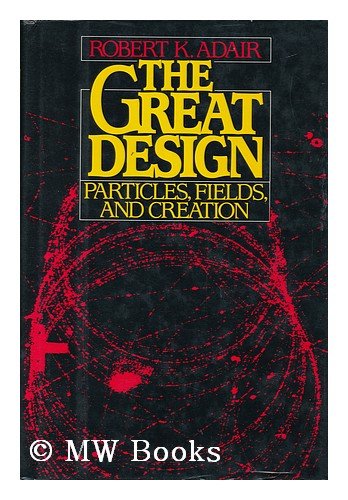
Although modern physics surrounds us, its concepts constantly referred to in every newspaper, even educated nonscientists find the subject intimidating in the extreme. Most attempts to explain physics to general readers are either obscured by masses of mathematics or gross oversimplifications written by laymen. Here at last is a comprehensive--and comprehensible--account of particles, fields and cosmology written by a working physicist not burdened by the weight of ponderous scientific notation. Robert K. Adair gives us a feel for how physicists think about problems: what assumptions must be made to simplify impossibly complex relationships between objects, on what scale the problem needs to be treated, how measurements are made, and what the interplay between theory and experiment is.
Adair gently guides the reader through the ideas of particles, fields, relativity, and quantum mechanics. He explains the great discoveries of this century, which have caused a revolution in how we view the universe, in logical, simple terms not requiring anything beyond high school algebra to comprehend. He has performed the difficult task of predigesting complex concepts to permit the layman access to what appears to be an arcane discipline. He captures the flavor of the joy of discovery at the heart of research.
"synopsis" may belong to another edition of this title.
About the Author
About the Author:
Robert K. Adair is Associate Director for High Energy and Nuclear Physics at the Brookhaven National Laboratory and Eugene Higgins Professor of Physics at Yale University. He is the author of Concepts in Physics and (with Earle C. Fowler) Strange Particles.
Reviews
Adair's aim is to explain the underlying ideas of modern physics to the educated layperson while avoiding mathematics as much as possible. Considering the difficulty of the task, he does a creditable job. Still, there is a fair amount of algebraic notation, using Greek letters and sub- and superscripts, which may intimidate some readers, and the author tacitly assumes familiarity with scientific terminology. This is a good book for anyone who has studied some physics at the undergraduate level but never really grasped its unifying concepts. It is also recommended to readers with a scientific background interested in the present state of the art in quantum mechanics, particle physics, and astrophysics. Harold D. Shane, Mathematics Dept., Baruch Coll. ,
Copyright 1987 Reed Business Information, Inc.
"About this title" may belong to another edition of this title.
Search results for The Great Design: Particles, Fields, and Creation

Stock Image
The Great Design: Particles, Fields and Creation
Published by
Oxford University Press Inc, 1987
ISBN 10: 0195043804
ISBN 13: 9780195043808
Used
Hardcover
Seller: World of Books (was SecondSale), Montgomery, IL, U.S.A.
Seller rating 5 out of 5 stars

Hardback. Condition: Good. This introductory volume emphasises our understanding of the fundamental forces - gravitation, electromagnetism - and the fundamental particles on which they act and which go to build atoms and molecules. There are chapters on concepts; invariance and conservation laws; covariance scalars, vectors, tensors; the electromagnetic field; cosmology; and much more. Seller Inventory # 00095898818
Stock Image
The Great Design: Particles, Fields, and Creation
Published by
Oxford University Press (edition 1), 1987
ISBN 10: 0195043804
ISBN 13: 9780195043808
Used
Hardcover
Seller: BooksRun, Philadelphia, PA, U.S.A.
Seller rating 5 out of 5 stars
Hardcover. Condition: Very Good. 1. With dust jacket. It's a well-cared-for item that has seen limited use. The item may show minor signs of wear. All the text is legible, with all pages included. It may have slight markings and/or highlighting. Seller Inventory # 0195043804-8-1-29
Stock Image
The Great Design: Particles, Fields, and Creation
Published by
Oxford University Press, 1987
ISBN 10: 0195043804
ISBN 13: 9780195043808
Used
Hardcover
Seller: Wonder Book, Frederick, MD, U.S.A.
Seller rating 5 out of 5 stars
Condition: Good. Good condition. Good dust jacket. A copy that has been read but remains intact. May contain markings such as bookplates, stamps, limited notes and highlighting, or a few light stains. Seller Inventory # E13O-00397
Stock Image
The Great Design : Particles, Fields, and Creation
Published by
Oxford University Press, Incorporated, 1987
ISBN 10: 0195043804
ISBN 13: 9780195043808
Used
Hardcover
Seller: Better World Books: West, Reno, NV, U.S.A.
Seller rating 5 out of 5 stars
Condition: Very Good. Former library copy. Pages intact with possible writing/highlighting. Binding strong with minor wear. Dust jackets/supplements may not be included. Includes library markings. Stock photo provided. Product includes identifying sticker. Better World Books: Buy Books. Do Good. Seller Inventory # GRP105413542
Stock Image
The Great Design : Particles, Fields, and Creation
Published by
Oxford University Press, Incorporated, 1987
ISBN 10: 0195043804
ISBN 13: 9780195043808
Used
Hardcover
Seller: Better World Books, Mishawaka, IN, U.S.A.
Seller rating 5 out of 5 stars
Condition: Good. Former library copy. Pages intact with minimal writing/highlighting. The binding may be loose and creased. Dust jackets/supplements are not included. Includes library markings. Stock photo provided. Product includes identifying sticker. Better World Books: Buy Books. Do Good. Seller Inventory # GRP71809748
Stock Image
The Great Design: Particles, Fields, and Creation
Published by
Oxford University Press, USA, 1987
ISBN 10: 0195043804
ISBN 13: 9780195043808
Used
Hardcover
Seller: ThriftBooks-Dallas, Dallas, TX, U.S.A.
Seller rating 5 out of 5 stars
Hardcover. Condition: Fair. No Jacket. Readable copy. Pages may have considerable notes/highlighting. ~ ThriftBooks: Read More, Spend Less. Seller Inventory # G0195043804I5N00
Stock Image
The Great Design: Particles, Fields, and Creation
Published by
Oxford University Press, 1987
ISBN 10: 0195043804
ISBN 13: 9780195043808
Used
Hardcover
Seller: HPB-Ruby, Dallas, TX, U.S.A.
Seller rating 5 out of 5 stars
hardcover. Condition: Very Good. Connecting readers with great books since 1972! Used books may not include companion materials, and may have some shelf wear or limited writing. We ship orders daily and Customer Service is our top priority! Seller Inventory # S_446411693
Seller Image
The Great Design: Particles, Fields, and Creation
Published by
Oxford University Press, 1987
ISBN 10: 0195043804
ISBN 13: 9780195043808
Used
Hardcover
Seller: Coas Books, Las Cruces, NM, U.S.A.
Seller rating 5 out of 5 stars
Condition: good. Seller Inventory # 55GP71000K2X_ns
Seller Image
The Great Design: Particles, Fields, and Creation
Published by
Oxford University Press, 1987
ISBN 10: 0195043804
ISBN 13: 9780195043808
Used
Hardcover
Seller: -OnTimeBooks-, Phoenix, AZ, U.S.A.
Seller rating 5 out of 5 stars
Condition: good. A copy that has been read, remains in good condition. All pages are intact, and the cover is intact. The spine and cover show signs of wear. Pages can include notes and highlighting and show signs of wear, and the copy can include "From the library of" labels or previous owner inscriptions. 100% GUARANTEE! Shipped with delivery confirmation, if you're not satisfied with purchase please return item! Ships via media mail. Seller Inventory # OTV.0195043804.G
Seller Image
The Great Design: Particles, Fields and Creation
Published by
Oxford University Press Inc, 1987
ISBN 10: 0195043804
ISBN 13: 9780195043808
Used
Hardcover
Seller: BoundlessBookstore, Wallingford, United Kingdom
Seller rating 5 out of 5 stars
Condition: Good. DJ will be clean and have at most light wear. Book will have been read but remains in excellent condition. Clean and tight binding. Cover may show slight wear. Contents will be clean and free from markings. Seller Inventory # 9999-99987789755
Buy Used
US$ 4.04
US$ 9.13 shipping
Ships from United Kingdom to U.S.A.
Ships from United Kingdom to U.S.A.
Quantity: 1 available