
Items related to The Lever of Riches: Technological Creativity and Economic...
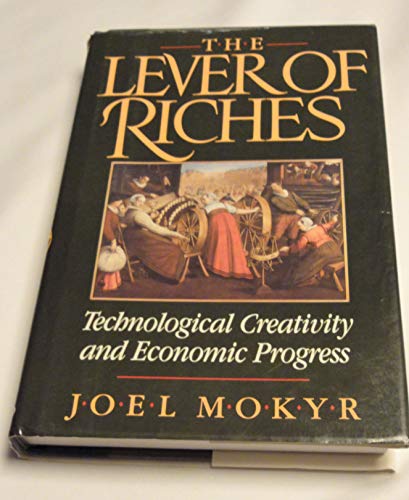
Synopsis
In a world of supercomputers, genetic engineering, and fiber optics, technological creativity is ever more the key to economic success. But why are some nations more creative than others, and why do some highly innovative societies--such as ancient China, or Britain in the industrial revolution--pass into stagnation?
Beginning with a fascinating, concise history of technological progress, Mokyr sets the background for his analysis by tracing the major inventions and innovations that have transformed society since ancient Greece and Rome. What emerges from this survey is often surprising: the classical world, for instance, was largely barren of new technology, the relatively backward society of medieval Europe bristled with inventions, and the period between the Reformation and the Industrial Revolution was one of slow and unspectacular progress in technology, despite the tumultuous developments associated with the Voyages of Discovery and the Scientific Revolution.
What were the causes of technological creativity? Mokyr distinguishes between the relationship of inventors and their physical environment--which determined their willingness to challenge nature--and the social environment, which determined the openness to new ideas. He discusses a long list of such factors, showing how they interact to help or hinder a nation's creativity, and then illustrates them by a number of detailed studies taken from the history of Europe and China. He examines such aspects as the role of the state (the Chinese gave up a millenium-wide lead in shipping to the Europeans, for example, when an Emperor banned large ocean-going vessels), the impact of science, as well as religion, politics, and even nutrition. He questions the importance of such commonly-cited factors as the spill-over benefits of war, the abundance of of natural resources, life expectancy, and labor costs. And he presents startlingly novel explanations of why China lost its dramatic lead in technology to Europe, why medieval Europe was technologically more creative than Classical Antiquity, and why Britain left the rest of the world behind during the Industrial Revolution only to lose its leadership a century later.
Today, an ever greater number of industrial economies are competing in the global market, locked in a struggle that revolves around technological ingenuity. Lever of Riches, with its keen analysis derived from a sweeping survey of creativity throughout history, offers telling insight into the question of how Western economies can maintain, and developing nations can unlock, their creative potential.
"synopsis" may belong to another edition of this title.
About the Author
About the Author:
Joel Mokyr is Professor of Economics and History at Northwestern University, and is the author of Why Ireland Starved, The Economics of the Industrial Revolution, and other books in economic history.
"About this title" may belong to another edition of this title.
Search results for The Lever of Riches: Technological Creativity and Economic...

Stock Image
The Lever of Riches
Published by
Oxford University Press Inc, 1990
ISBN 10: 0195061136
ISBN 13: 9780195061130
Used
Hardcover
Seller: World of Books (was SecondSale), Montgomery, IL, U.S.A.
Seller rating 5 out of 5 stars

Hardback. Condition: Good. An interpretive history of technology and its relation to economic growth is contained in this volume, spanning the period from 500 BC to the end of the 19th century. Seller Inventory # 00106512060
Stock Image
The Lever of Riches : Technological Creativity and Economic Progress
Published by
Oxford University Press, Incorporated, 1990
ISBN 10: 0195061136
ISBN 13: 9780195061130
Used
Hardcover
Seller: Better World Books: West, Reno, NV, U.S.A.
Seller rating 5 out of 5 stars
Condition: Very Good. Former library copy. Pages intact with possible writing/highlighting. Binding strong with minor wear. Dust jackets/supplements may not be included. Includes library markings. Stock photo provided. Product includes identifying sticker. Better World Books: Buy Books. Do Good. Seller Inventory # GRP97357169
Stock Image
The Lever of Riches : Technological Creativity and Economic Progress
Published by
Oxford University Press, Incorporated, 1990
ISBN 10: 0195061136
ISBN 13: 9780195061130
Used
Hardcover
Seller: Better World Books, Mishawaka, IN, U.S.A.
Seller rating 5 out of 5 stars
Condition: Very Good. Pages intact with possible writing/highlighting. Binding strong with minor wear. Dust jackets/supplements may not be included. Stock photo provided. Product includes identifying sticker. Better World Books: Buy Books. Do Good. Seller Inventory # 8011135-6
Stock Image
The Lever of Riches : Technological Creativity and Economic Progress
Published by
Oxford University Press, Incorporated, 1990
ISBN 10: 0195061136
ISBN 13: 9780195061130
Used
Hardcover
Seller: Better World Books, Mishawaka, IN, U.S.A.
Seller rating 5 out of 5 stars
Condition: Good. Former library copy. Pages intact with minimal writing/highlighting. The binding may be loose and creased. Dust jackets/supplements are not included. Includes library markings. Stock photo provided. Product includes identifying sticker. Better World Books: Buy Books. Do Good. Seller Inventory # GRP56614805
Stock Image
The Lever of Riches : Technological Creativity and Economic Progress
Published by
Oxford University Press, Incorporated, 1990
ISBN 10: 0195061136
ISBN 13: 9780195061130
Used
Hardcover
Seller: Better World Books, Mishawaka, IN, U.S.A.
Seller rating 5 out of 5 stars
Condition: Very Good. Former library copy. Pages intact with possible writing/highlighting. Binding strong with minor wear. Dust jackets/supplements may not be included. Includes library markings. Stock photo provided. Product includes identifying sticker. Better World Books: Buy Books. Do Good. Seller Inventory # GRP97357169
Stock Image
The Lever of Riches
Published by
Oxford University Press Inc, 1990
ISBN 10: 0195061136
ISBN 13: 9780195061130
Used
Hardcover
Seller: World of Books Inc, Montgomery, IL, U.S.A.
Seller rating 4 out of 5 stars

Hardback. Condition: Good. An interpretive history of technology and its relation to economic growth is contained in this volume, spanning the period from 500 BC to the end of the 19th century. Seller Inventory # CIN0195061136G
Seller Image
The Lever of Riches: Technological Creativity and Economic Progress
Published by
Oxford University Press, 1990
ISBN 10: 0195061136
ISBN 13: 9780195061130
Used
Hardcover
Seller: -OnTimeBooks-, Phoenix, AZ, U.S.A.
Seller rating 5 out of 5 stars
Condition: good. A copy that has been read, remains in good condition. All pages are intact, and the cover is intact. The spine and cover show signs of wear. Pages can include notes and highlighting and show signs of wear, and the copy can include "From the library of" labels or previous owner inscriptions. 100% GUARANTEE! Shipped with delivery confirmation, if you're not satisfied with purchase please return item! Ships via media mail. Seller Inventory # OTV.0195061136.G
Stock Image
The Lever of Riches: Technological Creativity and Economic Progress
Published by
Oxford University Press, 1990
ISBN 10: 0195061136
ISBN 13: 9780195061130
Used
Hardcover
Seller: ThriftBooks-Reno, Reno, NV, U.S.A.
Seller rating 5 out of 5 stars
Hardcover. Condition: Good. No Jacket. Pages can have notes/highlighting. Spine may show signs of wear. ~ ThriftBooks: Read More, Spend Less. Seller Inventory # G0195061136I3N00
Stock Image
The Lever of Riches: Technological Creativity and Economic Progress
Published by
Oxford University Press, 1990
ISBN 10: 0195061136
ISBN 13: 9780195061130
Used
Hardcover
Seller: ThriftBooks-Atlanta, AUSTELL, GA, U.S.A.
Seller rating 5 out of 5 stars
Hardcover. Condition: Good. No Jacket. Pages can have notes/highlighting. Spine may show signs of wear. ~ ThriftBooks: Read More, Spend Less. Seller Inventory # G0195061136I3N00
Stock Image
The Lever of Riches: Technological Creativity and Economic Progress
Published by
Oxford University Press, 1990
ISBN 10: 0195061136
ISBN 13: 9780195061130
Used
Hardcover
Seller: ThriftBooks-Dallas, Dallas, TX, U.S.A.
Seller rating 5 out of 5 stars
Hardcover. Condition: Good. No Jacket. Pages can have notes/highlighting. Spine may show signs of wear. ~ ThriftBooks: Read More, Spend Less. Seller Inventory # G0195061136I3N00