Items related to Zulfi Bhutto of Pakistan: His Life and Times
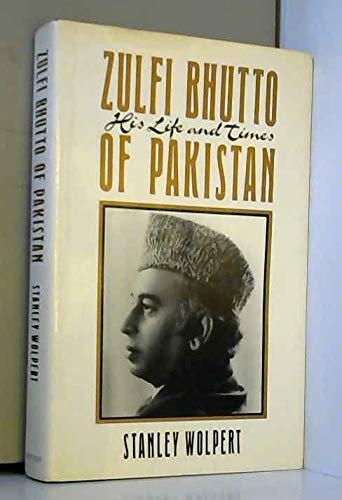

No individual in the history of Pakistan--indeed, few people in modern history--have achieved greater popular power or suffered so ignominious a death as Zulfikar Ali Bhutto. Bhutto's political rise and fall were so meteoric that his name became a legend in the land he once ruled. Indeed, a full decade after his execution his continuing popularity ensured the election of his daughter, Benazir, to the premier position he once held. As she campaigned in Sind and Punjab, the crowds cried "Jiye Bhutto!"--"Bhutto Lives!"--and the Bhutto they meant was Zulfi.
Zulfi Bhutto of Pakistan tells the story of this remarkable life in a vivid, insightful narrative. Written by Stanley Wolpert, a leading authority on South Asia and the author of the acclaimed biography Jinnah of Pakistan, the volume traces the life of this remarkable figure from the colorful days of his feudal ancestors to his imprisonment and hanging at the hands of a military dictatorship.
Bhutto, Wolpert writes, was a charismatic and contradictory man, a microcosmic reflection of Pakistan itself--a nation born out of division with India which later fell victim to its own internal split with the creation of Bangladesh. Wolpert follows him from his privileged youth in British-ruled India, to his years as a student at USC and UC Berkeley (where he sported a thin moustache, shiny two-tone shoes, and proved a keen, if rakish, fraternity brother), to Oxford and back to Pakistan. Bhutto climbed to the heights of power with amazing swiftness, winning a seat in the central Cabinet of Pakistan at the unprecedented age of thirty. Wolpert weaves Pakistan's turbulent politics and repeated wars with India together with Bhutto's ambitious maneuvering, tracing his rise to Foreign Minister, the founding of his own political movement, and finally leadership of the nation. The story of Bhutto's sometimes brilliant, sometimes quixotic career is a fascinating one, and Wolpert tells it well, through Bhutto's triumphant years in the mid-1970s, the military coup in 1977, and his treacherous imprisonment and execution in 1979.
Like the nation he embodied, Bhutto led a sprawling, ambitious, and tragic existence. Wolpert's intensively researched, engagingly written account captures the scheming, the grandeur, and the contradictions of one of modern history's most fascinating figures.
Zulfi Bhutto of Pakistan tells the story of this remarkable life in a vivid, insightful narrative. Written by Stanley Wolpert, a leading authority on South Asia and the author of the acclaimed biography Jinnah of Pakistan, the volume traces the life of this remarkable figure from the colorful days of his feudal ancestors to his imprisonment and hanging at the hands of a military dictatorship.
Bhutto, Wolpert writes, was a charismatic and contradictory man, a microcosmic reflection of Pakistan itself--a nation born out of division with India which later fell victim to its own internal split with the creation of Bangladesh. Wolpert follows him from his privileged youth in British-ruled India, to his years as a student at USC and UC Berkeley (where he sported a thin moustache, shiny two-tone shoes, and proved a keen, if rakish, fraternity brother), to Oxford and back to Pakistan. Bhutto climbed to the heights of power with amazing swiftness, winning a seat in the central Cabinet of Pakistan at the unprecedented age of thirty. Wolpert weaves Pakistan's turbulent politics and repeated wars with India together with Bhutto's ambitious maneuvering, tracing his rise to Foreign Minister, the founding of his own political movement, and finally leadership of the nation. The story of Bhutto's sometimes brilliant, sometimes quixotic career is a fascinating one, and Wolpert tells it well, through Bhutto's triumphant years in the mid-1970s, the military coup in 1977, and his treacherous imprisonment and execution in 1979.
Like the nation he embodied, Bhutto led a sprawling, ambitious, and tragic existence. Wolpert's intensively researched, engagingly written account captures the scheming, the grandeur, and the contradictions of one of modern history's most fascinating figures.
"synopsis" may belong to another edition of this title.
About the Author:
About the Author:
Stanley Wolpert is Professor of South Asian History at the University of California, Los Angeles. He is the author of a number of books on South Asian history, including A New History of India (Oxford, Fourth Edition, 1993), Nine Hours to Rama (subsequently filmed, and banned, in India), and Jinnah of Pakistan (Oxford University Press, 1984).
From Publishers Weekly:
About the Author:
Stanley Wolpert is Professor of South Asian History at the University of California, Los Angeles. He is the author of a number of books on South Asian history, including A New History of India (Oxford, Fourth Edition, 1993), Nine Hours to Rama (subsequently filmed, and banned, in India), and Jinnah of Pakistan (Oxford University Press, 1984).
Pakistanis still revere their slain prime minister, glib, charistmatic, Oxford-educated Zulfikar Ali Bhutto (1928-1979), who was arrested by his top general and hanged after two ignominious years in prison. His supporters hailed the fiery anti-Indian orator and pan-Islamic politician as a restorer of Pakistan's pride, and they see in his daughter Benazir Bhutto--ex-prime minster and now leader of the opposition--the promise of resuscitating Zulfi's glory. But this searching, brilliant, exhaustively researched biography dissolves Bhutto's aura to present him as a "schizoid personality" who ran Pakistan like a feudal lord. Wolpert, South Asian history professor at UCLA, tells how the "Islamic Napoleon" waged a disastrous genocidal war against newly independent Bangladesh, led a secret program to amass a nuclear arsenal for Pakistan and two-timed his Hindu wife Nusrat who, disconsolate over his lies and infidelities, attempted suicide. Photos.
Copyright 1993 Reed Business Information, Inc.
Copyright 1993 Reed Business Information, Inc.
"About this title" may belong to another edition of this title.
- PublisherOxford University Press
- Publication date1993
- ISBN 10 0195076613
- ISBN 13 9780195076615
- BindingHardcover
- Edition number1
- Number of pages400
- Rating
Buy New
Learn more about this copy
US$ 101.94
Shipping:
US$ 3.25
Within U.S.A.
Top Search Results from the AbeBooks Marketplace
Stock Image
Zulfi Bhutto of Pakistan: His Life and Times
Published by
Oxford University Press
(1993)
ISBN 10: 0195076613
ISBN 13: 9780195076615
New
Hardcover
Quantity: 1
Seller:
Rating

Book Description Hardcover. Condition: new. Buy for Great customer experience. Seller Inventory # GoldenDragon0195076613
Buy New
US$ 101.94
Convert currency
Stock Image
Zulfi Bhutto of Pakistan: His Life and Times
Published by
Oxford University Press
(1993)
ISBN 10: 0195076613
ISBN 13: 9780195076615
New
Hardcover
Quantity: 1
Seller:
Rating
Book Description Hardcover. Condition: new. New. Seller Inventory # Wizard0195076613
Buy New
US$ 104.14
Convert currency
Stock Image
Zulfi Bhutto of Pakistan: His Life and Times
Published by
Oxford University Press
(1993)
ISBN 10: 0195076613
ISBN 13: 9780195076615
New
Hardcover
Quantity: 1
Seller:
Rating
Book Description Hardcover. Condition: new. New Copy. Customer Service Guaranteed. Seller Inventory # think0195076613
Buy New
US$ 103.42
Convert currency
Stock Image
Zulfi Bhutto of Pakistan: His Life and Times
Published by
Oxford University Press
(1993)
ISBN 10: 0195076613
ISBN 13: 9780195076615
New
Hardcover
Quantity: 1
Seller:
Rating
Book Description Hardcover. Condition: new. New. Fast Shipping and good customer service. Seller Inventory # Holz_New_0195076613
Buy New
US$ 114.73
Convert currency
Stock Image
Zulfi Bhutto of Pakistan: His Life and Times
Published by
OXFORD UNIVERSITY PRESS
(1993)
ISBN 10: 0195076613
ISBN 13: 9780195076615
New
Hardcover
Quantity: 1
Seller:
Rating
Book Description Condition: new. Seller Inventory # FrontCover0195076613
Buy New
US$ 115.39
Convert currency
Stock Image
ZULFI BHUTTO OF PAKISTAN: HIS LI
Published by
Oxford University Press
(1993)
ISBN 10: 0195076613
ISBN 13: 9780195076615
New
Hardcover
Quantity: 1
Seller:
Rating

Book Description Condition: New. New. In shrink wrap. Looks like an interesting title! 2.35. Seller Inventory # Q-0195076613
Buy New
US$ 114.24
Convert currency
Stock Image
Zulfi Bhutto of Pakistan: His Life and Times
Published by
Oxford University Press
(1993)
ISBN 10: 0195076613
ISBN 13: 9780195076615
New
Hardcover
Quantity: 1
Seller:
Rating
Book Description Hardcover. Condition: New. Brand New!. Seller Inventory # VIB0195076613
Buy New
US$ 155.81
Convert currency
Stock Image
Zulfi Bhutto of Pakistan: His Life and Times
Published by
Oxford University Press
(1993)
ISBN 10: 0195076613
ISBN 13: 9780195076615
New
Hardcover
Quantity: 1
Seller:
Rating
Book Description Hardcover. Condition: New. Seller Inventory # Abebooks17687
Buy New
US$ 300.00
Convert currency
Stock Image
Zulfi Bhutto of Pakistan: His Life and Times Wolpert, Stanley
Published by
Oxford University Press
(1993)
ISBN 10: 0195076613
ISBN 13: 9780195076615
New
Hardcover
Quantity: 1
Seller:
Rating
Book Description Condition: New. (inventory#Shelf). Seller Inventory # EZ7094
Buy New
US$ 500.00
Convert currency