
Items related to "...the real war will never get in the books":...
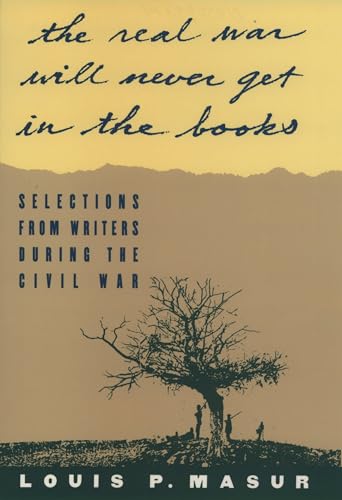
"...the real war will never get in the books": Selections from Writers During the Civil War - Softcover
Synopsis
"These thousands, and tens and twenties of thousands of American young men, badly wounded, all sorts of wounds, operated on, pallid with diarrhea, languishing, dying with fever, pneumonia, &c. open a new world somehow to me, giving closer insights, new things, exploring deeper mines than any yet, showing our humanity, (I sometimes put myself in fancy in the cot, with typhoid, or under the knife,) tried by terrible, fearfulest tests, probed deepest, the living soul's, the body's tragedies, bursting the petty bounds of art." So wrote Walt Whitman in March of 1863, in a letter telling friends in New York what he had witnessed in Washington's war hospitals. In this, we see both a description of war's ravages and a major artist's imaginative response to the horrors of war as it "bursts the petty bounds of art."
In "...the real war will never get in the books", Louis Masur has brought together fourteen of the most eloquent and articulate writers of the Civil War period, including such major literary figures as Nathaniel Hawthorne, Harriet Beecher Stowe, Ralph Waldo Emerson, Frederick Douglass, Herman Melville, Walt Whitman, Henry Adams, and Louisa May Alcott. Drawing on a wide range of material, including diaries, letters, and essays, Masur captures the reactions of these writers as the war was waged, providing a broad spectrum of views. Emerson, for instance, sees the war "come as a frosty October, which shall restore intellectual & moral power to these languid & dissipated populations." African-American writer Charlotte Forten writes sadly of the slaughter at Fort Wagner: "It seems very, very hard that the best and noblest must be the earliest called away. Especially has it been so throughout this dreadful war." There are writings by soldiers in combat. John Esten Cooke, a writer of popular pre-Revolutionary romances serving as a Confederate soldier under J.E.B. Stuart, describes Stonewall Jackson's uniform: "It was positively scorched by sun--had that dingy hue, the product of sun and rain, and contact with the ground...but the men of the old Stonewall Brigade loved that coat." And John De Forest, a Union officer, describes facing a Confederate volley: "It was a long rattle like that which a boy makes in running with a stick along a picket-fence, only vastly louder; and at the same time the sharp, quiet whit-whit of bullets chippered close to our ears." And along the way, we sample many vivid portraits of the era, perhaps the most surprising of which is Louisa May Alcott's explanation of why she preferred her noon-to-midnight schedule in a Washington hospital: "I like it as it leaves me time for a morning run which is what I need to keep well....I trot up & down the streets in all directions, some times to the Heights, then half way to Washington, again to the hill over which the long trains of army wagons are constantly vanishing & ambulances appearing. That way the fighting lies, & I long to follow."
With unmatched intimacy and immediacy, "...the real war will never get in the books" illuminates the often painful intellectual and emotional efforts of fourteen accomplished writers as they come to grips with "The American Apocalypse."
"synopsis" may belong to another edition of this title.
About the Author
Louis Masur is Associate Professor of History at City College of New York. He is the author of Rites of Execution: Capital Punishment and the Transformation of American Culture, 1776-1865 (Oxford, 1989).
"About this title" may belong to another edition of this title.
Search results for "...the real war will never get in the books":...

Stock Image
'The Real War Will Never Get in the Books': Selections from Writers During the Civil War
Published by
Oxford University Press Inc, 1995
ISBN 10: 0195098374
ISBN 13: 9780195098372
Used
Paperback
Seller: World of Books (was SecondSale), Montgomery, IL, U.S.A.
Seller rating 5 out of 5 stars

Paperback. Condition: Good. Drawing on a wide range of material, including diaries, letters, and essays, Masur captures the reactions, as the war was waged, of writers such as Nathaniel Hawthorne, Harriet Beecher Stowe, Ralph Waldo Emerson, Frederick Douglass, Herman Melville, Walt Whitman, Henry Adams, and Louisa May Alcott. Seller Inventory # 00088000862
Stock Image
'The Real War Will Never Get in the Books': Selections from Writers During the Civil War
Published by
Oxford University Press Inc, 1995
ISBN 10: 0195098374
ISBN 13: 9780195098372
Used
Paperback
Seller: World of Books (was SecondSale), Montgomery, IL, U.S.A.
Seller rating 5 out of 5 stars
Paperback. Condition: Very Good. Drawing on a wide range of material, including diaries, letters, and essays, Masur captures the reactions, as the war was waged, of writers such as Nathaniel Hawthorne, Harriet Beecher Stowe, Ralph Waldo Emerson, Frederick Douglass, Herman Melville, Walt Whitman, Henry Adams, and Louisa May Alcott. Seller Inventory # 00097055596
Stock Image
".the real war will never get in the books": Selections from Writers During the Civil War
Published by
Oxford University Press (edition 1), 1995
ISBN 10: 0195098374
ISBN 13: 9780195098372
Used
Paperback
Seller: BooksRun, Philadelphia, PA, U.S.A.
Seller rating 5 out of 5 stars
Paperback. Condition: Fair. 1. The item might be beaten up but readable. May contain markings or highlighting, as well as stains, bent corners, or any other major defect, but the text is not obscured in any way. Seller Inventory # 0195098374-7-1-13
Stock Image
". the Real War Will Never Get in the Books" : Selections from Writers During the Civil War
Published by
Oxford University Press, Incorporated, 1995
ISBN 10: 0195098374
ISBN 13: 9780195098372
Used
Softcover
Seller: Better World Books, Mishawaka, IN, U.S.A.
Seller rating 5 out of 5 stars
Condition: Very Good. Pages intact with possible writing/highlighting. Binding strong with minor wear. Dust jackets/supplements may not be included. Stock photo provided. Product includes identifying sticker. Better World Books: Buy Books. Do Good. Seller Inventory # 10628450-6
Stock Image
.the real war will never get in the books: Selections from Writers During the Civil War
Published by
Oxford University Press, 1995
ISBN 10: 0195098374
ISBN 13: 9780195098372
Used
Softcover
Seller: Wonder Book, Frederick, MD, U.S.A.
Seller rating 5 out of 5 stars
Condition: Very Good. Very Good condition. A copy that may have a few cosmetic defects. May also contain light spine creasing or a few markings such as an owner's name, short gifter's inscription or light stamp. Seller Inventory # R03B-05071
Stock Image
.the real war will never get in the books: Selections from Writers During the Civil War
Published by
Oxford University Press, 1995
ISBN 10: 0195098374
ISBN 13: 9780195098372
Used
Softcover
Seller: Wonder Book, Frederick, MD, U.S.A.
Seller rating 5 out of 5 stars
Condition: Good. Good condition. A copy that has been read but remains intact. May contain markings such as bookplates, stamps, limited notes and highlighting, or a few light stains. Bundled media such as CDs, DVDs, floppy disks or access codes may not be included. Seller Inventory # Z09I-00266
Stock Image
'The Real War Will Never Get in the Books': Selections from Writers During the Civil War
Published by
Oxford University Press Inc, 1995
ISBN 10: 0195098374
ISBN 13: 9780195098372
Used
Paperback
Seller: World of Books Inc, Montgomery, IL, U.S.A.
Seller rating 4 out of 5 stars

Paperback. Condition: Very Good. Drawing on a wide range of material, including diaries, letters, and essays, Masur captures the reactions, as the war was waged, of writers such as Nathaniel Hawthorne, Harriet Beecher Stowe, Ralph Waldo Emerson, Frederick Douglass, Herman Melville, Walt Whitman, Henry Adams, and Louisa May Alcott. Seller Inventory # CIN0195098374VG
Stock Image
'The Real War Will Never Get in the Books': Selections from Writers During the Civil War
Published by
Oxford University Press Inc, 1995
ISBN 10: 0195098374
ISBN 13: 9780195098372
Used
Paperback
Seller: World of Books Inc, Montgomery, IL, U.S.A.
Seller rating 4 out of 5 stars
Paperback. Condition: Good. Drawing on a wide range of material, including diaries, letters, and essays, Masur captures the reactions, as the war was waged, of writers such as Nathaniel Hawthorne, Harriet Beecher Stowe, Ralph Waldo Emerson, Frederick Douglass, Herman Melville, Walt Whitman, Henry Adams, and Louisa May Alcott. Seller Inventory # CIN0195098374G
Stock Image
The Real War Will Never Get in the Books: Selections from Writers During the Civil War
Published by
Oxford University Press, 1995
ISBN 10: 0195098374
ISBN 13: 9780195098372
Used
Paperback
Seller: ThriftBooks-Reno, Reno, NV, U.S.A.
Seller rating 5 out of 5 stars
Paperback. Condition: Good. No Jacket. Pages can have notes/highlighting. Spine may show signs of wear. ~ ThriftBooks: Read More, Spend Less. Seller Inventory # G0195098374I3N00
Stock Image
The Real War Will Never Get in the Books: Selections from Writers During the Civil War
Published by
Oxford University Press, 1995
ISBN 10: 0195098374
ISBN 13: 9780195098372
Used
Paperback
Seller: ThriftBooks-Dallas, Dallas, TX, U.S.A.
Seller rating 5 out of 5 stars
Paperback. Condition: Good. No Jacket. Pages can have notes/highlighting. Spine may show signs of wear. ~ ThriftBooks: Read More, Spend Less. Seller Inventory # G0195098374I3N00