
Items related to Lifelines: Biology Beyond Determinism
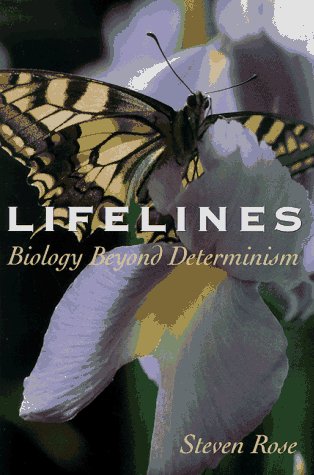
Synopsis
Reductionism--understanding complex processes by breaking them into simpler elements--dominates scientific thinking around the world and has certainly proved a powerful tool, leading to major discoveries in every field of science. But reductionism can be taken too far, especially in the life sciences, where sociobiological thinking has bordered on biological determinism. Thus popular science writers such as Richard Dawkins, author of the highly influential The Selfish Gene, can write that human beings are just "robot vehicles blindly programmed to preserve the selfish molecules known as genes." Indeed, for many in science, genes have become the fundamental unit for understanding human existence: genes determine every aspect of our lives, from personal success to existential despair: genes for health and illness, genes for criminality, violence, and sexual orientation. Others would say that this is reductionism with a vengeance.
In Lifelines, biologist Steven Rose offers a powerful alternative to the ultradarwinist claims of Dawkins, E.O. Wilson, Daniel Dennett and others. Rose argues against an extreme reductionist approach that would make the gene the key to understanding human nature, in favor of a more complex and richer vision of life. He urges instead that we focus on the organism and in particular on the organism's lifeline: the trajectory it takes through time and space. Our personal lifeline, Rose points out, is unique--even identical twins, with identical genes at birth, will differ over time. These differences are obviously not embedded in our genes, but come about through our developmental trajectory in which genes, as part of the biochemical orchestra of trillions of cells in each human body, have an important part--but only a part--to play. To illustrate this idea, Rose examines recent research in modern biology, and especially two disciplines--genetics (which looks at the impact of genes on form) and developmental biology (which examines the interaction between the organism and the environment)--and he explores new ideas on biological complexity proposed by scientists such as Stuart Kauffman. He shows how our lifelines are constructed through the interplay of physical forces--such as the intrinsic chemistry of lipids and proteins, and the self-organizing and stabilizing properties of complex metabolic webs--and he reaches a startling conclusion: that organisms are active players in their own fate, not simply the playthings of the gods, nature, or the inevitable workings out of gene-driven natural selection. The organism is both the weaver and the pattern it weaves.
Lifelines will be a rallying point for all who seek an alternative to the currently fashionable, deeply determinist accounts which dominate popular science writing and, in fact, crowd the pages of some of the major scientific journals. Based on solid, state-of-the-art research, it not only makes important contributions to our understanding of Darwin and natural selection, but will swing the pendulum back to a richer, more complex view of human nature and of life.
"synopsis" may belong to another edition of this title.
About the Author
About the Author:
Steven Rose is Professor and Chairman of the Department of Biology, Open University. He won the 1993 British Science Book Prize for The Making of Memory, and is also the author of The Conscious Brain and Not in Our Genes.
Reviews
Rejecting genetic reductionism and biological determinism as adequate explanations in the life sciences, neuroscientist Rose argues that understanding and appreciating an organism (including humans) requires focusing on its unique lifeline, i.e., its developmental trajectory over space and throughout time. Going beyond the ultra-Darwinism of Richard Dawkins, Daniel C. Dennett, and Edward O. Wilson (among others), Rose emphasizes the creative interaction between any complex life form and its dynamic environment. He pays special attention to the origin of life, discoveries in genetics, and the application of universal Darwinism. Although a materialist, Rose stresses that the gene is neither the only nor the final key to comprehending the complexity and development of an organism. Therefore, he concludes that epistemological diversity is necessary to understand and appreciate the ontological unity of evolving nature. As an alternative viewpoint in modern biology, this book is recommended for all large natural history collections.?H. James Birx, Canisius Coll., Buffalo, N.Y.
Copyright 1997 Reed Business Information, Inc.
"About this title" may belong to another edition of this title.
Search results for Lifelines: Biology Beyond Determinism

Stock Image
Lifelines: Biology Beyond Determinism
Published by
Oxford University Press, 1997
ISBN 10: 0195120353
ISBN 13: 9780195120356
Used
Hardcover
First Edition
Seller: Avenue Victor Hugo Books, Newmarket, NH, U.S.A.
Seller rating 4 out of 5 stars

Hardcover. Condition: Near Fine. Dust Jacket Condition: Near Fine. First Edition, first printing. Octavo, 9 1/2" tall, 308 pages, gray and purple boards. A near fine, clean, neat hard cover over all with light shelf wear, binding tight, paper clean and cream white. In a near fine, lightly worn dust jacket with the original price present. Seller Inventory # 56616
Stock Image
Lifelines: Biology Beyond Determinism
Published by
Oxford University Press, 1997
ISBN 10: 0195120353
ISBN 13: 9780195120356
Used
Hardcover
Seller: Half Price Books Inc., Dallas, TX, U.S.A.
Seller rating 5 out of 5 stars

Hardcover. Condition: Very Good. Connecting readers with great books since 1972! Used books may not include companion materials, and may have some shelf wear or limited writing. We ship orders daily and Customer Service is our top priority! Seller Inventory # S_340936994
Stock Image
Lifelines: Biology Beyond Determinism
Published by
Oxford University Press, 1997
ISBN 10: 0195120353
ISBN 13: 9780195120356
Used
Hardcover
Seller: ThriftBooks-Atlanta, AUSTELL, GA, U.S.A.
Seller rating 5 out of 5 stars
Hardcover. Condition: Good. No Jacket. Former library book; Pages can have notes/highlighting. Spine may show signs of wear. ~ ThriftBooks: Read More, Spend Less. Seller Inventory # G0195120353I3N10
Stock Image
Lifelines: Biology Beyond Determinism
Published by
Oxford University Press, 1997
ISBN 10: 0195120353
ISBN 13: 9780195120356
Used
Hardcover
Seller: ThriftBooks-Dallas, Dallas, TX, U.S.A.
Seller rating 5 out of 5 stars
Hardcover. Condition: As New. No Jacket. Pages are clean and are not marred by notes or folds of any kind. ~ ThriftBooks: Read More, Spend Less. Seller Inventory # G0195120353I2N00
Stock Image
Lifelines: Biology Beyond Determinism
Published by
Oxford University Press, 1997
ISBN 10: 0195120353
ISBN 13: 9780195120356
Used
Hardcover
Seller: ThriftBooks-Atlanta, AUSTELL, GA, U.S.A.
Seller rating 5 out of 5 stars
Hardcover. Condition: Good. No Jacket. Pages can have notes/highlighting. Spine may show signs of wear. ~ ThriftBooks: Read More, Spend Less. Seller Inventory # G0195120353I3N00
Stock Image
Lifelines: Biology Beyond Determinism
Published by
Oxford University Press, 1997
ISBN 10: 0195120353
ISBN 13: 9780195120356
Used
Hardcover
Seller: ThriftBooks-Dallas, Dallas, TX, U.S.A.
Seller rating 5 out of 5 stars
Hardcover. Condition: Very Good. No Jacket. May have limited writing in cover pages. Pages are unmarked. ~ ThriftBooks: Read More, Spend Less. Seller Inventory # G0195120353I4N00
Stock Image
Lifelines: Biology Beyond Determinism
Published by
Oxford University Press, 1997
ISBN 10: 0195120353
ISBN 13: 9780195120356
Used
Hardcover
Seller: ThriftBooks-Atlanta, AUSTELL, GA, U.S.A.
Seller rating 5 out of 5 stars
Hardcover. Condition: As New. No Jacket. Pages are clean and are not marred by notes or folds of any kind. ~ ThriftBooks: Read More, Spend Less. Seller Inventory # G0195120353I2N00
Stock Image
Lifelines: Biology Beyond Determinism
Published by
Oxford University Press, 1997
ISBN 10: 0195120353
ISBN 13: 9780195120356
Used
Hardcover
Seller: The Maryland Book Bank, Baltimore, MD, U.S.A.
Seller rating 5 out of 5 stars
hardcover. Condition: Very Good. Underlining. Used - Very Good. Seller Inventory # 12-G-4-0128
Stock Image
Lifelines: Biology Beyond Determinism
Published by
Oxford University Press, 1997
ISBN 10: 0195120353
ISBN 13: 9780195120356
Used
Hardcover
Seller: Books Revisited, Saint Cloud, MN, U.S.A.
Seller rating 4 out of 5 stars
Hardcover. Condition: Good. Hardcover with jacket, light underlining (pencil) on a few pages in the first chapter, a very nice copy. Seller Inventory # 162321
Stock Image
Lifelines: Biology Beyond Determinism
Published by
Oxford University Press, 1997
ISBN 10: 0195120353
ISBN 13: 9780195120356
Used
Hardcover
Seller: THE OLD LIBRARY SHOP, Bethlehem, PA, U.S.A.
Seller rating 5 out of 5 stars
Hard Cover. Condition: fine. Dust Jacket Condition: fine. 1st ptg. 335 pages including index; purple paper over boards with grey linen backstrip; color photo on dust jacket. Hardcover (dj). Seller Inventory # 159447