
Items related to Ernest Rutherford: And the Explosion of Atoms (Oxford...
Synopsis
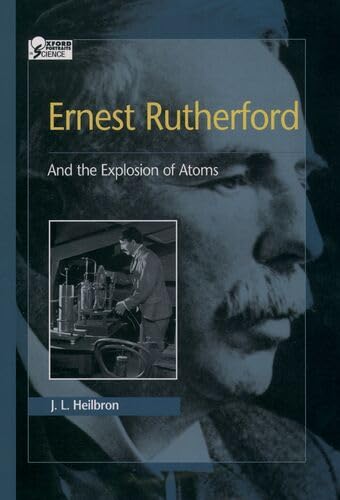
An engaging biography that captures the excitement of the early days of nuclear physics, Ernest Rutherford tells the story of the down-to-earth New Zealander who became one of the foremost pioneers of subatomic physics. Rutherford's achievements were numerous and included:
* Inventing a detector for electromagnetic waves
* Discovering the existence of alpha and beta rays in uranium radiation
* Creating (with Frederick Soddy) the "disintegration theory" of radioactivity, which regards radioactive phenomena as atomic -- not molecular -- processes
* Demonstrating that the inner structures of elements correspond with a group of lines that characterize them, which could then be assigned an atomic number and, more important, the properties of each element could be defined by this number
* And his greatest contribution of all - he discovered that the atom had a nucleus and that it contained the positively charged proton
From his early days as a scholarship student to the end of his life as he continued to work in his lab, Ernest Rutherford reveals the life and times of one of the greatest minds of the twentieth century.
Oxford Portraits in Science is an on-going series of scientific biographies for young adults. Written by top scholars and writers, each biography examines the personality of its subject as well as the thought process leading to his or her discoveries. These illustrated biographies combine accessible technical information with compelling personal stories to portray the scientists whose work has shaped our understanding of the natural world.
"synopsis" may belong to another edition of this title.
About the Author
John L. Heilbron is at University of Berkeley.
Reviews
Grade 9 Up-An introduction to the life and times of the great physicist from his birth in New Zealand in 1871 to his death in 1937. Rutherford's contributions include inventing a detector for electromagnetic waves, creating the disintegration theory of radioactivity, and, first and foremost, discovering the basic structure of the atom. He received the Nobel Prize in Chemistry in 1908 and worked on methods of locating submarines during World War I. The book includes numerous captioned, black-and-white photographs of Rutherford, his colleagues, and their laboratories and equipment. Sidebars and diagrams help to explain the many complex principles and equations. The book covers Rutherford's research in fine detail as well as that of many of his colleagues including Hans Geiger, Marie Curie, Niels Bohr, and J. J. Thomson. The author has finely interwoven the political and social context of the time into the significance of his subject's contributions in this authoritative work. A challenging read, it is best suited for serious students with some background in science.
Maren Ostergard, Bellevue Regional Library, WA
Copyright 2003 Reed Business Information, Inc.
"About this title" may belong to another edition of this title.
Search results for Ernest Rutherford: And the Explosion of Atoms (Oxford...

Seller Image
Ernest Rutherford: And the Explosion of Atoms (Oxford Portraits in Science)
Published by
Oxford University Press, 2003
ISBN 10: 0195123786
ISBN 13: 9780195123784
Used
Hardcover
Seller: Bay State Book Company, North Smithfield, RI, U.S.A.
Seller rating 5 out of 5 stars

Condition: good. The book is in good condition with all pages and cover intact, including the dust jacket if originally issued. The spine may show light wear. Pages may contain some notes or highlighting, and there might be a "From the library of" label. Boxed set packaging, shrink wrap, or included media like CDs may be missing. Seller Inventory # BSM.1EADG
Seller Image
Ernest Rutherford: And the Explosion of Atoms (Oxford Portraits in Science)
Published by
Oxford University Press, 2003
ISBN 10: 0195123786
ISBN 13: 9780195123784
Used
Hardcover
Seller: -OnTimeBooks-, Phoenix, AZ, U.S.A.
Seller rating 5 out of 5 stars
Condition: good. A copy that has been read, remains in good condition. All pages are intact, and the cover is intact. The spine and cover show signs of wear. Pages can include notes and highlighting and show signs of wear, and the copy can include "From the library of" labels or previous owner inscriptions. 100% GUARANTEE! Shipped with delivery confirmation, if you're not satisfied with purchase please return item! Ships via media mail. Seller Inventory # OTV.0195123786.G
Stock Image
Ernest Rutherford: And the Explosion of Atoms
Published by
Oxford University Press, USA, 2003
ISBN 10: 0195123786
ISBN 13: 9780195123784
Used
Hardcover
Seller: ThriftBooks-Atlanta, AUSTELL, GA, U.S.A.
Seller rating 5 out of 5 stars
Hardcover. Condition: Very Good. No Jacket. May have limited writing in cover pages. Pages are unmarked. ~ ThriftBooks: Read More, Spend Less. Seller Inventory # G0195123786I4N00
Stock Image
Ernest Rutherford : And the Explosion of Atoms
Published by
Oxford University Press, Incorporated, 2003
ISBN 10: 0195123786
ISBN 13: 9780195123784
Used
Hardcover
Seller: Better World Books, Mishawaka, IN, U.S.A.
Seller rating 5 out of 5 stars
Condition: Very Good. Former library copy. Pages intact with possible writing/highlighting. Binding strong with minor wear. Dust jackets/supplements may not be included. Includes library markings. Stock photo provided. Product includes identifying sticker. Better World Books: Buy Books. Do Good. Seller Inventory # 5199443-6
Seller Image
Ernest Rutherford and the Explosion of Atoms
Published by
Oxford University Press, New York, 2003
ISBN 10: 0195123786
ISBN 13: 9780195123784
Used
Hardcover
Seller: Stanley Louis Remarkable Books, Saint Charles, IL, U.S.A.
Seller rating 5 out of 5 stars
Hardcover. Condition: Very Good. First. From the publisher: An engaging biography that captures the excitement of the early days of nuclear physics, Ernest Rutherford tells the story of the down-to-earth New Zealander who became one of the foremost pioneers of subatomic physics. Rutherford's achievements were numerous and included: * Inventing a detector for electromagnetic waves * Discovering the existence of alpha and beta rays in uranium radiation * Creating (with Frederick Soddy) the "disintegration theory" of radioactivity, which regards radioactive phenomena as atomic -- not molecular -- processes * Demonstrating that the inner structures of elements correspond with a group of lines that characterize them, which could then be assigned an atomic number and, more important, the properties of each element could be defined by this number * And his greatest contribution of all - he discovered that the atom had a nucleus and that it contained the positively charged proton From his early days as a scholarship student to the end of his life as he continued to work in his lab, Ernest Rutherford reveals the life and times of one of the greatest minds of the twentieth century. Oxford Portraits in Science is an on-going series of scientific biographies for young adults. Written by top scholars and writers, each biography examines the personality of its subject as well as the thought process leading to his or her discoveries. These illustrated biographies combine accessible technical information with compelling personal stories to portray the scientists whose work has shaped our understanding of the natural world. John L. Heilbron (1934 - 2023) was an American historian of science best known for his work in the history of physics and the history of astronomy. He was Professor of History and Vice-Chancellor Emeritus (Vice-Chancellor 1990-1994) at the University of California, Berkeley, senior research fellow at Worcester College, Oxford, and visiting professor at Yale University and the California Institute of Technology. He edited the academic journal Historical Studies in the Physical and Biological Sciences for twenty-five years. This copy is very good in photo-illustrated paper-covered boards. No DJ as issued. Ex-library and so a few scattered library stamps and markings. But the binding and contents are in excellent condition with scant sign of usage. BW15. Seller Inventory # B1589
Stock Image
Ernest Rutherford: And the Explosion of Atoms (eng)
Print on DemandSeller: Brook Bookstore On Demand, Napoli, NA, Italy
Seller rating 5 out of 5 stars
Condition: new. Questo è un articolo print on demand. Seller Inventory # D1WMQ4WNBI
Buy New
US$ 45.39
US$ 6.25 shipping
Ships from Italy to U.S.A.
Ships from Italy to U.S.A.
Quantity: Over 20 available
Stock Image
Ernest Rutherford: And the Explosion of Atoms (Oxford Portraits in Science)
Seller: GoldBooks, Denver, CO, U.S.A.
Seller rating 5 out of 5 stars
Hardcover. Condition: new. New Copy. Customer Service Guaranteed. Seller Inventory # 23V28_49_0195123786
Stock Image
Ernest Rutherford: And the Explosion of Atoms
Published by
Oxford University Press Inc, 2003
ISBN 10: 0195123786
ISBN 13: 9780195123784
New
Hardcover
Seller: THE SAINT BOOKSTORE, Southport, United Kingdom
Seller rating 5 out of 5 stars
Hardback. Condition: New. New copy - Usually dispatched within 4 working days. Seller Inventory # B9780195123784
Buy New
US$ 53.53
US$ 20.66 shipping
Ships from United Kingdom to U.S.A.
Ships from United Kingdom to U.S.A.
Quantity: 15 available
Stock Image
Ernest Rutherford and the Explosion of Atoms: And the Explosion of Atoms
Seller: Revaluation Books, Exeter, United Kingdom
Seller rating 5 out of 5 stars
Hardcover. Condition: Brand New. 1st edition. 144 pages. 9.50x6.75x0.25 inches. In Stock. Seller Inventory # 0195123786
Buy New
US$ 78.73
US$ 13.25 shipping
Ships from United Kingdom to U.S.A.
Ships from United Kingdom to U.S.A.
Quantity: 1 available