
Items related to Life Itself: Exploring the Realm of the Living Cell
Synopsis
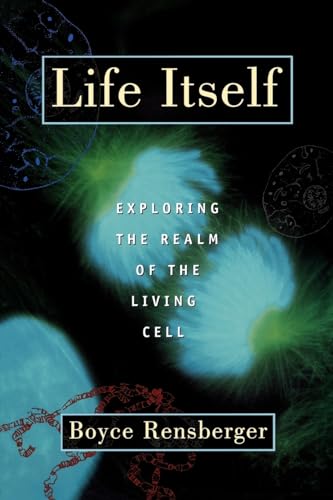
Hidden in a nondescript red-brick building in Rockville, Maryland, is the most unusual warehouse in the world, a bank of living cells called the American Type Culture Collection. Here, at 321 degrees below zero--a temperature at which life abandons its vital dance and enters limbo, but without dying--are some 30,000 vials holding 60 billion living forms in suspended animation, including mouse kidney cells, turkey blood cells, armadillo spleen cells, and some 40 billion human cells. These cultured cells are essential to modern biological research--in fact, cells today are the most intimately studied life forms in all of science, for both practical and philosophical reasons. For one, all disease--from cancer and the common cold, to arthritis and AIDS--stems from cells gone awry. And cell research not only promises a cure for a wide variety of disease--it also holds the key to the mystery of life itself.
In Life Itself, Boyce Rensberger, science writer for The Washington Post, takes readers to the frontlines of cell research with some of the brightest investigators in molecular, cellular, and developmental biology. Virtually all the hottest topics in biomedical research are covered here, such as how do cells and their minute components move? How do the body's cells heal wounds? What is cancer? Why do cells die? And what is the nature of life? Readers discover that--contrary to what we may have concluded from pictures in our high school textbooks--cells teem with activity and that, inside, they "are more crowded with components than the inside of a computer." We learn that scientists now know of at least ten molecular motors that move things about inside the cell--in most cells, this motion is short because the cell is tiny, but in the single-celled nerve fibers that run from the base of the spinal cord to the toes (measuring three or four feet in an adult human), molecular motors can take several days to make the trip. Rensberger describes the many fascinating kinds of cells found in the body, from "neural crest cells" (early in embryonic development, these cells crawl all over the embryo to the sites where they will pursue their fate--as nerve cells, or cartilage, or skin), to "dust cells" (nomadic cells in the lung that swallow and store indigestible particles, then migrate to the gullet where they themselves are swallowed and digested), to "natural killer cells" (millions of which roam the body looking for cancerous cells). We meet many of the scientists who have pioneered cell research, such as Rita Levi-Montalcini--an Italian who, shut out of her lab during World War II, continued to experiment in her bedroom at home, making the discovery ("nerve growth factor") for which she won the Nobel Prize--and American Leonard Hayflick, who proved that all human cells (except cancer cells) invariably die after about fifty divisions. Rensberger also provides an illuminating discussion of AIDS--revealing exactly why this virus is so difficult to defeat--and of cancer, explaining that before cancer can start, a whole series of rare events must occur, events so unlikely that it seems a wonder that anyone gets cancer at all.
The solutions to the most pressing challenges facing scientists today--from the efforts to conquer disease to the quest to understand life itself--will be found in the innermost workings of the cell. In Life Itself, Boyce Rensberger paints a colorful and fascinating portrait of modern research in this vital area, an account which will enthrall anyone interested in state-of-the-art science or the incredible workings of the human body.
"synopsis" may belong to another edition of this title.
About the Author
Boyce Rensberger has been a science writer and science editor for more than 30 years, including long stints at the New York Times and the Washington Post. He now directs the Knight Science Journalism Fellowship Program at the Massachusetts Institute of Technology.
"About this title" may belong to another edition of this title.
Search results for Life Itself: Exploring the Realm of the Living Cell

Stock Image
Life Itself: Exploring the Realm of the Living Cell
Published by
Oxford University Press Inc, 1999
ISBN 10: 0195125002
ISBN 13: 9780195125009
Used
Paperback
Seller: World of Books (was SecondSale), Montgomery, IL, U.S.A.
Seller rating 5 out of 5 stars

Paperback. Condition: Fair. This text explores cell research with some of the investigators in molecular, cellular, and developmental biology. Topics in late 1990s biomedical research are covered here, such as: how do cells and their minute components move?; how do the body's cells heal wounds?; and what is cancer? Seller Inventory # 00103134474
Stock Image
Life Itself: Exploring the Realm of the Living Cell
Published by
Oxford University Press Inc, 1999
ISBN 10: 0195125002
ISBN 13: 9780195125009
Used
Paperback
Seller: World of Books (was SecondSale), Montgomery, IL, U.S.A.
Seller rating 5 out of 5 stars
Paperback. Condition: Good. This text explores cell research with some of the investigators in molecular, cellular, and developmental biology. Topics in late 1990s biomedical research are covered here, such as: how do cells and their minute components move?; how do the body's cells heal wounds?; and what is cancer? Seller Inventory # 00108581329
Seller Image
Life Itself: Exploring the Realm of the Living Cell
Published by
Oxford University Press, 1998
ISBN 10: 0195125002
ISBN 13: 9780195125009
Used
Softcover
Seller: Bay State Book Company, North Smithfield, RI, U.S.A.
Seller rating 5 out of 5 stars
Condition: good. The book is in good condition with all pages and cover intact, including the dust jacket if originally issued. The spine may show light wear. Pages may contain some notes or highlighting, and there might be a "From the library of" label. Boxed set packaging, shrink wrap, or included media like CDs may be missing. Seller Inventory # BSM.1B1NI
Stock Image
Life Itself: Exploring the Realm of the Living Cell
Published by
Oxford University Press, 1998
ISBN 10: 0195125002
ISBN 13: 9780195125009
Used
Softcover
Seller: More Than Words, Waltham, MA, U.S.A.
Seller rating 5 out of 5 stars
Condition: Good. . . Before placing your order for please contact us for confirmation on the book's binding. Check out our other listings to add to your order for discounted shipping. All orders guaranteed and ship within 24 hours. Seller Inventory # BOS-D-12d-2141
Stock Image
Life Itself: Exploring the Realm of the Living Cell
Published by
Oxford University Press, 1998
ISBN 10: 0195125002
ISBN 13: 9780195125009
Used
Paperback
Seller: ThriftBooks-Reno, Reno, NV, U.S.A.
Seller rating 5 out of 5 stars
Paperback. Condition: Good. No Jacket. Pages can have notes/highlighting. Spine may show signs of wear. ~ ThriftBooks: Read More, Spend Less. Seller Inventory # G0195125002I3N00
Stock Image
Life Itself: Exploring the Realm of the Living Cell
Published by
Oxford University Press, 1998
ISBN 10: 0195125002
ISBN 13: 9780195125009
Used
Paperback
Seller: ThriftBooks-Phoenix, Phoenix, AZ, U.S.A.
Seller rating 5 out of 5 stars
Paperback. Condition: Good. No Jacket. Pages can have notes/highlighting. Spine may show signs of wear. ~ ThriftBooks: Read More, Spend Less. Seller Inventory # G0195125002I3N00
Stock Image
Life Itself: Exploring the Realm of the Living Cell
Published by
Oxford University Press, 1998
ISBN 10: 0195125002
ISBN 13: 9780195125009
Used
Paperback
Seller: ThriftBooks-Dallas, Dallas, TX, U.S.A.
Seller rating 5 out of 5 stars
Paperback. Condition: Good. No Jacket. Pages can have notes/highlighting. Spine may show signs of wear. ~ ThriftBooks: Read More, Spend Less. Seller Inventory # G0195125002I3N00
Stock Image
Life Itself: Exploring the Realm of the Living Cell
Published by
Oxford University Press, 1998
ISBN 10: 0195125002
ISBN 13: 9780195125009
Used
Paperback
Seller: ThriftBooks-Atlanta, AUSTELL, GA, U.S.A.
Seller rating 5 out of 5 stars
Paperback. Condition: Good. No Jacket. Pages can have notes/highlighting. Spine may show signs of wear. ~ ThriftBooks: Read More, Spend Less. Seller Inventory # G0195125002I3N00
Seller Image
Life Itself: Exploring the Realm of the Living Cell
Published by
Oxford University Press, 1998
ISBN 10: 0195125002
ISBN 13: 9780195125009
Used
Softcover
Seller: Goodwill Books, Hillsboro, OR, U.S.A.
Seller rating 5 out of 5 stars
Condition: acceptable. Fairly worn, but readable and intact. If applicable: Dust jacket, disc or access code may not be included. Seller Inventory # 3IIK3O006J7M_ns
Stock Image
Life Itself: Exploring the Realm of the Living Cell
Published by
Oxford University Press, 1998
ISBN 10: 0195125002
ISBN 13: 9780195125009
Used
paperback
Seller: The Maryland Book Bank, Baltimore, MD, U.S.A.
Seller rating 5 out of 5 stars
paperback. Condition: Good. Revised ed. Corners are bent. Used - Good. Seller Inventory # 17-U-1-0022