
Items related to Referring to the World: An Opinionated Introduction...
Synopsis
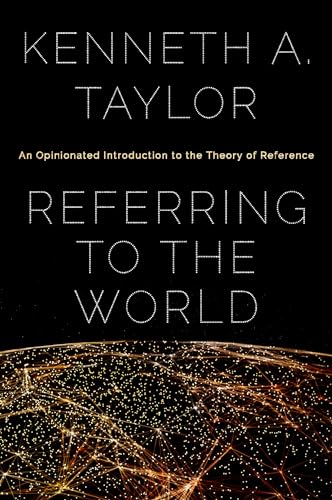
This book is a contribution to ongoing debates in the philosophy of language about reference and truth. The ideas discussed have been important not only in philosophy but in logic, linguistics, psychology, computer science and other areas concerned with thought and communication. Taylor was an important philosopher and led Stanford's influential Symbolic Systems Program, graduates of which are leaders in Silicon Valley. The book is not elementary, but it presents rich and subtle products of his years of thought on important topics with many examples and clear discussions.
"synopsis" may belong to another edition of this title.
About the Author
Kenneth A. Taylor was Professor of Philosophy at Stanford University from 1995 until his death in 2019.
"About this title" may belong to another edition of this title.
Search results for Referring to the World: An Opinionated Introduction...

Stock Image
Referring to the World: An Opinionated Introduction to the Theory of Reference
Published by
Oxford University Press, 2021
ISBN 10: 0195144740
ISBN 13: 9780195144741
Used
Hardcover
Seller: ThriftBooks-Atlanta, AUSTELL, GA, U.S.A.
Seller rating 5 out of 5 stars

Hardcover. Condition: Very Good. No Jacket. May have limited writing in cover pages. Pages are unmarked. ~ ThriftBooks: Read More, Spend Less. Seller Inventory # G0195144740I4N00
Stock Image
REFERRING TO THE WORLD FPH - FUNDAMENTALS OF PHILOSOPHY
Seller: INDOO, Avenel, NJ, U.S.A.
Seller rating 5 out of 5 stars
Condition: New. Brand New. Seller Inventory # 9780195144741
Stock Image
Referring to the World: An Opinionated Introduction to the Theory of Reference (eng)
Print on DemandSeller: Brook Bookstore On Demand, Napoli, NA, Italy
Seller rating 5 out of 5 stars
Condition: new. Questo è un articolo print on demand. Seller Inventory # C35PIG30NV
Buy New
US$ 109.01
US$ 7.91 shipping
Ships from Italy to U.S.A.
Ships from Italy to U.S.A.
Quantity: Over 20 available
Seller Image
Referring to the World (Hardcover)
Published by
Oxford University Press Inc, New York, 2021
ISBN 10: 0195144740
ISBN 13: 9780195144741
New
Hardcover
Seller: Grand Eagle Retail, Bensenville, IL, U.S.A.
Seller rating 5 out of 5 stars
Hardcover. Condition: new. Hardcover. Our words and ideas refer to objects and properties in the external world; this phenomenon is central to thought, language, communication, and science. But great works of fiction are full of names that don't seem to refer to anything! In this book Kenneth A. Taylor explores the myriad of problems that surround the phenomenon of reference. How can words in language and perturbations in our brains come to stand for external objects? Reference is essential to truth,but which is more basic: reference or truth? How can fictional characters play such an important role in imagination and literature, and how does this use of language connect with more mundane uses?Taylor develops a framework for understanding reference, and the theories that other thinkers-past and present-have developed about it. But Taylor doesn't simply tell us what others thought; the book is full of new ideas and analyses, making for a vital final contribution from a seminal philosopher. This book is a contribution to ongoing debates in the philosophy of language about reference and truth. The ideas discussed have been important not only in philosophy but in logic, linguistics, psychology, computer science and other areas concerned with thought and communication. Taylor was an important philosopher and led Stanford's influential Symbolic Systems Program, graduates of which are leaders in Silicon Valley. The book is not elementary, but it presentsrich and subtle products of his years of thought on important topics with many examples and clear discussions. Shipping may be from multiple locations in the US or from the UK, depending on stock availability. Seller Inventory # 9780195144741
Stock Image
Referring to the World: An Introduction to the Theory of Reference
Published by
Oxford University Press, USA, 2021
ISBN 10: 0195144740
ISBN 13: 9780195144741
New
Hardcover
Seller: THE SAINT BOOKSTORE, Southport, United Kingdom
Seller rating 5 out of 5 stars
Hardback. Condition: New. New copy - Usually dispatched within 4 working days. Seller Inventory # B9780195144741
Buy New
US$ 133.92
US$ 22.55 shipping
Ships from United Kingdom to U.S.A.
Ships from United Kingdom to U.S.A.
Quantity: 15 available
Stock Image
Referring To The World
Seller: Kennys Bookshop and Art Galleries Ltd., Galway, GY, Ireland
Seller rating 5 out of 5 stars
Condition: New. Seller Inventory # V9780195144741
Buy New
US$ 153.38
US$ 11.05 shipping
Ships from Ireland to U.S.A.
Ships from Ireland to U.S.A.
Quantity: Over 20 available
Stock Image
Referring To The World
Seller: Kennys Bookstore, Olney, MD, U.S.A.
Seller rating 5 out of 5 stars
Condition: New. Seller Inventory # V9780195144741
Stock Image
Referring to the World: An Opinionated Introduction to the Theory of Reference
Seller: Revaluation Books, Exeter, United Kingdom
Seller rating 5 out of 5 stars
Hardcover. Condition: Brand New. 297 pages. 9.25x6.25x0.80 inches. In Stock. Seller Inventory # x-0195144740
Buy New
US$ 180.25
US$ 16.93 shipping
Ships from United Kingdom to U.S.A.
Ships from United Kingdom to U.S.A.
Quantity: 2 available