
Items related to Galileo in Rome: The Rise and Fall of a Troublesome...
Synopsis
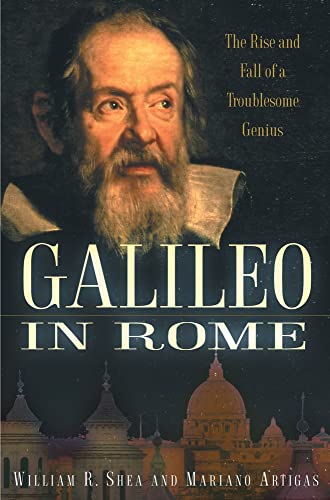
Galileo's trial by the Inquisition is one of the most dramatic incidents in the history of science and religion. Today, we tend to see this event in black and white--Galileo all white, the Church all black. Galileo in Rome presents a much more nuanced account of Galileo's relationship with Rome.
The book offers a fascinating account of the six trips Galileo made to Rome, from his first visit at age 23, as an unemployed mathematician, to his final fateful journey to face the Inquisition. The authors reveal why the theory that the Earth revolves around the Sun, set forth in Galileo's Dialogue, stirred a hornet's nest of theological issues, and they argue that, despite these issues, the Church might have accepted Copernicus if there had been solid proof. More interesting, they show how Galileo dug his own grave. To get the imprimatur, he brought political pressure to bear on the Roman Censor. He disobeyed a Church order not to teach the heliocentric theory. And he had a character named Simplicio (which in Italian sounds like simpleton) raise the same objections to heliocentrism that the Pope had raised with Galileo. The authors show that throughout the trial, until the final sentence and abjuration, the Church treated Galileo with great deference, and once he was declared guilty commuted his sentence to house arrest.
Here then is a unique look at the life of Galileo as well as a strikingly different view of an event that has come to epitomize the Church's supposed antagonism toward science.
"synopsis" may belong to another edition of this title.
About the Author
William R. Shea holds the "Galileo Chair" of the History of Science at the University of Padua, in Italy. He is Past President of both the International Union of the History and Philosophy of Science and the International Academy of the History of Science, and is currently Chairman of the Standing Committee for the Humanities of the European Science Foundation in Strasbourg. He is the author, co-author, or editor of 25 books, including Galileo's Intellectual Revolution and The Magic of Numbers and Motion: The Scientific Career of Rene Descartes.
Mariano Artigas is Professor of Philosophy of Science and was Dean of the Ecclesiastical Faculty of Philosophy at the University of Navarra, in Pamplona, Spain. He holds a Ph.D. both in physics and philosophy, is an ordained Catholic priest, and has written 14 books, including The Mind of the Universe, which won a Templeton Award.
Reviews
One of the best-known episodes in the history of science is Galileo's run-in with the Catholic Church, which left him under house arrest and his Dialogue on the Two Chief World Systems on the Church's Index of Prohibited Books. Though conventional wisdom dictates that the controversy was simply a clash between the traditional doctrine that the Sun revolved around Earth and Galileo's heliocentric theory, Shea, a historian of science at the University of Padua, and Artigas, a philosopher of science at the University of Navarra and an ordained Catholic priest, argue that there was a lot more going on than simply an intellectual disagreement. Drawing on a wealth of letters and archives, the authors construct a nuanced portrait of the complex web of political and religious institutional forces that constituted 17th-century Rome, showing that the trial of Galileo was as much the product of tension between the pope and the grand duke of Tuscany (Galileo's patron) and of Galileo's arrogance when dealing with Jesuit astronomers as it was a result of the oppressive Inquisition. Much like the Medici court that Mario Biagioli portrayed in Galileo, Courtier, the Rome that emerges here is one of political in-fighting, misunderstandings, deceit, closed-door machinations and greed, dominated by a church that is as much political as theological. While engaging and accessible (if at moments awkwardly written), this is less a general biography than a detailed study of Galileo's six visits to Rome and best suited to readers looking for a new understanding of an oft-told and familiar story. 40 photos and illus.
Copyright 2003 Reed Business Information, Inc.
Galileo's story has always been read as a cautionary tale about religious authority suffocating science. However, the epic episode seems less symbolically clear-cut when examined closely. This work (following Galileo's Mistake by Wade Rowland [BKL Ag 03]) promotes the idea that Galileo himself contributed to his fate. Because he was well connected--the pope who brought the Inquisition down on his head, Urban VIII, was a personal friend--Galileo knew how the powers-that-be felt about his championing of Copernicus. Structuring their narrative around the several journeys Galileo made from Florence to Rome, Shea and Artigas identify numerous friendly suggestions given to him by supporters to tone things down. Galileo's mockery of his opponents made enemies of them, but they did have ammunition in that, as Rowland and these authors point out, two items in Galileo's scheme (concerning tides and "circular" orbits) are not true. In recounting the actual people with whom Galileo fenced, as well as the theological doctrines involved, the authors demythologize the man. Their criticism makes Galileo as interesting a figure as ever. Gilbert Taylor
Copyright © American Library Association. All rights reserved
"About this title" may belong to another edition of this title.
Search results for Galileo in Rome: The Rise and Fall of a Troublesome...

Stock Image
Galileo in Rome : The Rise and Fall of a Troublesome Genius
Published by
Oxford University Press, Incorporated, 2003
ISBN 10: 0195165985
ISBN 13: 9780195165982
Used
Hardcover
Seller: Better World Books, Mishawaka, IN, U.S.A.
Seller rating 5 out of 5 stars

Condition: Good. Pages intact with minimal writing/highlighting. The binding may be loose and creased. Dust jackets/supplements are not included. Stock photo provided. Product includes identifying sticker. Better World Books: Buy Books. Do Good. Seller Inventory # 4377852-6
Stock Image
Galileo in Rome: The Rise and Fall of a Troublesome Genius
Published by
Oxford University Press, 2003
ISBN 10: 0195165985
ISBN 13: 9780195165982
Used
Hardcover
Seller: HPB-Diamond, Dallas, TX, U.S.A.
Seller rating 5 out of 5 stars
hardcover. Condition: Very Good. Connecting readers with great books since 1972! Used books may not include companion materials, and may have some shelf wear or limited writing. We ship orders daily and Customer Service is our top priority! Seller Inventory # S_467683324
Stock Image
Galileo in Rome: The Rise and Fall of a Troublesome Genius
Published by
Oxford University Press, 2003
ISBN 10: 0195165985
ISBN 13: 9780195165982
Used
Hardcover
Seller: HPB-Emerald, Dallas, TX, U.S.A.
Seller rating 5 out of 5 stars
hardcover. Condition: Very Good. Connecting readers with great books since 1972! Used books may not include companion materials, and may have some shelf wear or limited writing. We ship orders daily and Customer Service is our top priority! Seller Inventory # S_477628574
Stock Image
Galileo in Rome: The Rise and Fall of a Troublesome Genius
Published by
Oxford University Press, 2003
ISBN 10: 0195165985
ISBN 13: 9780195165982
Used
Hardcover
Seller: HPB-Ruby, Dallas, TX, U.S.A.
Seller rating 5 out of 5 stars
hardcover. Condition: Very Good. Connecting readers with great books since 1972! Used books may not include companion materials, and may have some shelf wear or limited writing. We ship orders daily and Customer Service is our top priority! Seller Inventory # S_467769414
Stock Image
Galileo in Rome: The Rise and Fall of a Troublesome Genius
Published by
Oxford University Press, 2003
ISBN 10: 0195165985
ISBN 13: 9780195165982
Used
Hardcover
Seller: ThriftBooks-Dallas, Dallas, TX, U.S.A.
Seller rating 5 out of 5 stars
Hardcover. Condition: Very Good. No Jacket. Missing dust jacket; May have limited writing in cover pages. Pages are unmarked. ~ ThriftBooks: Read More, Spend Less. Seller Inventory # G0195165985I4N01
Stock Image
Galileo in Rome: The Rise and Fall of a Troublesome Genius
Published by
Oxford University Press, 2003
ISBN 10: 0195165985
ISBN 13: 9780195165982
Used
Hardcover
Seller: ThriftBooks-Atlanta, AUSTELL, GA, U.S.A.
Seller rating 5 out of 5 stars
Hardcover. Condition: Very Good. No Jacket. May have limited writing in cover pages. Pages are unmarked. ~ ThriftBooks: Read More, Spend Less. Seller Inventory # G0195165985I4N00
Stock Image
Galileo in Rome: The Rise and Fall of a Troublesome Genius
Published by
Oxford University Press, 2003
ISBN 10: 0195165985
ISBN 13: 9780195165982
Used
Hardcover
Seller: ThriftBooks-Atlanta, AUSTELL, GA, U.S.A.
Seller rating 5 out of 5 stars
Hardcover. Condition: Good. No Jacket. Former library book; Pages can have notes/highlighting. Spine may show signs of wear. ~ ThriftBooks: Read More, Spend Less. Seller Inventory # G0195165985I3N10
Stock Image
Galileo in Rome: The Rise and Fall of a Troublesome Genius
Published by
Oxford University Press, 2003
ISBN 10: 0195165985
ISBN 13: 9780195165982
Used
Hardcover
Seller: Books From California, Simi Valley, CA, U.S.A.
Seller rating 4 out of 5 stars

hardcover. Condition: Good. Dust Jacket Condition: Includes dust jacket. Cover boards are slightly bowing/bending. DJ shows light scuffing/edge wear. Pages are clean, crisp, and unmarked. Text block has intact & firm binding. Good reading copy. Seller Inventory # mon0004234224
Stock Image
Galileo in Rome. The Rise and Fall of a Troublesome Genius
Published by
Oxford University Press, Oxford, 2003
ISBN 10: 0195165985
ISBN 13: 9780195165982
Used
Hardcover
Seller: Research Ink, Takoma Park, MD, U.S.A.
Seller rating 5 out of 5 stars
Hardback. Condition: Very Good. xi + 226 pp. dj. Rubber-stamped on front free endpaper. book. Seller Inventory # 32726
Stock Image
Galileo in Rome: The Rise and Fall of a Troublesome Genius
Published by
Oxford University Press 2003(03) no place given, 2003
ISBN 10: 0195165985
ISBN 13: 9780195165982
Used
Hardcover
First Edition
Seller: Prairie Archives, Springfield, IL, U.S.A.
Seller rating 4 out of 5 stars
Very good in lightly edgeworn, lightly rubbed dust jacket. First Printing hardbound. Seller Inventory # BOOKS028181