
Items related to Dillinger's Wild Ride: The Year That Made America's...
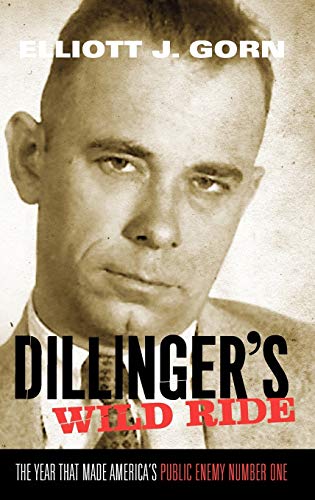
Synopsis
What is the power of Dillinger's story? Why has it lingered so long? Who was John Dillinger? Gorn illuminates the significance of Dillinger's tremendous fame and the endurance of his legacy, arguing that he represented an American fascination with primitive freedom against social convention. Dillinger's story has much to tell us about our enduring fascination with outlaws, crime and violence, about the complexity of our transition from rural to urban life, and about the transformation of America during the Great Depression.
Dillinger's Wild Ride is a compulsively readable story with an unforgettable protagonist.
"synopsis" may belong to another edition of this title.
About the Author
Elliott J. Gorn is Professor of History and American Studies at Brown University. He is the author of The Manly Art: Bare-Knuckle Prize Fighting in America and Mother Jones: The Most Dangerous Woman in America, among other books.
Reviews
From The Washington Post's Book World/washingtonpost.com I n knowledge of most aspects of our collective history, most Americans probably would flunk even the easiest of tests, but in one department we are scholars of the first rank: We know our crooks. We don't just know them, we love them: Billy the Kid, Jesse James, Bonnie and Clyde, Baby Face Nelson, Pretty Boy Floyd, Ma Barker, not to mention the fictional ones, most notably Vito and Sonny Corleone, and of course Luca Brasi, who for all eternity sleeps with the fishes. Long after their deaths, they live on in our mythology as what Elliott J. Gorn calls "part of America's deepest hero myths." All these pale, though, next to John Dillinger. His life in the headlines was remarkably brief -- it began in the early summer of 1933 and ended almost exactly a year later, when FBI agents killed him as he left a movie theater in Chicago -- but he had risen to the status of legend long before his death, and he has kept it ever since. He has been the subject of books (both fiction and nonfiction), songs, poems and movies. Played by Johnny Depp, he is the central character in "Public Enemies," a film to be released this week that, considering Depp's huge popularity, is certain to burnish the legend still further. "Dillinger's Wild Ride" is, inevitably, a rehash of familiar stories about Dillinger's crime spree. But Gorn -- a professor of history at Brown University who has a particular interest in popular history and sports -- tries hard to separate fact from myth, and he makes plausible arguments for why Dillinger captured the popular imagination. Born on June 22, 1903, in Indianapolis, he was in prison by the time he was 21 for attempted robbery and assault, and remained there until his release in May 1933. By June or July -- "as with so much of the Dillinger chronicle, there is lots of information, but much of it is unreliable" -- he and his gang were off and running, knocking off banks all over Indiana. It was the beginning of a "rampage" at the end of which "a dozen policemen, gang members, and civilians were dead, hundreds of thousands of dollars had been stolen, and public faith in law enforcement was shaken." This last certainly is true, but it needs to be amended with the caveat that if much of the public was appalled, much of it also was thrilled, or amused, or delighted, or all of the above. The Depression was at its nadir, hundreds of banks had collapsed, depriving ordinary people of their savings, and to many Americans the sight of bankers in terror was anything but uncongenial. After one famous getaway, Mary Kinder, the girlfriend of a gang member, told a reporter: "Of course I'm glad [Dillinger] got away. . . . I am tickled to death. The whole United States is glad. Everybody was for him." About which Gorn writes: "Most citizens' feelings were more complicated than that, but Kinder was on to something. Dillinger might be a hardened criminal, but the man had style. 'Hard and implacable to his enemies,' one [newspaper] writer observed, 'the killer is a bit of a gallant and a debonair to those who cross his path casually.' He described Dillinger as 'a carefree devil with many likeable traits.' " This may seem a bit difficult to swallow, but it is true. Dillinger was close to his family and was remembered by his sister (to whom he was devoted) as "a sweet-tempered boy who had a mostly pleasant childhood." True, "there was an edge to Dillinger's personality, something more than mischievous, less than sociopathic," but he was also "funny, philosophical, sentimental, in a word, human." Precisely why he chose the criminal life will forever be a mystery, but there's a hint of it in Gorn's description of him at the time he was released from prison: "John Dillinger was then nearly thirty years old and had spent almost a third of his life behind bars. A spotty work record and a failed marriage did not inspire confidence in his chances for a productive civilian life. Neither the Navy nor prison had enhanced his sense of discipline; quite the contrary. He was a felon with a serious crime to his name, an armed attack on an old man. In prison Dillinger engaged in steady, mostly petty, though occasionally serious infractions; he seemed unable to restrain himself. His professions of reform notwithstanding, he had changed over the course of the decade, and not for the better. He told his sister Audrey shortly after he got out, 'When you're in a place like that, with not a kind word from anyone, how could you help from being sore toward everybody.' He got a 'bum rap,' he said, and he swore never to go back to [prison] alive." In January 1934 it looked as if he wasn't going to pull that off. He and other gang members were captured in Tucson, and he was flown back to Indiana for trial. But he bluffed prison guards with a wooden pistol -- it's unclear whether he carved it himself or had it smuggled in -- and escaped with another prisoner, a feat that astonished the nation and humiliated Indiana prison authorities. With that he and the gang were off on another rampage, to the extent that it seemed "Dillinger was everywhere" and "brushes with Dillinger were more like celebrity sightings." Then, in April, while holed up with the gang at a lodge in Northern Wisconsin, he was tracked down by the FBI but escaped again thanks to his own bravado and the bureau's "bungling." That escapade sealed his legend once and for all, but as Gorn says, his end was inevitable and drawing ever closer. He was wounded a couple of time in close calls, and as the FBI ratcheted up its surveillance -- the young agency's ambitious new director, J. Edgar Hoover, knew that capturing and/or killing Dillinger would be a public-relations bonanza -- there were fewer and fewer places for him to hide. Incredibly, he visited his family while this was going on and had a sentimental reunion with them that anticipated scenes in "Bonnie and Clyde" and "Butch Cassidy and the Sundance Kid." But soon thereafter he was dead, betrayed by a woman who sang to the FBI and said she could be identified at the movie theater by her red dress, hence the legend of "The Woman in Red." He was dead, but he had fixed himself in the American imagination as a romantic figure: "His story . . . evoked the picaresque heroes of fiction. The picaro was a man of low birth who made his way up the social ladder with laughter, cunning, physical bravado, and sexual prowess. Most of all Dillinger embodied the American road trip, that liminal journey filled with freedom and adventure, even sex and violence, set apart from the crushing ordinariness of daily life." Or, as Gorn says elsewhere: "Dillinger proved that the old American fascination with movement, with flight, with lighting out for the territories was still alive, still glorious, even if the journey lasted only long enough to flame out and die. To die, his friends would add, not like a rat, but like a man." yardleyj@washpost.com
Copyright 2009, The Washington Post. All Rights Reserved.
Gorn (Mother Jones) presents a solid, unromanticized account of the last year in the short life of famed bank robber John Dillinger. Gorn rejects psychologizing about why Dillinger, the unexceptional if restless grocerÖs son, born in Indianapolis in 1903, turned to a life of crime, arrested first in 1924 for assaulting an elderly store clerk in a botched robbery. After spending nine years—almost a third of his short life—in jail, Dillinger found a Depression-era America far different from the one heÖd left. Less than two months into his parole, Dillinger and the first in a revolving parade of Dillinger gang members robbed the Commercial Bank in Daleville, Ind., making off with $3,500. Between July 1933 and his death just one year later, Dillinger robbed more than 10 banks, killed at least five people (all lawmen) and stole over $300,000, all the while evading capture by local law enforcement and later the FBI. Gorn, who teaches at Brown University, relies on newspaper accounts and government documents (and, thankfully, no reconstructed dialogue) to plot the movements of a criminal who, 75 years after his death, still reverberates in the American consciousness. 30 b&w photos. (June)
Copyright © Reed Business Information, a division of Reed Elsevier Inc. All rights reserved.
"About this title" may belong to another edition of this title.
Search results for Dillinger's Wild Ride: The Year That Made America's...

Stock Image
Dillinger's Wild Ride: The Year that Made America's Public Enemy Number One
Published by
Oxford University Press Inc, 2009
ISBN 10: 0195304837
ISBN 13: 9780195304831
Used
Hardcover
Seller: World of Books (was SecondSale), Montgomery, IL, U.S.A.
Seller rating 5 out of 5 stars

Hardback. Condition: Good. In an era that witnessed the rise of celebrity outlaws like Baby Face Nelson, Pretty Boy Floyd, and Bonnie and Clyde, John Dillinger was the most famous and flamboyant of them all. Reports on the man and his misdeeds--spiced with accounts of his swashbuckling bravado and cool daring--provided an America worn down by the Great Depression with a salacious mix of sex and violence that proved irresistible. In Dillinger's Wild Ride, Elliott J. Gorn provides a riveting account of the year between 1933 and 1934, when the Dillinger gang pulled over a dozen bank jobs, and stole hundreds of thousands of dollars. A dozen men--police, FBI agents, gangsters, and civilians--lost their lives in the rampage, and American newspapers breathlessly followed every shooting and jail-break. As Dillinger's wild year unfolded, the tale grew larger and larger in newspapers and newsreels, and even today, Dillinger is the subject of pulp literature, serious poetry and fiction, and films, including a new movie starring Johnny Depp. What is the power of his story? Why has it lingered so long? Who was John Dillinger? Gorn illuminates the significance of Dillinger's tremendous fame and the endurance of his legacy, arguing that he represented an American fascination with primitive freedom against social convention. Dillinger's story has much to tell us about our enduring fascination with outlaws, crime and violence, about the complexity of our transition from rural to urban life, and about the transformation of America during the Great Depression. Dillinger's Wild Ride is a compulsively readable story with an unforgettable protagonist. Seller Inventory # 00097456293
Stock Image
Dillinger's Wild Ride: The Year that Made America's Public Enemy Number One
Published by
Oxford University Press Inc, 2009
ISBN 10: 0195304837
ISBN 13: 9780195304831
Used
Hardcover
Seller: World of Books (was SecondSale), Montgomery, IL, U.S.A.
Seller rating 5 out of 5 stars
Hardback. Condition: Very Good. In an era that witnessed the rise of celebrity outlaws like Baby Face Nelson, Pretty Boy Floyd, and Bonnie and Clyde, John Dillinger was the most famous and flamboyant of them all. Reports on the man and his misdeeds--spiced with accounts of his swashbuckling bravado and cool daring--provided an America worn down by the Great Depression with a salacious mix of sex and violence that proved irresistible. In Dillinger's Wild Ride, Elliott J. Gorn provides a riveting account of the year between 1933 and 1934, when the Dillinger gang pulled over a dozen bank jobs, and stole hundreds of thousands of dollars. A dozen men--police, FBI agents, gangsters, and civilians--lost their lives in the rampage, and American newspapers breathlessly followed every shooting and jail-break. As Dillinger's wild year unfolded, the tale grew larger and larger in newspapers and newsreels, and even today, Dillinger is the subject of pulp literature, serious poetry and fiction, and films, including a new movie starring Johnny Depp. What is the power of his story? Why has it lingered so long? Who was John Dillinger? Gorn illuminates the significance of Dillinger's tremendous fame and the endurance of his legacy, arguing that he represented an American fascination with primitive freedom against social convention. Dillinger's story has much to tell us about our enduring fascination with outlaws, crime and violence, about the complexity of our transition from rural to urban life, and about the transformation of America during the Great Depression. Dillinger's Wild Ride is a compulsively readable story with an unforgettable protagonist. Seller Inventory # 00100246550
Stock Image
Dillinger's Wild Ride: The Year That Made America's Public Enemy Number One
Published by
Oxford University Press, 2009
ISBN 10: 0195304837
ISBN 13: 9780195304831
Used
Hardcover
Seller: Your Online Bookstore, Houston, TX, U.S.A.
Seller rating 5 out of 5 stars
Hardcover. Condition: Good. Seller Inventory # 0195304837-3-23618067
Seller Image
Dillinger's Wild Ride: The Year That Made America's Public Enemy Number One
Published by
Oxford University Press, 2009
ISBN 10: 0195304837
ISBN 13: 9780195304831
Used
Hardcover
Seller: Greenworld Books, Arlington, TX, U.S.A.
Seller rating 5 out of 5 stars
Condition: very_good. Fast Free Shipping â" Very Good condition book with a firm cover and clean pages. Shows normal use and some light wear or limited notes markings. A solid, nice copy to enjoy. Seller Inventory # GWV.0195304837.VG
Stock Image
Dillinger's Wild Ride: The Year That Made America's Public Enemy Number One
Published by
Oxford University Press, 2009
ISBN 10: 0195304837
ISBN 13: 9780195304831
Used
Hardcover
Seller: Evergreen Goodwill, Seattle, WA, U.S.A.
Seller rating 5 out of 5 stars
hardcover. Condition: Good. Seller Inventory # mon0000736391
Stock Image
Dillinger's Wild Ride: The Year That Made America's Public Enemy Number One
Published by
Oxford University Press (edition 1), 2009
ISBN 10: 0195304837
ISBN 13: 9780195304831
Used
Hardcover
Seller: BooksRun, Philadelphia, PA, U.S.A.
Seller rating 5 out of 5 stars
Hardcover. Condition: Very Good. 1. With dust jacket. It's a well-cared-for item that has seen limited use. The item may show minor signs of wear. All the text is legible, with all pages included. It may have slight markings and/or highlighting. Seller Inventory # 0195304837-11-1-29
Stock Image
Dillinger's Wild Ride: The Year That Made America's Public Enemy Number One
Published by
Oxford University Press, 2009
ISBN 10: 0195304837
ISBN 13: 9780195304831
Used
Hardcover
Seller: ThriftBooks-Atlanta, AUSTELL, GA, U.S.A.
Seller rating 5 out of 5 stars
Hardcover. Condition: As New. No Jacket. Pages are clean and are not marred by notes or folds of any kind. ~ ThriftBooks: Read More, Spend Less. Seller Inventory # G0195304837I2N00
Stock Image
Dillinger's Wild Ride: The Year That Made America's Public Enemy Number One
Published by
Oxford University Press, 2009
ISBN 10: 0195304837
ISBN 13: 9780195304831
Used
Hardcover
Seller: ThriftBooks-Dallas, Dallas, TX, U.S.A.
Seller rating 5 out of 5 stars
Hardcover. Condition: Very Good. No Jacket. Former library book; May have limited writing in cover pages. Pages are unmarked. ~ ThriftBooks: Read More, Spend Less. Seller Inventory # G0195304837I4N10
Stock Image
Dillinger's Wild Ride: The Year That Made America's Public Enemy Number One
Published by
Oxford University Press, 2009
ISBN 10: 0195304837
ISBN 13: 9780195304831
Used
Hardcover
Seller: ThriftBooks-Dallas, Dallas, TX, U.S.A.
Seller rating 5 out of 5 stars
Hardcover. Condition: As New. No Jacket. Pages are clean and are not marred by notes or folds of any kind. ~ ThriftBooks: Read More, Spend Less. Seller Inventory # G0195304837I2N00
Stock Image
Dillinger's Wild Ride: The Year That Made America's Public Enemy Number One
Published by
Oxford University Press, 2009
ISBN 10: 0195304837
ISBN 13: 9780195304831
Used
Hardcover
First Edition
Seller: The Maryland Book Bank, Baltimore, MD, U.S.A.
Seller rating 5 out of 5 stars
hardcover. Condition: Very Good. 1st Edition. Used - Very Good. Seller Inventory # 13-P-4-0203