
Items related to THE POWER OF PLACE GEOGRAPHY DESTINY AND GLOBALIZATIONS...
Synopsis
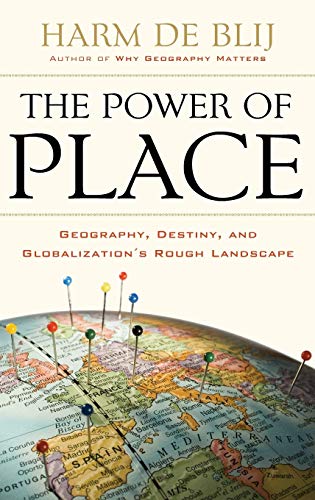
The world is not as mobile or as interconnected as we like to think. As Harm de Blij argues in The Power of Place, in crucial ways--from the uneven distribution of natural resources to the unequal availability of opportunity--geography continues to hold billions of people in its grip. We are all born into natural and cultural environments that shape what we become, individually and collectively. From our "mother tongue" to our father's faith, from medical risks to natural hazards, where we start our journey has much to do with our destiny. Hundreds of millions of farmers in the river basins of Asia and Africa, and tens of millions of shepherds in isolated mountain valleys from the Andes to Kashmir, all live their lives much as their distant ancestors did, remote from the forces of globalization. Incorporating a series of persuasive maps, De Blij describes the tremendously varied environments across the planet and shows how migrations between them are comparatively rare. De Blij also looks at the ways we are redefining place so as to make its power even more potent than it has been, with troubling implications.
"synopsis" may belong to another edition of this title.
About the Author
Harm de Blij is the John A. Hannah Professor of Geography at Michigan State University. The author of 30 books, including Why Geography Matters, he is an honorary life member of the National Geographic Society and was previously the Geography Editor on ABC's "Good Morning America."
Reviews
De Blij is the author of a variety of influential works on geography, including a best-selling college textbook on the subject, as well as a celebrated exploration of wine (Wine: A Geographic Appreciation, 1983). With this selection, de Blij adds a geographer’s voice to the growing chorus of those objecting to Thomas Friedman’s flat earth. Globalization may indeed level the global playing field for the “fortunate minority in control of, in the path of, or with access to the mainstreams of modernization,” concedes de Blij, but the great majority of the earth’s six billion people face obstacles that are steeper than ever. Not the first book to decry the dramatic contrasts between the “globals,” the locals, and the “mobals” (migrants), this selection is nevertheless unique in cataloging the myriad ways in which such contrasts are informed by geographic factors, including language, natural resources, urbanization, and environmental risks. De Blij is as engaging as ever, and his fear for our collective future is evident on every page. --Brendan Driscoll
"About this title" may belong to another edition of this title.
Search results for THE POWER OF PLACE GEOGRAPHY DESTINY AND GLOBALIZATIONS...

Stock Image
The Power of Place: Geography, Destiny, and Globalization's Rough Landscape
Published by
Oxford University Press, 2008
ISBN 10: 0195367707
ISBN 13: 9780195367706
Used
Hardcover
Seller: Gulf Coast Books, Cypress, TX, U.S.A.
Seller rating 5 out of 5 stars

hardcover. Condition: Fair. Seller Inventory # 0195367707-4-37140836
Seller Image
THE POWER OF PLACE GEOGRAPHY DESTINY AND GLOBALIZATIONS ROUGH LANDSCAPE
Published by
Oxford University Press, 2008
ISBN 10: 0195367707
ISBN 13: 9780195367706
Used
Hardcover
Seller: ZBK Books, Carlstadt, NJ, U.S.A.
Seller rating 5 out of 5 stars
Condition: good. Fast & Free Shipping â" Good condition. It may show normal signs of use, such as light writing, highlighting, or library markings, but all pages are intact and the book is fully readable. A solid, complete copy that's ready to enjoy. Seller Inventory # ZWV.0195367707.G
Stock Image
The Power of Place: Geography, Destiny, and Globalization's Rough Landscape
Published by
Oxford University Press Inc, 2008
ISBN 10: 0195367707
ISBN 13: 9780195367706
Used
Hardcover
Seller: World of Books (was SecondSale), Montgomery, IL, U.S.A.
Seller rating 5 out of 5 stars
Hardback. Condition: Good. In recent years a spate of books and articles have argued that the world today is so mobile, so interconnected and so integrated that it is, in one prominent assessment, flat. But as Harm de Blij contends in The Power of Place, geography continues to hold billions of people in an unrelenting grip. We are all born into natural and cultural environments that shape what we become, individually and collectively. From our "mother tongue" to our father's faith, from medical risks to natural hazards, where we start our journey has much to do with our destiny, and thus with our chances of overcoming the obstacles in our way. Incorporating a series of revealing maps, de Blij focuses on the rough terrain of the world's human and environmental geography. The world's continuing partition into core and periphery, and apartheid-like obstructions to migration from the former to the latter, help explain why, in this age of globalization, less than 3 percent of "mobals" live in countries other than where they were born. Maps of language distribution suggest why English, the Latin of the latter day, may become as hybridized as its forerunner. The fateful map of religion casts a shadow of what he calls "endarkenment" over the future of the planet in a time of increasingly destructive weaponry. De Blij also looks at the ways we are redefining place so as to make its power even more potent than it has been, with troubling implications for the future. Optimistic demographic projections based on declining national populations in the global core are tempered by the prospect that the vast majority of the 3 billion additions to the world's population will burden the periphery. Megacities such as Lagos and Jakarta with their corridors and nodes of globalization foreshadow a future of potentially explosive social contrasts. Subnational entities from southern Sudan to northern Sri Lanka seek independence at a time when the planet's limited living space is already fragmented into 200 states. Looking down from the business-class compartment of a transcontinental airliner, the world looks a lot flatter than it does from the doorway of a dwelling in a local village. Harm de Blij brings us back to earth to reveal the all-too-rugged contours of place. Seller Inventory # 00095053205
Stock Image
The Power of Place: Geography, Destiny, and Globalization's Rough Landscape
Published by
Oxford University Press Inc, 2008
ISBN 10: 0195367707
ISBN 13: 9780195367706
Used
Hardcover
Seller: World of Books (was SecondSale), Montgomery, IL, U.S.A.
Seller rating 5 out of 5 stars
Hardback. Condition: Very Good. In recent years a spate of books and articles have argued that the world today is so mobile, so interconnected and so integrated that it is, in one prominent assessment, flat. But as Harm de Blij contends in The Power of Place, geography continues to hold billions of people in an unrelenting grip. We are all born into natural and cultural environments that shape what we become, individually and collectively. From our "mother tongue" to our father's faith, from medical risks to natural hazards, where we start our journey has much to do with our destiny, and thus with our chances of overcoming the obstacles in our way. Incorporating a series of revealing maps, de Blij focuses on the rough terrain of the world's human and environmental geography. The world's continuing partition into core and periphery, and apartheid-like obstructions to migration from the former to the latter, help explain why, in this age of globalization, less than 3 percent of "mobals" live in countries other than where they were born. Maps of language distribution suggest why English, the Latin of the latter day, may become as hybridized as its forerunner. The fateful map of religion casts a shadow of what he calls "endarkenment" over the future of the planet in a time of increasingly destructive weaponry. De Blij also looks at the ways we are redefining place so as to make its power even more potent than it has been, with troubling implications for the future. Optimistic demographic projections based on declining national populations in the global core are tempered by the prospect that the vast majority of the 3 billion additions to the world's population will burden the periphery. Megacities such as Lagos and Jakarta with their corridors and nodes of globalization foreshadow a future of potentially explosive social contrasts. Subnational entities from southern Sudan to northern Sri Lanka seek independence at a time when the planet's limited living space is already fragmented into 200 states. Looking down from the business-class compartment of a transcontinental airliner, the world looks a lot flatter than it does from the doorway of a dwelling in a local village. Harm de Blij brings us back to earth to reveal the all-too-rugged contours of place. Seller Inventory # 00110292211
Stock Image
The Power of Place : Geography, Destiny, and Globalization's Rough Landscape
Published by
Oxford University Press, Incorporated, 2008
ISBN 10: 0195367707
ISBN 13: 9780195367706
Used
Hardcover
Seller: Better World Books: West, Reno, NV, U.S.A.
Seller rating 5 out of 5 stars
Condition: Very Good. Pages intact with possible writing/highlighting. Binding strong with minor wear. Dust jackets/supplements may not be included. Stock photo provided. Product includes identifying sticker. Better World Books: Buy Books. Do Good. Seller Inventory # 5011737-6
Stock Image
The Power of Place : Geography, Destiny, and Globalization's Rough Landscape
Published by
Oxford University Press, Incorporated, 2008
ISBN 10: 0195367707
ISBN 13: 9780195367706
Used
Hardcover
Seller: Better World Books, Mishawaka, IN, U.S.A.
Seller rating 5 out of 5 stars
Condition: Very Good. Pages intact with possible writing/highlighting. Binding strong with minor wear. Dust jackets/supplements may not be included. Stock photo provided. Product includes identifying sticker. Better World Books: Buy Books. Do Good. Seller Inventory # 5011737-6
Seller Image
THE POWER OF PLACE GEOGRAPHY DESTINY AND GLOBALIZATIONS ROUGH LANDSCAPE
Published by
Oxford University Press, 2008
ISBN 10: 0195367707
ISBN 13: 9780195367706
Used
Hardcover
Seller: -OnTimeBooks-, Phoenix, AZ, U.S.A.
Seller rating 5 out of 5 stars
Condition: good. A copy that has been read, remains in good condition. All pages are intact, and the cover is intact. The spine and cover show signs of wear. Pages can include notes and highlighting and show signs of wear, and the copy can include "From the library of" labels or previous owner inscriptions. 100% GUARANTEE! Shipped with delivery confirmation, if you're not satisfied with purchase please return item! Ships via media mail. Seller Inventory # OTV.0195367707.G
Stock Image
Power of Place: Geography, Destiny, and Globalization's Rough Landscape
Published by
Oxford University Press, 2008
ISBN 10: 0195367707
ISBN 13: 9780195367706
Used
Hardcover
Seller: ThriftBooks-Phoenix, Phoenix, AZ, U.S.A.
Seller rating 5 out of 5 stars
Hardcover. Condition: Good. No Jacket. Missing dust jacket; Pages can have notes/highlighting. Spine may show signs of wear. ~ ThriftBooks: Read More, Spend Less. Seller Inventory # G0195367707I3N01
Stock Image
Power of Place: Geography, Destiny, and Globalization's Rough Landscape
Published by
Oxford University Press, 2008
ISBN 10: 0195367707
ISBN 13: 9780195367706
Used
Hardcover
Seller: ThriftBooks-Dallas, Dallas, TX, U.S.A.
Seller rating 5 out of 5 stars
Hardcover. Condition: Good. No Jacket. Pages can have notes/highlighting. Spine may show signs of wear. ~ ThriftBooks: Read More, Spend Less. Seller Inventory # G0195367707I3N00
Stock Image
Power of Place: Geography, Destiny, and Globalization's Rough Landscape
Published by
Oxford University Press, 2008
ISBN 10: 0195367707
ISBN 13: 9780195367706
Used
Hardcover
Seller: ThriftBooks-Atlanta, AUSTELL, GA, U.S.A.
Seller rating 5 out of 5 stars
Hardcover. Condition: Good. No Jacket. Pages can have notes/highlighting. Spine may show signs of wear. ~ ThriftBooks: Read More, Spend Less. Seller Inventory # G0195367707I3N00