
Items related to A Performer's Guide to Transcribing, Editing, and...
Synopsis
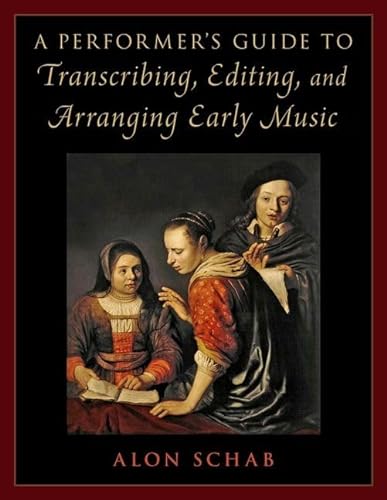
A Performer's Guide to Transcribing, Editing, and Arranging Early Music provides instruction on three important tasks that early music performers often undertake in order to make their work more noticeable and appealing to their audiences. First, the book provides instruction on using early sources-manuscripts, prints, and treatises-in score, parts, or tablature. It then illuminates priorities behind basic editorial decisions-determining what constitutes a "version" of a musical piece, how to choose a version, and how to choose the source for that version. Lastly, the book offers advice about arranging both early and new music for early instruments, including how to consider instruments' ranges and various registers, how to exploit the unique characteristics of period instruments, and how to produce convincing textures of accompaniment. Drawing on methods based on early models (for example, how baroque composers arranged the music of their contemporaries), Alon Schab pays tribute to the ideas and ideals promoted by the pioneers of the early music revival and examines how these could be implemented in an early music field revolutionized by technology and unprecedented artistic independence.
"synopsis" may belong to another edition of this title.
About the Author
Alon Schab is Senior Lecturer in the Department of Music at the University of Haifa and a committee member of the Purcell Society. A musicologist, composer, and recorder player, he focuses on English music and has published extensively on the music of Henry Purcell.
"About this title" may belong to another edition of this title.
Search results for A Performer's Guide to Transcribing, Editing, and...

Seller Image
A Performer's Guide to Transcribing, Editing, and Arranging Early Music
Published by
Oxford University Press, 2022
ISBN 10: 0197600662
ISBN 13: 9780197600665
Used
Softcover
Seller: Gate City Books, GREENSBORO, NC, U.S.A.
Seller rating 5 out of 5 stars

Condition: acceptable. USED book in ACCEPTABLE condition. Cover and pages are in tact but may show creases, tears, water damage, handwriting, underlining, or highlighting. May be missing dust jacket. Supplemental items such as access codes and CDs not guaranteed. Seller Inventory # GCM.3QH9
Stock Image
A Performer's Guide to Transcribing, Editing, and Format: Hardback
Seller: INDOO, Avenel, NJ, U.S.A.
Seller rating 5 out of 5 stars
Condition: New. Brand New. Seller Inventory # 9780197600665
Seller Image
A Performer's Guide to Transcribing, Editing, and Arranging Early Music
Published by
Oxford University Press, Oxford, 2022
ISBN 10: 0197600662
ISBN 13: 9780197600665
Used
Paperback
Seller: Midway Book Store (ABAA), St. Paul, MN, U.S.A.
Seller rating 5 out of 5 stars
Paperback. Condition: Near Fine. 27cm x 22cm, 276pp. In near fine condition. Seller Inventory # 86928
Stock Image
Performer's Guide to Transcribing, Editing, and Arranging Early Music
Published by
Oxford University Press, 2022
ISBN 10: 0197600662
ISBN 13: 9780197600665
Used
Softcover
Seller: GreatBookPrices, Columbia, MD, U.S.A.
Seller rating 5 out of 5 stars
Condition: As New. Unread book in perfect condition. Seller Inventory # 44415890
Stock Image
Performer's Guide to Transcribing, Editing, and Arranging Early Music
Seller: GreatBookPrices, Columbia, MD, U.S.A.
Seller rating 5 out of 5 stars
Condition: New. Seller Inventory # 44415890-n
Stock Image
A Performer's Guide to Transcribing, Editing, and Arranging Early Music
Seller: PBShop.store US, Wood Dale, IL, U.S.A.
Seller rating 5 out of 5 stars
PAP. Condition: New. New Book. Shipped from UK. Established seller since 2000. Seller Inventory # FU-9780197600665
Stock Image
A Performer's Guide to Transcribing, Editing, and Arranging Early Music
Seller: PBShop.store UK, Fairford, GLOS, United Kingdom
Seller rating 5 out of 5 stars
PAP. Condition: New. New Book. Shipped from UK. Established seller since 2000. Seller Inventory # FU-9780197600665
Buy New
US$ 38.39
US$ 7.77 shipping
Ships from United Kingdom to U.S.A.
Ships from United Kingdom to U.S.A.
Quantity: 3 available
Stock Image
A Performer's Guide to Transcribing, Editing, and Arranging Early Music
Seller: Chiron Media, Wallingford, United Kingdom
Seller rating 5 out of 5 stars
Paperback. Condition: New. Brand new book, sourced directly from publisher. Dispatch time is 24-48 hours from our warehouse. Book will be sent in robust, secure packaging to ensure it reaches you securely. Seller Inventory # 6666-GRD-9780197600665
Buy New
US$ 38.46
US$ 8.59 shipping
Ships from United Kingdom to U.S.A.
Ships from United Kingdom to U.S.A.
Quantity: 2 available
Seller Image
A Performer's Guide to Transcribing, Editing, and Arranging Early Music
Published by
Oxford University Press Inc, US, 2022
ISBN 10: 0197600662
ISBN 13: 9780197600665
New
Paperback
Seller: Rarewaves.com USA, London, LONDO, United Kingdom
Seller rating 5 out of 5 stars
Paperback. Condition: New. A Performer's Guide to Transcribing, Editing, and Arranging Early Music provides instruction on three important tasks that early music performers often undertake in order to make their work more noticeable and appealing to their audiences. First, the book provides instruction on using early sources-manuscripts, prints, and treatises-in score, parts, or tablature. It then illuminates priorities behind basic editorial decisions-determining what constitutes a "version" of a musical piece, how to choose a version, and how to choose the source for that version. Lastly, the book offers advice about arranging both early and new music for early instruments, including how to consider instruments' ranges and various registers, how to exploit the unique characteristics of period instruments, and how to produce convincing textures of accompaniment. Drawing on methods based on early models (for example, how baroque composers arranged the music of their contemporaries), Alon Schab pays tribute to the ideas and ideals promoted by the pioneers of the early music revival and examines how these could be implemented in an early music field revolutionized by technology and unprecedented artistic independence. Seller Inventory # LU-9780197600665
Buy New
US$ 50.69
Free Shipping
Ships from United Kingdom to U.S.A.
Ships from United Kingdom to U.S.A.
Quantity: 1 available
Seller Image
A Performer's Guide to Transcribing, Editing, and Arranging Early Music
Published by
Oxford University Press Inc, US, 2022
ISBN 10: 0197600662
ISBN 13: 9780197600665
New
Paperback
Seller: Rarewaves USA, HEBRON, KY, U.S.A.
Seller rating 5 out of 5 stars
Paperback. Condition: New. A Performer's Guide to Transcribing, Editing, and Arranging Early Music provides instruction on three important tasks that early music performers often undertake in order to make their work more noticeable and appealing to their audiences. First, the book provides instruction on using early sources-manuscripts, prints, and treatises-in score, parts, or tablature. It then illuminates priorities behind basic editorial decisions-determining what constitutes a "version" of a musical piece, how to choose a version, and how to choose the source for that version. Lastly, the book offers advice about arranging both early and new music for early instruments, including how to consider instruments' ranges and various registers, how to exploit the unique characteristics of period instruments, and how to produce convincing textures of accompaniment. Drawing on methods based on early models (for example, how baroque composers arranged the music of their contemporaries), Alon Schab pays tribute to the ideas and ideals promoted by the pioneers of the early music revival and examines how these could be implemented in an early music field revolutionized by technology and unprecedented artistic independence. Seller Inventory # LU-9780197600665