
Items related to Narrative Comprehension: A Discourse Perspective
Synopsis
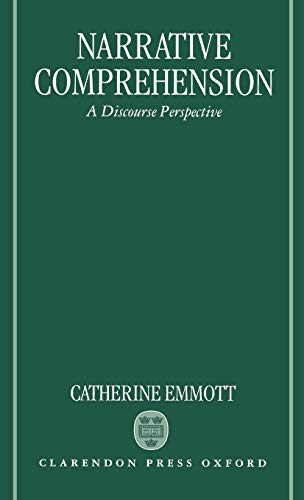
There has so far been relatively little research by cognitive linguists on the comprehension of narrative texts. This book draws on insights from discourse analysis and artificial intelligence to explore how readers construct and maintain mental representations of fictional characters and contexts, and goes on to consider the implications of cognitive modelling for grammatical theory and a literary-linguistic model of narrative text-types.
"synopsis" may belong to another edition of this title.
About the Author
Catherine Emmott is a Lecturer in the Department of English Language at University of Glasgow.
"About this title" may belong to another edition of this title.
Search results for Narrative Comprehension: A Discourse Perspective

Stock Image
Narrative Comprehension: A Discourse Perspective
Seller: Zubal-Books, Since 1961, Cleveland, OH, U.S.A.
Seller rating 5 out of 5 stars

Condition: New. 336 pp., hardcover, new in new dust jacket. - If you are reading this, this item is actually (physically) in our stock and ready for shipment once ordered. We are not bookjackers. Buyer is responsible for any additional duties, taxes, or fees required by recipient's country. Seller Inventory # ZB1319396
Stock Image
Narrative Comprehension: A Discourse Perspective (eng)
Print on DemandSeller: Brook Bookstore On Demand, Napoli, NA, Italy
Seller rating 5 out of 5 stars
Condition: new. Questo è un articolo print on demand. Seller Inventory # 0135f3d71fd1c6a1ae503ed00c177066
Buy New
US$ 293.71
US$ 7.60 shipping
Ships from Italy to U.S.A.
Ships from Italy to U.S.A.
Quantity: Over 20 available
Seller Image
Narrative Comprehension : A Discourse Perspective
Seller: GreatBookPrices, Columbia, MD, U.S.A.
Seller rating 5 out of 5 stars
Condition: New. Seller Inventory # 78629-n
Seller Image
Narrative Comprehension : A Discourse Perspective
Seller: GreatBookPricesUK, Woodford Green, United Kingdom
Seller rating 5 out of 5 stars
Condition: New. Seller Inventory # 78629-n
Buy New
US$ 306.11
US$ 20.02 shipping
Ships from United Kingdom to U.S.A.
Ships from United Kingdom to U.S.A.
Quantity: Over 20 available
Stock Image
Narrative Comprehension (Hardcover)
Published by
Oxford University Press, Oxford, 1997
ISBN 10: 0198236492
ISBN 13: 9780198236498
New
Hardcover
Seller: AussieBookSeller, Truganina, VIC, Australia
Seller rating 5 out of 5 stars
Hardcover. Condition: new. Hardcover. Despite the current explosion of interest in cognitive linguistics, there has so far been relatively little research by cognitive linguists on narrative comprehension. Emmott draws on insights from discourse analysis and artificial intelligence to present a detailed model of how readers build, maintain, and use mental representations of fictional contexts, and how they keep track of characters and contexts within a complex, changing fictional world. The work hasimplications for linguistic theory since it questions several long-held assumptions about anaphora, arguing for a `levels of consciousness' model for the processing of referring expressions.The book begins with a summary of current issues in text-processing theory and a discussion of the methodological importance of recognizing the hierarchical structure of discourse. The core of the book explores the significance of contextual monitoring in narrative comprehension and looks particularly at the cognitive demands placed on readers by flashbacks. Later chapters examine the implications of contextual monitoring for reference theory and for a literary-linguistic model ofnarrative text types. The study focuses on anaphoric pronouns in narratives, assessing the accumulated knowledge required for readers to interpret these key grammatical items. This book draws on insights from discourse analysis and artificial intelligence to explore how readers construct and maintain mental representations of fictional characters and contexts, and goes on to consider the implications of cognitive modelling for grammatical theory and a literary-linguistic model of narrative text-types. This item is printed on demand. Shipping may be from our Sydney, NSW warehouse or from our UK or US warehouse, depending on stock availability. Seller Inventory # 9780198236498
Buy New
US$ 307.20
US$ 37.00 shipping
Ships from Australia to U.S.A.
Ships from Australia to U.S.A.
Quantity: 1 available
Stock Image
Narrative Comprehension
Print on DemandSeller: PBShop.store US, Wood Dale, IL, U.S.A.
Seller rating 5 out of 5 stars
HRD. Condition: New. New Book. Shipped from UK. THIS BOOK IS PRINTED ON DEMAND. Established seller since 2000. Seller Inventory # L1-9780198236498
Seller Image
Narrative Comprehension : A Discourse Perspective
Seller: GreatBookPrices, Columbia, MD, U.S.A.
Seller rating 5 out of 5 stars
Condition: As New. Unread book in perfect condition. Seller Inventory # 78629
Stock Image
Narrative Comprehension (Hardcover)
Published by
Oxford University Press, Oxford, 1997
ISBN 10: 0198236492
ISBN 13: 9780198236498
New
Hardcover
Seller: Grand Eagle Retail, Bensenville, IL, U.S.A.
Seller rating 5 out of 5 stars
Hardcover. Condition: new. Hardcover. Despite the current explosion of interest in cognitive linguistics, there has so far been relatively little research by cognitive linguists on narrative comprehension. Emmott draws on insights from discourse analysis and artificial intelligence to present a detailed model of how readers build, maintain, and use mental representations of fictional contexts, and how they keep track of characters and contexts within a complex, changing fictional world. The work hasimplications for linguistic theory since it questions several long-held assumptions about anaphora, arguing for a `levels of consciousness' model for the processing of referring expressions.The book begins with a summary of current issues in text-processing theory and a discussion of the methodological importance of recognizing the hierarchical structure of discourse. The core of the book explores the significance of contextual monitoring in narrative comprehension and looks particularly at the cognitive demands placed on readers by flashbacks. Later chapters examine the implications of contextual monitoring for reference theory and for a literary-linguistic model ofnarrative text types. The study focuses on anaphoric pronouns in narratives, assessing the accumulated knowledge required for readers to interpret these key grammatical items. This book draws on insights from discourse analysis and artificial intelligence to explore how readers construct and maintain mental representations of fictional characters and contexts, and goes on to consider the implications of cognitive modelling for grammatical theory and a literary-linguistic model of narrative text-types. This item is printed on demand. Shipping may be from multiple locations in the US or from the UK, depending on stock availability. Seller Inventory # 9780198236498
Stock Image
Narrative Comprehension
Print on DemandSeller: PBShop.store UK, Fairford, GLOS, United Kingdom
Seller rating 5 out of 5 stars
HRD. Condition: New. New Book. Delivered from our UK warehouse in 4 to 14 business days. THIS BOOK IS PRINTED ON DEMAND. Established seller since 2000. Seller Inventory # L1-9780198236498
Buy New
US$ 345.35
US$ 7.83 shipping
Ships from United Kingdom to U.S.A.
Ships from United Kingdom to U.S.A.
Quantity: Over 20 available
Seller Image
Narrative Comprehension : A Discourse Perspective
Seller: GreatBookPricesUK, Woodford Green, United Kingdom
Seller rating 5 out of 5 stars
Condition: As New. Unread book in perfect condition. Seller Inventory # 78629
Buy Used
US$ 360.28
US$ 20.02 shipping
Ships from United Kingdom to U.S.A.
Ships from United Kingdom to U.S.A.
Quantity: Over 20 available