
Items related to Crystallography of the Polymethylene Chain: An Inquiry...
Crystallography of the Polymethylene Chain: An Inquiry into the Structure of Waxes (International Union of Crystallography Monographs on Crystallography) - Hardcover
Book 4 of 18: International Union of Crystallography Monographs on Crystallography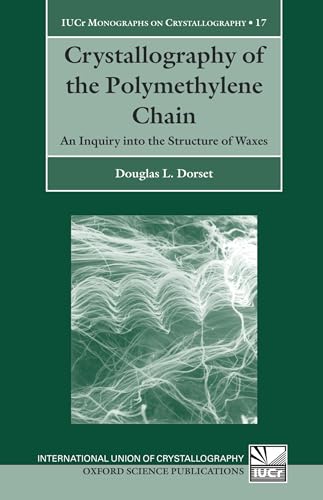
Synopsis
By considering the solid state packing of linear chain wax components, this book aims at understanding three things: firstly, which modifications of molecular components are allowed for maintaining stable solid solutions; secondly, what happens when stability conditions are traversed and fractionation begins and thirdly, the structure of fractionated arrays. The co-compatibility of molecular ingredients is considered in terms of their shapes and relative sizes, following an approach originally proposed by Kitaigorodskii. As demonstrated profusely by the crystal structures of pure component types (e. g. alkanes, fatty alcohols, fatty acids, long chain esters, cholesteryl esters) and insertion of functional groups (e. g. chain branches, unsaturation, heteroatoms), characteristic molecular packing arrays provide important geometric information for understanding the co-packing of different molecules in mixtures. Single crystal and spectroscopic data from polydisperse arrays can then be evaluated to arrive at plausible structures of solid solutions and fractionated systems. The resultant structures are not only relevant to the understanding of so-called waxes but also include certain classes of polymers. The ramifications of this work extend into any solid state array of polymethylene chains, including lipid foodstuffs.
"synopsis" may belong to another edition of this title.
About the Author
Douglas L. Dorset is Senior Research Associate at ExxonMobil Research & Engineering Company in Annandale, New Jersey.
"About this title" may belong to another edition of this title.
Search results for Crystallography of the Polymethylene Chain: An Inquiry...

Seller Image
Crystallography of the Polymethylene Chain (Hardcover)
Published by
Oxford University Press, Oxford, 2004
ISBN 10: 0198529082
ISBN 13: 9780198529088
New
Hardcover
Seller: AussieBookSeller, Truganina, VIC, Australia
Seller rating 5 out of 5 stars

Hardcover. Condition: new. Hardcover. By considering the solid state packing of linear chain wax components, this book aims at understanding three things: firstly, which modifications of molecular components are allowed for maintaining stable solid solutions; secondly, what happens when stability conditions are traversed and fractionation begins and thirdly, the structure of fractionated arrays. The co-compatibility of molecular ingredients is considered in terms of their shapes and relative sizes,following an approach originally proposed by Kitaigorodskii. As demonstrated profusely by the crystal structures of pure component types (e. g. alkanes, fatty alcohols, fatty acids, long chain esters,cholesteryl esters) and insertion of functional groups (e. g. chain branches, unsaturation, heteroatoms), characteristic molecular packing arrays provide important geometric information for understanding the co-packing of different molecules in mixtures. Single crystal and spectroscopic data from polydisperse arrays can then be evaluated to arrive at plausible structures of solid solutions and fractionated systems. The resultant structures are not only relevant to the understanding of so-calledwaxes but also include certain classes of polymers. The ramifications of this work extend into any solid state array of polymethylene chains, including lipid foodstuffs. How do mixtures of differently sized and shaped molecules form the plastic solids known as waxes? Firstly, this book considers the characteristic crystalline assemblies of wax ingredients; secondly, it looks at assemblies of two separate components; and finally, it shows how plausible molecular models for several types of wax can be constructed. This item is printed on demand. Shipping may be from our Sydney, NSW warehouse or from our UK or US warehouse, depending on stock availability. Seller Inventory # 9780198529088
Buy New
US$ 214.19
US$ 37.00 shipping
Ships from Australia to U.S.A.
Ships from Australia to U.S.A.
Quantity: 1 available
Stock Image
Crystallography of the Polymethylene Chain: An Inquiry into the Structure of Waxes (International Union of Crystallography Monographs on Crystallography)
Published by
Oxford University Press, 2005
ISBN 10: 0198529082
ISBN 13: 9780198529088
Used
Hardcover
Seller: Phatpocket Limited, Waltham Abbey, HERTS, United Kingdom
Seller rating 5 out of 5 stars
Condition: Good. Your purchase helps support Sri Lankan Children's Charity 'The Rainbow Centre'. Ex-library, so some stamps and wear, but in good overall condition. Our donations to The Rainbow Centre have helped provide an education and a safe haven to hundreds of children who live in appalling conditions. Seller Inventory # Z1-K-025-02022
Buy Used
US$ 273.01
US$ 14.08 shipping
Ships from United Kingdom to U.S.A.
Ships from United Kingdom to U.S.A.
Quantity: 1 available
Stock Image
Crystallography of the Polymethylene Chain: An Inquiry into the Structure of Waxes: 17 (International Union of Crystallography Monographs on Crystallography)
Seller: Kennys Bookshop and Art Galleries Ltd., Galway, GY, Ireland
Seller rating 5 out of 5 stars
Condition: New. How do mixtures of differently sized and shaped molecules form the plastic solids known as waxes? Firstly, this book considers the characteristic crystalline assemblies of wax ingredients; secondly, it looks at assemblies of two separate components; and finally, it shows how plausible molecular models for several types of wax can be constructed. Series: International Union of Crystallography - Monographs on Crystallography. Num Pages: 246 pages, numerous line figures and halftones. BIC Classification: PHV; PNNP; PNR; PNT. Category: (P) Professional & Vocational. Dimension: 242 x 163 x 18. Weight in Grams: 569. . 2004. Illustrated. hardcover. . . . . Seller Inventory # V9780198529088
Buy New
US$ 282.52
US$ 10.50 shipping
Ships from Ireland to U.S.A.
Ships from Ireland to U.S.A.
Quantity: Over 20 available
Stock Image
Crystallography of the Polymethylene Chain: An Inquiry into the Structure of Waxes (eng)
Print on DemandSeller: Brook Bookstore On Demand, Napoli, NA, Italy
Seller rating 5 out of 5 stars
Condition: new. Questo è un articolo print on demand. Seller Inventory # 8b2e158c78ca916fca5f859ce5d5cae3
Buy New
US$ 286.25
US$ 7.51 shipping
Ships from Italy to U.S.A.
Ships from Italy to U.S.A.
Quantity: Over 20 available
Seller Image
Crystallography Of The Polymethylene Chain : An Inquiry Into The Structure Of Waxes
Seller: GreatBookPrices, Columbia, MD, U.S.A.
Seller rating 5 out of 5 stars
Condition: New. Seller Inventory # 3333113-n
Seller Image
Crystallography Of The Polymethylene Chain : An Inquiry Into The Structure Of Waxes
Seller: GreatBookPricesUK, Woodford Green, United Kingdom
Seller rating 5 out of 5 stars
Condition: New. Seller Inventory # 3333113-n
Buy New
US$ 293.80
US$ 19.85 shipping
Ships from United Kingdom to U.S.A.
Ships from United Kingdom to U.S.A.
Quantity: Over 20 available
Seller Image
Crystallography of the Polymethylene Chain (Hardcover)
Published by
Oxford University Press, Oxford, 2004
ISBN 10: 0198529082
ISBN 13: 9780198529088
New
Hardcover
Seller: Grand Eagle Retail, Bensenville, IL, U.S.A.
Seller rating 5 out of 5 stars
Hardcover. Condition: new. Hardcover. By considering the solid state packing of linear chain wax components, this book aims at understanding three things: firstly, which modifications of molecular components are allowed for maintaining stable solid solutions; secondly, what happens when stability conditions are traversed and fractionation begins and thirdly, the structure of fractionated arrays. The co-compatibility of molecular ingredients is considered in terms of their shapes and relative sizes,following an approach originally proposed by Kitaigorodskii. As demonstrated profusely by the crystal structures of pure component types (e. g. alkanes, fatty alcohols, fatty acids, long chain esters,cholesteryl esters) and insertion of functional groups (e. g. chain branches, unsaturation, heteroatoms), characteristic molecular packing arrays provide important geometric information for understanding the co-packing of different molecules in mixtures. Single crystal and spectroscopic data from polydisperse arrays can then be evaluated to arrive at plausible structures of solid solutions and fractionated systems. The resultant structures are not only relevant to the understanding of so-calledwaxes but also include certain classes of polymers. The ramifications of this work extend into any solid state array of polymethylene chains, including lipid foodstuffs. How do mixtures of differently sized and shaped molecules form the plastic solids known as waxes? Firstly, this book considers the characteristic crystalline assemblies of wax ingredients; secondly, it looks at assemblies of two separate components; and finally, it shows how plausible molecular models for several types of wax can be constructed. This item is printed on demand. Shipping may be from multiple locations in the US or from the UK, depending on stock availability. Seller Inventory # 9780198529088
Seller Image
Crystallography Of The Polymethylene Chain : An Inquiry Into The Structure Of Waxes
Published by
Oxford University Press, 2005
ISBN 10: 0198529082
ISBN 13: 9780198529088
Used
Hardcover
Seller: GreatBookPrices, Columbia, MD, U.S.A.
Seller rating 5 out of 5 stars
Condition: As New. Unread book in perfect condition. Seller Inventory # 3333113
Stock Image
Crystallography of the Polymethylene Chain
Print on DemandSeller: PBShop.store US, Wood Dale, IL, U.S.A.
Seller rating 5 out of 5 stars
HRD. Condition: New. New Book. Shipped from UK. THIS BOOK IS PRINTED ON DEMAND. Established seller since 2000. Seller Inventory # L1-9780198529088
Stock Image
Crystallography of the Polymethylene Chain
Print on DemandSeller: PBShop.store UK, Fairford, GLOS, United Kingdom
Seller rating 5 out of 5 stars
HRD. Condition: New. New Book. Delivered from our UK warehouse in 4 to 14 business days. THIS BOOK IS PRINTED ON DEMAND. Established seller since 2000. Seller Inventory # L1-9780198529088
Buy New
US$ 334.40
US$ 6.64 shipping
Ships from United Kingdom to U.S.A.
Ships from United Kingdom to U.S.A.
Quantity: Over 20 available