
Items related to Shadows of the Mind: A Search for the Missing Science...
Synopsis
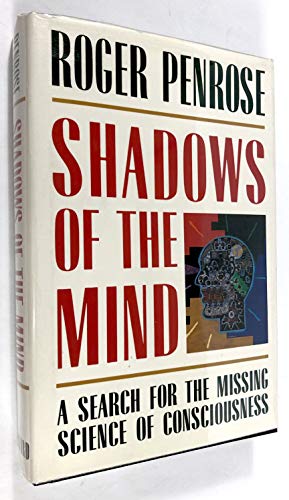
A New York Times bestseller when it appeared in 1989, Roger Penrose's The Emperor's New Mind was universally hailed as a marvelous survey of modern physics as well as a brilliant reflection on the human mind, offering a new perspective on the scientific landscape and a visionary glimpse of the possible future of science. Now, in Shadows of the Mind, Penrose offers another exhilarating look at modern science as he mounts an even more powerful attack on artificial intelligence. But perhaps more important, in this volume he points the way to a new science, one that may eventually explain the physical basis of the human mind.
Penrose contends that some aspects of the human mind lie beyond computation. This is not a religious argument (that the mind is something other than physical) nor is it based on the brain's vast complexity (the weather is immensely complex, says Penrose, but it is still a computable thing, at least in theory). Instead, he provides powerful arguments to support his conclusion that there is something in the conscious activity of the brain that transcends computation--and will find no explanation in terms of present-day science. To illuminate what he believes this "something" might be, and to suggest where a new physics must proceed so that we may understand it, Penrose cuts a wide swathe through modern science, providing penetrating looks at everything from Turing computability and Godel's incompleteness, via Schrodinger's Cat and the Elitzur-Vaidman bomb-testing problem, to detailed microbiology. Of particular interest is Penrose's extensive examination of quantum mechanics, which introduces some new ideas that differ markedly from those advanced in The Emperor's New Mind, especially concerning the mysterious interface where classical and quantum physics meet. But perhaps the most interesting wrinkle in Shadows of the Mind is Penrose's excursion into microbiology, where he examines cytoskeletons and microtubules, minute substructures lying deep within the brain's neurons. (He argues that microtubules--not neurons--may indeed be the basic units of the brain, which, if nothing else, would dramatically increase the brain's computational power.) Furthermore, he contends that in consciousness some kind of global quantum state must take place across large areas of the brain, and that it within microtubules that these collective quantum effects are most likely to reside.
For physics to accommodate something that is as foreign to our current physical picture as is the phenomenon of consciousness, we must expect a profound change--one that alters the very underpinnings of our philosophical viewpoint as to the nature of reality. Shadows of the Mind provides an illuminating look at where these profound changes may take place and what our future understanding of the world may be.
"synopsis" may belong to another edition of this title.
About the Author
About the Author:
Roger Penrose is the Rouse Ball Professor of Mathematics at the University of Oxford. He is the author of The Emperor's New Mind, which was a New York Times bestseller and was awarded the UK's 1990 COPUS Prize for science writing. In 1988, he received the internationally prestigious Wolf Prize for physics, shared with Stephen Hawking, for their joint contribution to our understanding of the universe.
Reviews
A leading critic of artificial intelligence research returns to the attack, attempting to lay the groundwork for an analysis of the true nature of intelligence. Building on his arguments in The Emperor's New Mind (not reviewed), Penrose (Mathematics/Oxford) begins by refuting the assertion that true intelligence can be attained--or even adequately simulated--by the strictly computational means to which current computers are ultimately limited. Much of his argument depends closely on the application of G”del's Undecidability Theorem to Turing machines--deep waters for laypeople, although the fundamentals of his argument are accessible to readers without sophisticated mathematical training. Having disposed of the central tenets of current AI research, Penrose then turns to an even more fundamental question: the actual foundations in modern physics (i.e., relativity and quantum theory) of the phenomenon of consciousness. Here much of his summary depends on fairly complex mathematical reasoning, although the key points are summarized for the general reader who has been willing to follow him so far. Penrose feels that a new physical synthesis, reconciling the paradoxes of quantum theory and bringing them into harmony with Einstein's gravitational theories, is ultimately necessary to explain the noncomputational elements of consciousness and intelligence. He speculates on the possible role of cellular structures called microtubules in creating a quantum phenomenon on a macroscopic scale within the brain, but grants that more research is needed to establish any connection between physical and mental phenomena. His conclusion steps back to a philosophical overview of the subject, paying homage to Plato, among others. A challenging examination of a central problem of modern philosophy, with no final answers but plenty of food for thought. (76 line drawings) (First printing of 50,000; $50,000 ad/promo) -- Copyright ©1994, Kirkus Associates, LP. All rights reserved.
This book asserts that human consciousness is not necessarily intelligible in terms of computational models. The brain's conscious activity essentially transcends the forms or possibilities of computation. Penrose (mathematics, Oxford) illustrates his thesis via mathematical logic, including detailed discussions of Godel's proposition of incompleteness, Turing's machines and computabilities, quantum mechanics, and microbiology. Eventually, Penrose argues that artificial intelligence and computer-controlled expert systems are capable of assisting local human expertise but will not be able to replace such expertise. Expanding on some of the ideas and concepts proposed in his controversial book, The Emperor's New Mind (Oxford Univ. Pr., 1989), Penrose challenges others to reconsider traditional concepts. Some familiarity with mathematical logic or processes will facilitate one's appreciation of this book. Recommended for scholars, specialists, and informed lay readers.
Donald G. Frank, Harvard Univ., Cambridge, Mass.
Copyright 1994 Reed Business Information, Inc.
"About this title" may belong to another edition of this title.
Search results for Shadows of the Mind: A Search for the Missing Science...

Stock Image
Shadows of the Mind: A Search for the Missing Science of Consciousness
Published by
Oxford University Press, 1994
ISBN 10: 0198539789
ISBN 13: 9780198539780
Used
Hardcover
Seller: HPB-Red, Dallas, TX, U.S.A.
Seller rating 5 out of 5 stars

hardcover. Condition: Acceptable. Connecting readers with great books since 1972. Used textbooks may not include companion materials such as access codes, etc. May have condition issues including wear and notes/highlighting. We ship orders daily and Customer Service is our top priority! Seller Inventory # S_477979288
Stock Image
Shadows of the Mind
Published by
Oxford University Press, 1994
ISBN 10: 0198539789
ISBN 13: 9780198539780
Used
Hardcover
Seller: World of Books (was SecondSale), Montgomery, IL, U.S.A.
Seller rating 5 out of 5 stars
Hardback. Condition: Good. The motivation for this book arose, in part, from a need for detailed replies to a number of queries and criticisms from readers of the author's previous book, The Emperor's New Mind , many of whom have gone to extraordinary lengths to avoid the conclusion that there must be something non-computational involved in thinking. Penrose searches for a means, within the constraints of the hard facts of science, whereby a scientifically describable brain might be able to perform the needed non-computational actions. He develops the argument of how quantum effects might have a fundamental relevance to consciousness and to non-computable brain action. Some of the more startling implications of this are based on new scientific information which is discussed in detail, leading to one of the most extraordinary and fundamental implications of quantum theory: quantum entanglement, the process by which the behaviour of `classically' described systems is explicable only in quantum mechanical terms. There is a thorough examination of the implications of G "odel's theorem maintaining that conscious thinking must indeed involve ingredients that cannot adequately be simulated by mere computation. No prior knowledge of quantum theory on the part of the reader is assumed. This book is intended for the general reader; physicists, computer scientists, philosophers, etc. Seller Inventory # 00108447544
Stock Image
Shadows of the Mind : A Search for the Missing Science of Consciousness
Published by
Oxford University Press, Incorporated, 1994
ISBN 10: 0198539789
ISBN 13: 9780198539780
Used
Hardcover
Seller: Better World Books, Mishawaka, IN, U.S.A.
Seller rating 5 out of 5 stars
Condition: Good. Pages intact with minimal writing/highlighting. The binding may be loose and creased. Dust jackets/supplements are not included. Stock photo provided. Product includes identifying sticker. Better World Books: Buy Books. Do Good. Seller Inventory # 3145568-6
Stock Image
Shadows of the Mind: A Search for the Missing Science of Consciousness
Published by
Oxford University Press, 1994
ISBN 10: 0198539789
ISBN 13: 9780198539780
Used
Hardcover
Seller: HPB-Red, Dallas, TX, U.S.A.
Seller rating 5 out of 5 stars
hardcover. Condition: Good. Connecting readers with great books since 1972! Used textbooks may not include companion materials such as access codes, etc. May have some wear or writing/highlighting. We ship orders daily and Customer Service is our top priority! Seller Inventory # S_473179572
Stock Image
Shadows of the Mind
Published by
Oxford University Press, 1994
ISBN 10: 0198539789
ISBN 13: 9780198539780
Used
Hardcover
Seller: World of Books Inc, Montgomery, IL, U.S.A.
Seller rating 4 out of 5 stars

Hardback. Condition: Good. The motivation for this book arose, in part, from a need for detailed replies to a number of queries and criticisms from readers of the author's previous book, The Emperor's New Mind , many of whom have gone to extraordinary lengths to avoid the conclusion that there must be something non-computational involved in thinking. Penrose searches for a means, within the constraints of the hard facts of science, whereby a scientifically describable brain might be able to perform the needed non-computational actions. He develops the argument of how quantum effects might have a fundamental relevance to consciousness and to non-computable brain action. Some of the more startling implications of this are based on new scientific information which is discussed in detail, leading to one of the most extraordinary and fundamental implications of quantum theory: quantum entanglement, the process by which the behaviour of `classically' described systems is explicable only in quantum mechanical terms. There is a thorough examination of the implications of G "odel's theorem maintaining that conscious thinking must indeed involve ingredients that cannot adequately be simulated by mere computation. No prior knowledge of quantum theory on the part of the reader is assumed. This book is intended for the general reader; physicists, computer scientists, philosophers, etc. Seller Inventory # CIN0198539789G
Stock Image
Shadows of the Mind: A Search for the Missing Science of Consciou
Published by
Oxford University Press, 1994
ISBN 10: 0198539789
ISBN 13: 9780198539780
Used
Hardcover
Seller: Hawking Books, Edgewood, TX, U.S.A.
Seller rating 4 out of 5 stars
Condition: Very Good. Very Good Condition. Five star seller - Buy with confidence! Seller Inventory # X0198539789X2
Stock Image
Shadows of the Mind: A Search for the Missing Science of Consciousness
Published by
Oxford University Press, 1994
ISBN 10: 0198539789
ISBN 13: 9780198539780
Used
Hardcover
Seller: St Vincent de Paul of Lane County, Eugene, OR, U.S.A.
Seller rating 5 out of 5 stars
Condition: Good. EXTERIOR PAGE EDGES HAVE SOME STAINING AND/OR SMUDGING ON THEM BUT BOOK REMAINS IN GOOD READABLE CONDITION. hardcover 100% of proceeds go to charity! Good condition with all pages in tact. Item shows signs of use and may have cosmetic defects. Seller Inventory # 2CC-03-3049
Seller Image
Shadows of the Mind: A Search for the Missing Science of Consciousness
Published by
Oxford University Press, 1994
ISBN 10: 0198539789
ISBN 13: 9780198539780
Used
Hardcover
Seller: Goodbooks Company, Springdale, AR, U.S.A.
Seller rating 5 out of 5 stars
Condition: acceptable. This book is in acceptable condition and may have highlighting and or writing throughout. The actual cover image may not match the stock photo, dust jacket may be damaged or missing. Book may show internal and or external wear on spine or cover and may be slightly skewed or have creased pages. This is a used book so codes may be invalid or accompanying media may be missing. May be an Ex library book with stickers and stamps. Seller Inventory # GBV.0198539789.A
Stock Image
Shadows of the Mind: A Search for the Missing Science of Consciousness
Published by
Oxford University Press, 1994
ISBN 10: 0198539789
ISBN 13: 9780198539780
Used
Hardcover
Seller: Half Price Books Inc., Dallas, TX, U.S.A.
Seller rating 5 out of 5 stars
Hardcover. Condition: Very Good. Connecting readers with great books since 1972! Used books may not include companion materials, and may have some shelf wear or limited writing. We ship orders daily and Customer Service is our top priority! Seller Inventory # S_485101659
Stock Image
Shadows of the Mind: A Search for the Missing Science of Consciousness
Published by
Oxford University Press, 1994
ISBN 10: 0198539789
ISBN 13: 9780198539780
Used
Hardcover
Seller: HPB-Emerald, Dallas, TX, U.S.A.
Seller rating 5 out of 5 stars
Hardcover. Condition: Very Good. Connecting readers with great books since 1972! Used books may not include companion materials, and may have some shelf wear or limited writing. We ship orders daily and Customer Service is our top priority! Seller Inventory # S_485342800