
Items related to Nuclear Physics: A Very Short Introduction
Synopsis
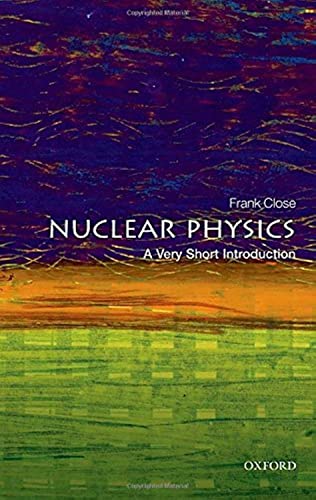
Nuclear physics began long before the identification of fundamental particles, with J. J. Thomson's discovery of the electron at the end of the 19th century, which implied the existence of a positive charge in the atom to make it neutral. In this Very Short Introduction Frank Close gives an account of how this area of physics has progressed, including the recognition of how heavy nuclei are built up in the cores of stars and in supernovae, the identification of quarks and gluons, and the development of quantum chromodynamics (QCD). Exploring key concepts such as the stability of different configurations of protons and neutrons in nuclei, Frank Close shows how nuclear physics brings the physics of the stars to Earth and provides us with important applications, particularly in medicine.
ABOUT THE SERIES:
The Very Short Introductions series from Oxford University Press contains hundreds of titles in almost every subject area. These pocket-sized books are the perfect way to get ahead in a new subject quickly. Our expert authors combine facts, analysis, perspective, new ideas, and enthusiasm to make interesting and challenging topics highly readable.
"synopsis" may belong to another edition of this title.
About the Author
Frank Close is Professor of Physics at Oxford University and a Fellow of Exeter College. He was formerly the Head of the Theoretical Physics Division at the Rutherford Appleton Laboratory, and Head of Communications and Public Education at CERN. He is the author of several books, including the best-selling Lucifer's Legacy (OUP, 2000), and was the winner of the Kelvin Medal of the Institute of Physics for his 'outstanding contributions to the public understanding of physics'. His other books include The Cosmic Onion (1983), The Particle Explosion (1987), End (1988), Too Hot to Handle (1991), and The Particle Odyssey (OUP, 2002). In 2013 Professor Close was awarded the Royal Society Michael Faraday Prize for Communication of Science.
"About this title" may belong to another edition of this title.
Search results for Nuclear Physics: A Very Short Introduction

Stock Image
Nuclear Physics: A Very Short Introduction
Published by
Oxford University Press, 2015
ISBN 10: 0198718632
ISBN 13: 9780198718635
Used
Paperback
Seller: World of Books (was SecondSale), Montgomery, IL, U.S.A.
Seller rating 5 out of 5 stars

Paperback. Condition: Good. Nuclear physics began long before the identification of fundamental particles, with J. J. Thomson's discovery of the electron at the end of the 19th century, which implied the existence of a positive charge in the atom to make it neutral. In this Very Short Introduction Frank Close gives an account of how this area of physics has progressed, including the recognition of how heavy nuclei are built up in the cores of stars and in supernovae, the identification of quarks and gluons, and the development of quantum chromodynamics (QCD). Exploring key concepts such as the stability of different configurations of protons and neutrons in nuclei, Frank Close shows how nuclear physics brings the physics of the stars to Earth and provides us with important applications, particularly in medicine.ABOUT THE SERIES: The Very Short Introductions series from Oxford University Press contains hundreds of titles in almost every subject area. These pocket-sized books are the perfect way to get ahead in a new subject quickly. Our expert authors combine facts, analysis, perspective, new ideas, and enthusiasm to make interesting and challenging topics highly readable. Seller Inventory # CIN0198718632G
Stock Image
Nuclear Physics: A Very Short Introduction
Published by
Oxford University Press, 2015
ISBN 10: 0198718632
ISBN 13: 9780198718635
Used
Paperback
Seller: World of Books (was SecondSale), Montgomery, IL, U.S.A.
Seller rating 5 out of 5 stars
Paperback. Condition: Very Good. Nuclear physics began long before the identification of fundamental particles, with J. J. Thomson's discovery of the electron at the end of the 19th century, which implied the existence of a positive charge in the atom to make it neutral. In this Very Short Introduction Frank Close gives an account of how this area of physics has progressed, including the recognition of how heavy nuclei are built up in the cores of stars and in supernovae, the identification of quarks and gluons, and the development of quantum chromodynamics (QCD). Exploring key concepts such as the stability of different configurations of protons and neutrons in nuclei, Frank Close shows how nuclear physics brings the physics of the stars to Earth and provides us with important applications, particularly in medicine.ABOUT THE SERIES: The Very Short Introductions series from Oxford University Press contains hundreds of titles in almost every subject area. These pocket-sized books are the perfect way to get ahead in a new subject quickly. Our expert authors combine facts, analysis, perspective, new ideas, and enthusiasm to make interesting and challenging topics highly readable. Seller Inventory # 00106885672
Stock Image
Nuclear Physics: A Very Short Introduction
Published by
Oxford University Press (edition 1), 2015
ISBN 10: 0198718632
ISBN 13: 9780198718635
Used
Paperback
Seller: BooksRun, Philadelphia, PA, U.S.A.
Seller rating 5 out of 5 stars
Paperback. Condition: Very Good. 1. It's a well-cared-for item that has seen limited use. The item may show minor signs of wear. All the text is legible, with all pages included. It may have slight markings and/or highlighting. Seller Inventory # 0198718632-11-1
Seller Image
Nuclear Physics: A Very Short Introduction
Published by
Oxford University Press, 2015
ISBN 10: 0198718632
ISBN 13: 9780198718635
Used
Softcover
Seller: Dream Books Co., Denver, CO, U.S.A.
Seller rating 5 out of 5 stars
Condition: good. Gently used with minimal wear on the corners and cover. A few pages may contain light highlighting or writing, but the text remains fully legible. Dust jacket may be missing, and supplemental materials like CDs or codes may not be included. May be ex-library with library markings. Ships promptly! Seller Inventory # DBV.0198718632.G
Stock Image
Nuclear Physics: A Very Short Introduction
Published by
Oxford University Press, 2015
ISBN 10: 0198718632
ISBN 13: 9780198718635
Used
Paperback
Seller: World of Books Inc, Montgomery, IL, U.S.A.
Seller rating 4 out of 5 stars

Paperback. Condition: Good. Nuclear physics began long before the identification of fundamental particles, with J. J. Thomson's discovery of the electron at the end of the 19th century, which implied the existence of a positive charge in the atom to make it neutral. In this Very Short Introduction Frank Close gives an account of how this area of physics has progressed, including the recognition of how heavy nuclei are built up in the cores of stars and in supernovae, the identification of quarks and gluons, and the development of quantum chromodynamics (QCD). Exploring key concepts such as the stability of different configurations of protons and neutrons in nuclei, Frank Close shows how nuclear physics brings the physics of the stars to Earth and provides us with important applications, particularly in medicine.ABOUT THE SERIES: The Very Short Introductions series from Oxford University Press contains hundreds of titles in almost every subject area. These pocket-sized books are the perfect way to get ahead in a new subject quickly. Our expert authors combine facts, analysis, perspective, new ideas, and enthusiasm to make interesting and challenging topics highly readable. Seller Inventory # CIN0198718632G
Stock Image
Nuclear Physics: A Very Short Introduction
Published by
Oxford University Press, 2015
ISBN 10: 0198718632
ISBN 13: 9780198718635
Used
Paperback
Seller: World of Books Inc, Montgomery, IL, U.S.A.
Seller rating 4 out of 5 stars
Paperback. Condition: Very Good. Nuclear physics began long before the identification of fundamental particles, with J. J. Thomson's discovery of the electron at the end of the 19th century, which implied the existence of a positive charge in the atom to make it neutral. In this Very Short Introduction Frank Close gives an account of how this area of physics has progressed, including the recognition of how heavy nuclei are built up in the cores of stars and in supernovae, the identification of quarks and gluons, and the development of quantum chromodynamics (QCD). Exploring key concepts such as the stability of different configurations of protons and neutrons in nuclei, Frank Close shows how nuclear physics brings the physics of the stars to Earth and provides us with important applications, particularly in medicine.ABOUT THE SERIES: The Very Short Introductions series from Oxford University Press contains hundreds of titles in almost every subject area. These pocket-sized books are the perfect way to get ahead in a new subject quickly. Our expert authors combine facts, analysis, perspective, new ideas, and enthusiasm to make interesting and challenging topics highly readable. Seller Inventory # CIN0198718632VG
Stock Image
Nuclear Physics: A Very Short Introduction
Published by
Oxford University Press, 2015
ISBN 10: 0198718632
ISBN 13: 9780198718635
Used
Paperback
Seller: ThriftBooks-Dallas, Dallas, TX, U.S.A.
Seller rating 5 out of 5 stars
Paperback. Condition: Very Good. No Jacket. May have limited writing in cover pages. Pages are unmarked. ~ ThriftBooks: Read More, Spend Less. Seller Inventory # G0198718632I4N00
Seller Image
Nuclear Physics: A Very Short Introduction
Published by
Oxford University Press, 2015
ISBN 10: 0198718632
ISBN 13: 9780198718635
Used
Softcover
Seller: Goodwill of Colorado, COLORADO SPRINGS, CO, U.S.A.
Seller rating 5 out of 5 stars
Condition: very_good. Item may have minor cosmetic defects marks, wears, cuts, bends, crushes on the cover, spine, pages or dust cover. Shrink wrap, dust covers, or boxed set case may be missing. Item may contain remainder marks on outside edges, which should be noted in Product Details. Item may be missing bundled media. Seller Inventory # COLV.0198718632.VG
Seller Image
Nuclear Physics: A Very Short Introduction
Published by
Oxford University Press, 2015
ISBN 10: 0198718632
ISBN 13: 9780198718635
Used
Softcover
Seller: Goodwill of Central and Coastal Virginia, Richmond, VA, U.S.A.
Seller rating 4 out of 5 stars
Condition: acceptable. Seller Inventory # CCVV.0198718632.A
Seller Image
Nuclear Physics : A Very Short Introduction
Seller: GreatBookPrices, Columbia, MD, U.S.A.
Seller rating 5 out of 5 stars
Condition: New. Seller Inventory # 22766861-n